6 min readDec 26, 2023 11:02 PM IST
First published on: Dec 25, 2023 at 02:35 PM IST
The Indian Army is not used to persistent negative encounters that upset its tremendous track record in counter-terrorist operations. It does not claim continuous success either, as negative encounters did occur in the past intermittently — although mostly after long intervals. That was when the strength of terrorists was high, intelligence less reliable, and even speculative search and destroy operations were productive in contacts. The recent run of encounters in the depth areas of the Poonch-Rajouri sector have resulted in more losses for the Army than the terrorists, in an environment in which the strength of terrorists is much diluted, but better technologies are available. In addition, while the Kashmir zone — the traditionally more volatile area — is relatively quiet, it’s the Pir Panjal (South) in the Jammu sector which has, in recent months, witnessed more operational activity and presence of terrorists.
Why has terrorist presence and activity shifted to the Poonch-Rajouri sector? The answer is clear. Terrorism is like water; it takes the path of least resistance. Kashmir is too hot for Pakistan to make a strong statement on its “relevance” and “capability to calibrate” — both issues that are important to Pakistan’s doctrine of proxy hybrid war. Kashmir’s strong and layered counter-infiltration (CI) and counter-terrorism (CT) grid makes planning of proxy operations difficult. The Poonch-Rajouri sector has had a chequered history of local support, which enabled Pakistan to establish a strong proxy presence in the forested and rocky tracts of the Pir Panjal (South). Although this waned over time, perhaps some clandestine efforts to re-cultivate the population have occurred in recent years, with some reported antipathy among the Gujjar community. However, there is only speculative evidence of this. The abrogation of Article 370 has also made Kashmir less conducive to separatist trends.

Secondly, is there any truth that the Army’s redeployment of some formations from this sector has led to the dilution of optimum deployment? From May 2020 onwards when the Ladakh sector was activated, some troops were lifted from the Jammu sector and redeployed there. There may have been some dilution, but HQ Northern Command has always been watchful of this and has followed the basic principle of re-deploying and creating other reserves. In any case, the Rashtriya Rifles troops from the Poonch-Rajouri sector were never disturbed. Yet, when adversary focus comes on a sub-sector, some redeployment for a stronger grid, especially the presence of uncommitted response elements, must be arranged. Some of this has already been done, a little more could follow.
Has the Indian Army encountered anything similar in the past? If so, how did it deal with it? My own experience in the Valley in 1999-2001, provides an answer. The move of the Army’s 8 Mountain Division from North Kashmir to Kargil in June 1999 opened up wide spaces for the entry of terrorists from across an unfenced LoC. They adopted the tactics of suicide attacks on Army and police camps. It was rumoured that some Pakistan Army elements were providing the field leadership. There were big contacts and raging battles with the Army for the better part of the next 18 months or so. Redeployment did take place and the Kilo Force was created to take charge. I do not think tactical or operational space has been lost in Poonch-Rajouri and the overall capability of Pakistan to sustain any success is still limited. Besides, the Indian government’s demonstrated capability for retaliation when an undetermined threshold is crossed will keep Pakistan on tenterhooks.
So, is this about drills, SOPs and minor tactics? Does the Army accept the need for a review of some identified weaknesses — for example, the inevitable aspect of convoy security, hardening of operational vehicles, enhancing the size of movement of reinforcements, etc? I recall 2007-08 when there were several ambushes in the Valley from maize fields which terrorists stopped from being harvested. We reviewed all movements, SOPs and response drills with special emphasis on the first two minutes of contact when most casualties occur. The Army is an organisation adept at self-learning. It only needs reminders of legacy events and the methods that are available in-house. I recommend brigade-sized operations to be conducted in the lower reaches of the Pir Panjal with drone support, as the foliage cover is lowest at this time. This needs to be reinforced by a strong public outreach, as done in the Valley.
Lastly, and very importantly, the unfortunate post-event happenings remain allegations until a thorough investigation is carried out. Three local civilians have died under questionable and suspicious circumstances. With experience, I may state that the Army is an institution in which ethics cannot be diluted. Even if mistakes have occurred, the transparency of an inquiry and suitable disciplinary action is something that is expected of it. Senior commanders and political and civil society leaders will need to be balanced in their utterances and the media must not speculate. Such events have a nasty way of upsetting much of the balance achieved by the bold decisions of August 5, 2019. An immediate drive to address the emotions prevailing among the local communities in the area of Pir Panjal South must be undertaken by direct contact and interaction. Its effect on the Valley must not be underestimated and precautionary measures must also be taken there. The gunning down of a former SSP at Baramulla indicates there is more to come. Rumours will be rife and adversaries and their cohorts will be on the lookout to exploit this.
Over the last 33 years, such moments have often come and gone. I think the nation needs to remain reassured of the ability of the government and Army to see it through.
The writer, a member of the National Disaster Management Authority, is former corps commander of the Srinagar-based 15 Corps

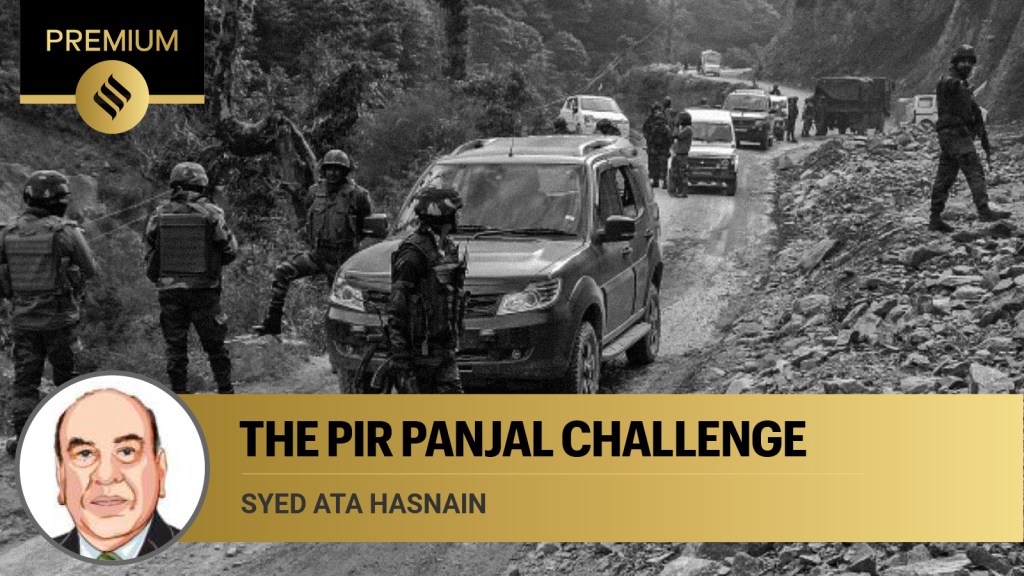 Army personnel during a cordon and search operation in Poonch district on Friday. (Photo: PTI)

 Share


