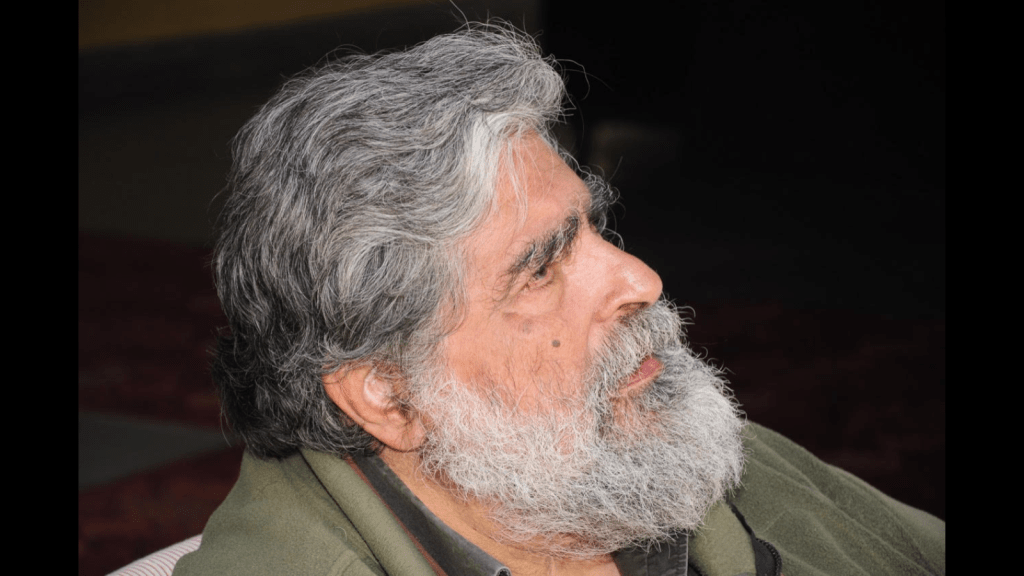
Valmik Thapar — Valu, as many of us knew him — was the fiercest voice for the tiger. His gruff, deep voice often resembled a tiger’s growl. As an emerging wildlife conservation filmmaker in the 1990s, I knew about him and his tigers of Ranthambore. Even before I began, his first book, With Tigers in the Wild, co-authored with his guru Fateh Singh Rathore and his brother-in-law Tejbir Singh, adorned my bookshelf. After Indira Gandhi, who established Project Tiger to protect the rapidly vanishing animal in 1973, and its first director, Kailash Sankhala, I would place Valmik Thapar as the person who most contributed to the cause of tigers. I attended a talk he gave about his journey and the conservation of the Indian tiger at the Royal Geographic Society in London. His booming voice and the rare behavioural images of tigers, primarily captured by him, kept the audience on the edge of their seats. The evening ended with a standing ovation. The cherry on top was the six-part BBC series The Land of the Tiger filmed and broadcast in 1996-97. Valu was the presenter, traversing the length and breadth of India, unspooling the story of Indian wildlife and its rich biodiversity. As a young filmmaker, I was offered a small role in making the series.
Over the years, I bumped into Valu at conservation meetings and would visit his house to discuss collaborative film projects. This invariably led to debates on contentious issues surrounding Indian conservation policy and practice. In my early years of filmmaking during the ’80s and ’90s, he and I belonged to two distinct conservation spheres. The term “coexistence” was highly contested, representing a chasm between these two worlds. The one I occupied believed in a historical coexistence between forest dwellers and wild animals, asserting that any conservation policy must incorporate people’s physical presence and participation. Conversely, the world inhabited by Valmik and other prominent conservationists and scientists maintained that wildlife should reside in “inviolate” zones, meaning that forest dwellers and wildlife areas must be entirely separated. The “inviolate” argument had a royal lineage tracing back to the times of the Maharajas and their protected hunting blocks. It was so deeply entrenched in the formative years of Project Tiger that, to establish the first nine tiger reserves, all forest dwellers, primarily indigenous peoples, were forcibly evicted, rendering these reserves “inviolate”. Later, in 2001, we traced three Gond and Baiga Adivasis, who were among the original inhabitants of Kanha National Park and had been removed, to film their experiences and conservation vision in There is a Fire in Your Forest.

Despite having a great deal of respect and love for one another, these two worlds remained at loggerheads. As a young, wide-eyed learner, it was sometimes amusing to witness these meetings. Both sides were passionate and dedicated to conservation, presenting thoroughly researched and scientific arguments. However, the truth lay somewhere in between. Valmik’s inviolate zones for tigers should coexist with multiple-use forest ranges where forest dwellers could sustain their livelihoods. The power and influence of the “inviolate zone” lobby controlled the narrative for many decades, and the middle ground policy finally began to take form in the early 2000s. The passing of the Forest Rights Act in 2006 marked a milestone moment, creating distinct divisions in the use of natural resources. The tigers and their forest would represent the inviolate range in the tiger reserves and national parks, while the designated community reserves would support the indigenous communities and forest dwellers dependent on forest resources. The democratisation of conservation policies was finally beginning to take shape.
Amidst these tectonic shifts in the Indian conservation world, one morning in 2005, The Indian Express reported that all 22 tigers in the Sariska tiger reserve were poached right under the eyes of state protection, signalling the complete collapse of the protection system. Termites had hollowed out the system, and the crumbling of several other tiger reserves subsequently came to light.
I jumped to investigate the collapse and made Tigers: The Death Chronicles. I interviewed Valmik for the film. He appeared on camera, disturbed by the developments in Sariska and livid with the likes of me, who proposed participation and coexistence. He was convinced it would never work. He angrily threw a punch and said that all forest areas should be opened and handed over to indigenous people and forest dwellers, and that we should say goodbye to wildlife. Although I disagreed with his harsh counterargument, I couldn’t help but be struck by his passion and emotions for the tiger. His reaction was personal, radiating from a deep-seated hurt and love nestled somewhere deep down in his heart.
Valmik embodied the deadlock and the eventual transition. He established a non-governmental organisation in his learning nursery, Ranthambore, to collaborate with the local communities. Ultimately, he straddled both worlds to promote holistic conservation in the Indian forests.
Valu was an outspoken man who wore his heart on his sleeve, calling a spade a spade. You didn’t have to agree with him to admire him for his strong convictions; he thumped the table and spat them out. The lashing out in my film is also a part of this. In today’s India, it is unthinkable that a man would be allowed to criticise and work alongside those whom he criticised. That was the respect he commanded. Serious science and scientists like Ullas Karanth and dedicated forest officers and guards have shaped tiger conservation. Global and Indian conservation organisations have helped build the conservation edifice brick by brick. But Valu wasn’t part of any organisation, the government, or any scientific institution. He was a lone ranger in love with this animal and became one of its most important supporters. The tigers, especially those of Ranthambore, have lost a friend and will miss him!
Bose is a filmmaker, writer and teacher



 Share


