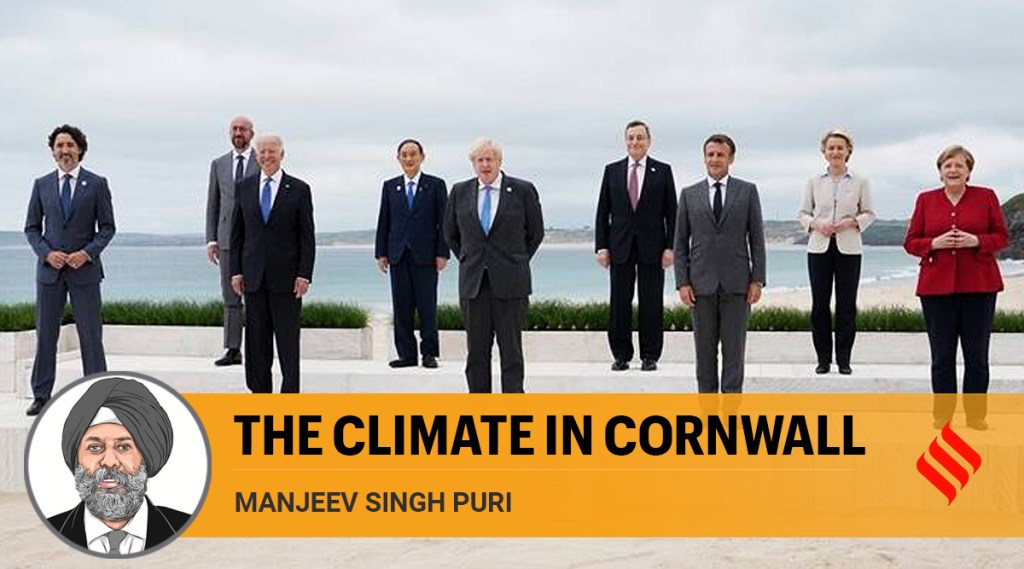
The Cornwall G7 summit sought to re-establish a common purpose among the richest democracies of the world. It also continued with the recent tradition among the rich to seek more than their “fair” share from the large developing countries. Climate change was a clear case in point.

The Cornwall summit, however, made an equal effort to shift the responsibility to the large developing countries, even though “common and differentiated responsibilities” is the agreed guiding principle for tackling climate change — differentiation underscores the responsibility of the industrialised countries to lead. In the new template, differentiation appears to mean that the big push on climate change must come from the large developing countries. So, all eyes will now shift to the G20 summit in October in Italy, where China, India and Russia will be present.
The G7 agreed “collectively” to net-zero GHG emissions by 2050 and called on “all countries, in particular, major emitting economies” to join as part of global efforts. And, ODA (official development assistance) has been made contingent on net-zero emissions by 2050 and deep cuts in emissions in the 2020s. Coal was particularly in the eye of the G7 which stressed “that international investments in unabated coal must stop now” “including through ODA, export finance, investment, and financial and trade promotion support”. India, that continues to rely on coal, could face a crunch in assistance in thermal power.
Finance and technology are the key areas where the industrialised West can and must lead. However, the G7 came up short in only reaffirming the collective developed countries’ commitment of $ 100 billion per year. This pledge was made in Copenhagen in 2009 and is nowhere near being reached. A smallish sum of $2 billion was committed to accelerating the transition from coal. Once again, “other major economies were called to adopt such commitments and join in phasing out the most polluting energy sources and scaling up investment in the technology and infrastructure to facilitate the clean, green transition”.
India has been a leading stakeholder in climate action and is among the few in the G20 in line to meet their commitments under the Paris Accord. It has also taken on a most ambitious target of 450 GW of renewable power by 2030 and has shown the world the way forward on solar power with producers now offering ultra-competitive tariffs.
As the world’s largest democracy, India is a natural ally of the G7 and Prime Minister Narendra Modi’s championing of the environment is globally recognised. However, global climate negotiations are not about good collective action for the environment or even energy security; they are strategic negotiations where no quarter is given, and external pressures abound.
BASIC, comprising India, China, Brazil and South Africa, has so far led the efforts of large developing countries in climate negotiations. Even as recently as April, it issued a statement underlining that developing countries require time and policy space to achieve a just transition of their economies. But with possible differences of opinion on net zero — and other differences as well — the jury is out on BASIC’s clout in future global negotiations. For India, with its huge developmental needs and global high-table aspirations that require carbon and policy spaces, the imperative is strong diplomatic partnerships with large developing economies that have an inherent interest in GREEN (Growth with Renewable Energy, Entrepreneurship and Nature).
This column first appeared in the print edition on June 19, 2021 under the title ‘The climate in Cornwall’. The writer, a former ambassador to EU and lead climate change negotiator for India, is distinguished fellow, TERI. Views are personal.




 Share


