
What international jurisprudence says about the use of nuclear weapons
All the nations of the world – nuclear and non-nuclear – must join together to establish a regime of a nuclear-free world. “Wars begin in the minds of men, and it is in the minds of men (and women) that the defences of peace must be constructed.”
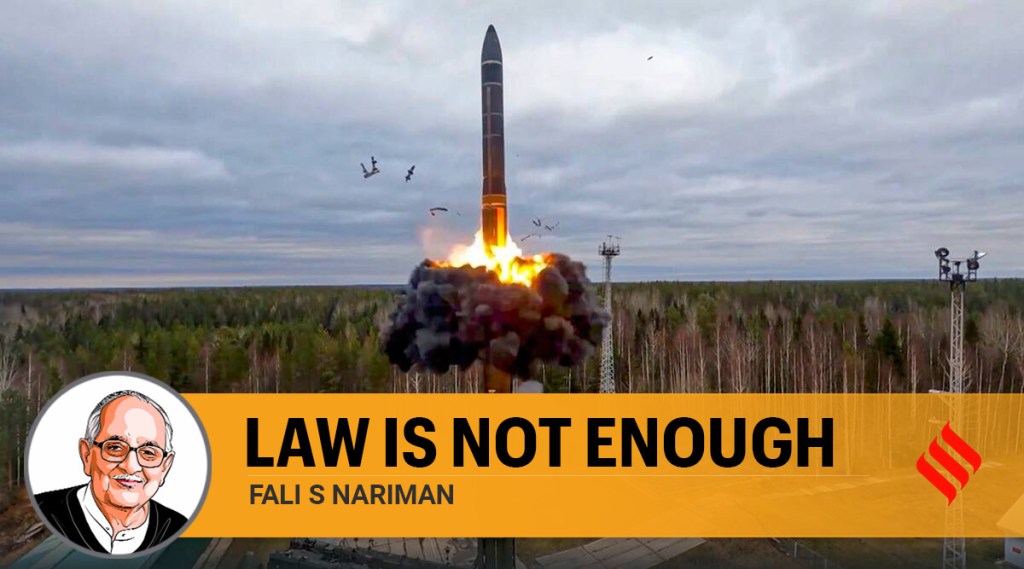 In this handout photo taken from video released by Russian Defense Ministry Press Service, a Yars intercontinental ballistic missile is test-fired as part of Russia's nuclear drills. (Photo: AP)
In the past few days there has been much talk (and considerable apprehension) about the use of nuclear weapons as a result of the Ukraine conflict.
What is the law on the subject? Nearly 30 years ago the International Court of Justice was requested by the UN for an Advisory Opinion “as to whether the threat or use of Nuclear Weapons in any circumstance was permitted under International law”. In other words, could the use of nuclear weapons be reconciled with the basic principles of humanitarian law? Representatives of 22 nation-states appeared before the ICJ and made written and oral submissions. In the end, a majority of 12 out of 15 judges said “that humanitarian law has to be read subject to an exception viz. that it permitted a State to use Nuclear Weapons in self defence when its survival was at stake, even where such use would otherwise be a breach of humanitarian law.” Alarming, but true. Only three judges disagreed — Judge Weeramantry of Sri Lanka, Judge Shahbuddin of Guyana and Judge Koroma of Sierra Leone. All three were from the developing world. They said that the concept of the humanitarian laws of war was not a recent invention, nor the product of any one culture. It was deep rooted in many ancient cultures — Buddhist, Hindu, Chinese, Christian, Islamic and traditional African. Each of these cultures had given expression to a variety of means that can be used for the purposes of fighting one’s enemy. They also said that the problem under consideration was universal, and the world court being a universal court, its composition “should reflect the world’s principal cultural traditions”.


 Share


