No country has as much area under farming as India. At 169.3 million hectares (mh) in 2019, its land used for crop cultivation was higher than that of the US (160.4 mh), China (135.7 mh), Russia (123.4 mh) or Brazil (63.5 mh). With its perennial Himalayan rivers and average annual rainfall of nearly 1,200 mm – against Russia’s 475 mm, China’s 650 mm and the US’s 750 mm – India has no dearth of land, water and sunshine to sustain vibrant agriculture. Which it has for 3,000 years and more.
But there’s one resource in which the country is short and heavily import-dependent — mineral fertilisers. In 2021-22, India imported 10.16 million tonnes (mt) of urea, 5.86 mt of di-ammonium phosphate (DAP) and 2.91 mt of muriate of potash (MOP). In value terms, imports of all fertilisers touched an all-time high of $12.77 billion last fiscal.

That figure, however, presents an incomplete picture. In 2021-22, India also produced 25.07 mt of urea, 4.22 mt of DAP, 8.33 mt of complex fertilisers (containing nitrogen-N, phosphorus-P, potassium-K and sulphur-S in different ratios) and 5.33 mt of single super phosphate (SSP). The intermediates or raw materials for the manufacture of these fertilisers were substantially imported.
Take urea, whose primary feedstock is natural gas. In 2021-22, India imported 23.42 mt of liquefied natural gas (LNG) valued at $13.47 billion. As per the petroleum ministry’s data, the fertiliser sector’s share in the consumption of re-gasified LNG was over 41 per cent. The industry’s LNG imports would have, then, been worth more than $5.5 billion.
For DAP, domestic manufacturers import intermediate chemicals, namely phosphoric acid and ammonia. Some even produce phosphoric acid by importing rock phosphate and sulphuric acid. The latter can be further made from the import of sulphur. During the last fiscal, 6.44 mt of phosphoric acid, 2.31 mt of ammonia, 9.66 mt of rock phosphate, 1.92 mt of sulphuric acid and 1.90 mt of sulphur were imported into the country.
Table 1: Import of fertilisers and inputs ($MN); Table 2: Sale of fertilisers (in lakh metric tonnes)
Table 1 shows the total value of fertiliser imports by India, inclusive of inputs used in domestic production, was a whopping $24.3 billion in 2021-22. There are two costs here. The first is foreign exchange outgo: Imports are mostly from China, Oman, UAE and Egypt (urea); China, Saudi Arabia and Morocco (DAP); Belarus, Canada, Russia, Israel and Jordan (MOP); Qatar, US, UAE and Nigeria (LNG); Morocco, Jordan, Senegal and Tunisia (phosphoric acid); Saudi Arabia and Qatar (ammonia); and Jordan, Morocco, Egypt and Togo (rock phosphate). The second cost is fiscal. Fertilisers are not only imported, but Indian farmers also pay below what it costs to import or manufacture using imported inputs. The difference is paid as a subsidy by the government. That bill was Rs 1,53,658.11 crore or $20.6 billion in 2021-22 and projected at Rs 2,50,000 crore ($32 billion) this fiscal.
Both costs are unsustainably high to bear for a mineral resource-poor country. We are feeling it, especially with global prices of urea, DAP, MOP, phosphoric acid, ammonia and LNG soaring two to two-and-a-half times in the last year (they have softened a bit of late). There was a time farmers had to be incentivised to use chemical fertilisers for boosting crop yields. Today, they have to be restrained from over-application. Farmers should know India imports half of its natural gas requirement – that will only go up – and hardly has any mineable rock phosphate, potash or elemental sulphur reserves.
There is a need, first of all, to cap or even reduce consumption of high-analysis fertilisers – particularly urea (46 per cent N content), DAP (18 per cent N and 46 per cent P) and MOP (60 per cent).
One way to do this is by incorporating urease and nitrification inhibition compounds in urea. These are basically chemicals that slow down the rate at which urea is hydrolysed (resulting in the production of ammonia gas and its release into the atmosphere) and nitrified (leading to below-ground loss of nitrogen through leaching). By reducing ammonia volatilisation and nitrate leaching, more nitrogen is made available to the crop, enabling farmers to harvest the same, if not better, yields with a lesser number of urea bags. Together with products such as liquid “nano urea” – their ultra-small particle size is conducive to easier absorption by the plants than with bulk fertilisers, translating into higher nitrogen use efficiency – it is possible to achieve a 20 per cent or more drop in urea consumption from the present 34-35 mt levels. That works out to 6.5-7 mt fewer imports, equivalent to $4.5-5 billion at current prices.
A second route is by promoting sales of SSP (containing 16 per cent P and 11 per cent S) and complex fertilisers such as “20:20:0:13” and “10:26:26”. DAP use should be restricted mainly to paddy and wheat; other crops don’t require fertilisers with 46 per cent P content. India can also import more rock phosphate to make SSP directly or it can be converted into “weak” phosphoric acid. The latter, having only about 29 per cent P (compared to 52-54 per cent in normal “strong” merchant-grade phosphoric acid), is good enough for manufacturing “20:20:0:13”, “10:26:26” and other low-analysis complex fertilisers.
As regards MOP, roughly three-fourths of the imported material is now applied directly and only the balance is sold after incorporating into complexes. It should be the other way around. India, to re-emphasise, needs to wean its farmers away from all high-analysis fertilisers. That movement, to use more NPKS complexes and SSP, is already happening (Table 2). It requires a concerted push, alongside popularising high nutrient use-efficient water-soluble fertilisers (potassium nitrate, potassium sulphate, calcium nitrate, etc) and exploiting alternative indigenous sources (for example, potash derived from molasses-based distillery spent-wash and from seaweed extract).
Finally, no plan to cap/reduce consumption of high-analysis fertilisers can succeed without farmers knowing what is a suitable substitute for DAP and which NPK complex or organic manure can bring down their urea application from 2.5 to 1.5 bags per acre. It calls for agriculture departments and universities not just revisiting their existing crop-wise nutrient application recommendations, but disseminating this information to farmers on a campaign mode.
Prasad is a fertiliser industry veteran and Damodaran is National Rural Affairs & Agriculture Editor of The Indian Express

 Costs are unsustainably high to bear for a mineral resource-poor country

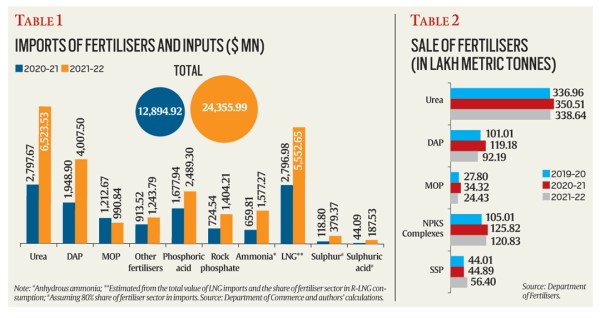 Table 1: Import of fertilisers and inputs ($MN); Table 2: Sale of fertilisers (in lakh metric tonnes)

 Share


