One can appreciate why Bengal’s school service commission says it cannot recruit 25,000 teachers within the next three months. When schools reopen after the summer break, they will have to be content with whatever teachers they have. That won’t be unusually hard. Government schools all over the country are used to running with staff shortages. Headmasters and principals know what to do when a class has no teacher because of transfer, retirement, election duty, enumeration work, or excessive administrative work. Often, the reason is simpler: A chronic lack of teachers for a subject. School heads do their best, but are often helpless. I have seen an English graduate managing Geography, a Maths teacher managing Science, but how do you manage a senior secondary vacancy in Maths or Physics? On a visit to a nicely maintained school in Haryana, I once met a group of children bemoaning the sudden transfer of their Maths teacher. Board exams were six weeks away.
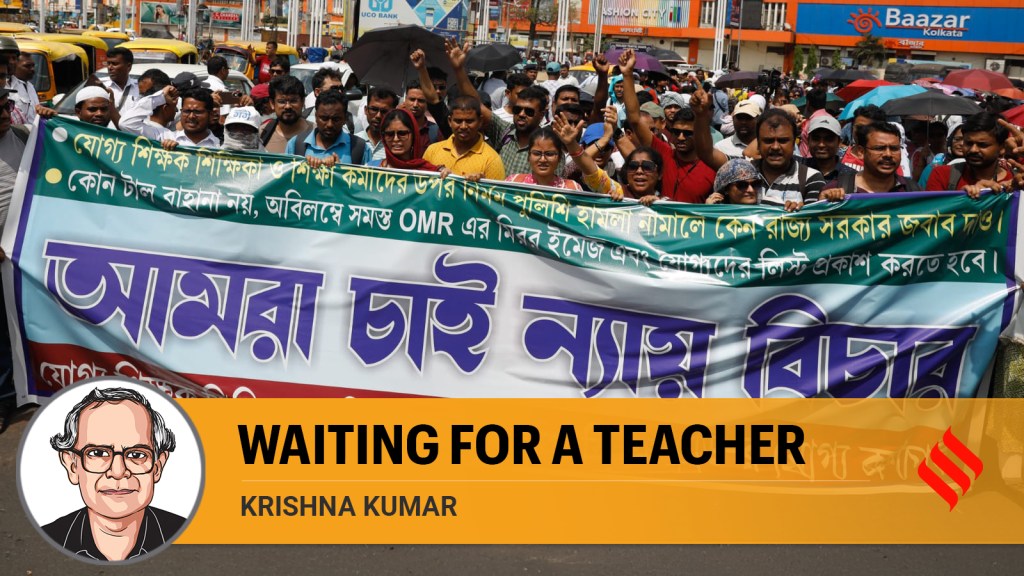
In Bengal, the current crisis has deeper origins. Four years ago, the School Service Commission had selected 25,000 teachers. One can only imagine how long it had taken for the vacancies to reach this number. Every state waits for vacancies to reach a substantial number before organising a selection test. The long wait that children must suffer for a basic educational need — a teacher — doesn’t matter to the state machinery. Its job is to ensure a fair, mass selection. The 2016 test in Bengal attracted over two million eligible aspirants for teaching and non-teaching jobs in schools. One can imagine how difficult it must be to conduct such a massive test without the common menace of a paper leak disrupting the whole process. Something worse happened. Reports of bribery surfaced, and the courts were called upon to adjudicate. Now, the highest court has given its verdict that a fresh process of selection is required.

This story offers us one more factor for explaining why parents prefer private schools over those run by the government. When a private (unaided) school has a vacancy, it advertises and selects, and life goes on. Why can’t that happen in a government school? One answer is that the government does not treat its schools as individual entities. Since British times — when the system was put in place — all governments treat their schools en masse. The better-endowed Kendriya Vidyalayas are no exception. Vacancies are reported to higher levels, and eventually a mass selection takes place, followed by allocation of the newly recruited to individual schools. The process is neither quick nor simple. The successful candidates sometimes wait for months to receive their appointment letters.
Matching vacancies with school subjects is difficult, so quite often you meet teachers handling a subject they have not studied beyond their own schooling. Vacancies keep piling up. Then, one day, the staff selection agency is told to recruit. Meanwhile, the number of eligible aspirants also keeps rising. Given the state of teacher education, no planning for future requirements is possible. Teacher education has been ill for a long time, and the hope of reform aroused by the commission appointed by the Supreme Court, under the late Justice J S Verma, has receded. The sector is now faced with a fresh chaos in the regulatory framework. It will directly influence eligibility across stages and subjects.
Children, meanwhile, learn how to cope. Many move to a new grade by the time a new teacher comes. And in schools located in so-called “remote” areas, the appointed teacher does not join and tries for an alternative posting. If that happens, the helpless headmistress waits for someone to be transferred to her school. If she succeeds in finally getting a teacher, the story does not end. Its focus shifts to the school where the teacher came from. Government school heads are used to this game, but they are no magicians. They cope with chronic vacancies by using familiar methods. These include merging two sections of a class or two classes, or asking local unemployed youth to help. Their ability to teach is not relevant. Looking after children in a vacant period is what such a stand-in teacher must do.
This slow, dark drama is ignored when people compare the board results of government and private schools. The plethora of extra duties government school teachers perform is also ignored. Private school teachers have been somewhat protected from non-teaching work, but the digital age has crept up on them. Teachers and heads of all schools are now on an all-day digital leash, receiving messages that require quick compliance. The uploading of various activities and exam time rituals makes everybody permanently nervous. Covid provided a rehearsal of the new professional life that teachers and school heads are now inescapably handling. The constant stress under which they function affects the quality of classroom teaching. The transfer of some of their stress onto their students is an obvious outcome of the administrative practices now regarded as normal.
Can the gap in recruitment procedures between government and private schools be bridged? For such a fantasy to come true, every government school would have to be treated as an autonomous unit. The pain and loss children suffer when a teacher is not available on account of an unfilled vacancy will have to be acknowledged.
For now, we can anticipate that the staff shortage in Bengal will persist for a while. Fresh recruitment will involve organising the mass testing of lakhs of candidates. The preparation of multiple choice questions will take its own time. In thousands of villages, children and their parents will wait for the teachers selected. The freedom and flexibility to select a teacher that unaided private schools have will remain a dream for government schools. At present, it is not even a minor priority for policy reforms.
The writer is former NCERT director



 Share


