
Welfare schemes will falter in the absence of accurate population data
The Census is necessary since it forms the basis of all the plans and programmes that the government wants to implement. Postponing the Census has immediate and long-term negative consequences for India. The government should take urgent steps to conduct the Census
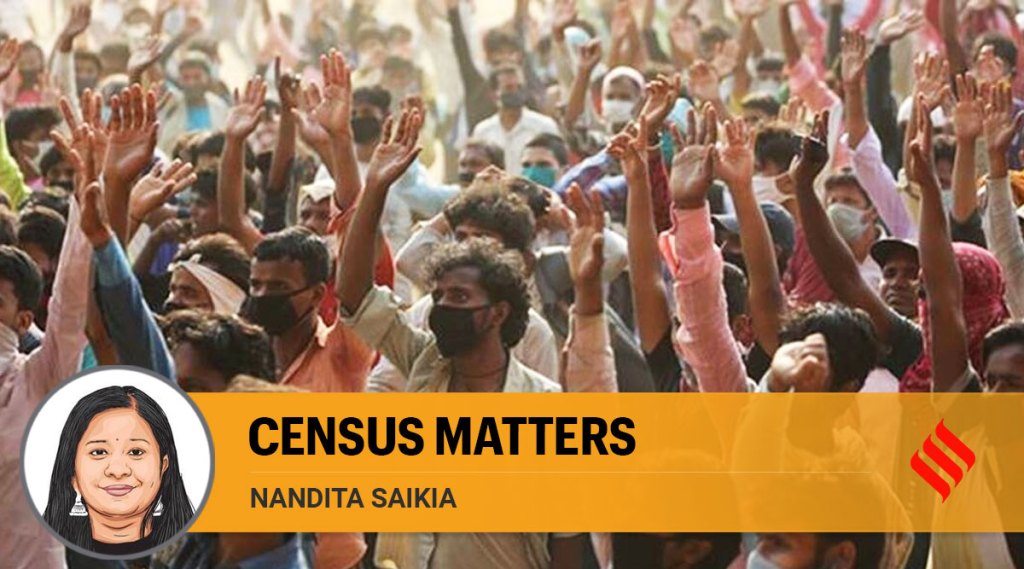 Postponing the Census has immediate and long-term negative consequences for India. (Representational/Express File Photo)
India aspires to be a $10 trillion economy by 2035. To achieve this, conducting population Census, due in 2021 but postponed indefinitely because of Covid, is necessary. Census data is essential for planning at the village or block level to usher in economic and social development, ensure better governance, and increase the transparency of public schemes and programmes.
There are many reasons why conducting a Census has become a prerequisite for economic development. At present, the biggest challenge facing demographers, planners, and other stakeholders is how to estimate the district population — the district is the basic administrative unit for governing, planning, and executing government projects and schemes. In the absence of updated Census data, demographers estimate the annual population count at the district level using past Census information for the intercensal or postcensal period. Say, to estimate the population of a district in India in the year 2015, they use the district-level population growth rate between the 2001 and 2011 Census. Such demographic exercises give reasonably fair estimates when the year of population estimation is within the range of a maximum of 10 years. Beyond this period, estimations can be erroneous, particularly at the district level due to dynamic patterns of population components, among them fertility, mortality and migration. Many districts of India are experiencing a faster demographic transition with varying fertility and mortality rates. So using the growth rate of 2001-2011 for the period after 2021 becomes more of an assumption-based model than a model that reflects empirical reality. Covid-19 further makes the situation complex as it impacts the fertility and mortality situation in the country. Since many states (and districts) lack a complete civil registration system with a full count of birth and death data, demographers face enormous challenges in providing population counts at the district level. For the above reasons, in several instances, estimates tend to be far off the mark, especially for newly formed districts and states.


 Share


