6 min readApr 17, 2026 03:44 AM IST
First published on: Sep 1, 2025 at 05:02 PM IST
In her 2018 breakout stand-up special, Nanette, comedian and actor Hannah Gadsby talks about the role tension plays in the telling of a good joke: If you build it just right, when you finally break that tension — by relieving the audience — you will get a great pay-off. The telling of a horror story follows a similar logic. But there is one way in which the format can deviate from that of comedy: With horror, the breaking of the tension does not always lead to relief (or at least, long-lasting relief) for the viewers. This is why horror films are notably sequel-prone.
This cleavage between closure and relief has, in the last decade, been explored by many filmmakers to create horror films that speak to larger social and political tensions. There may be resolution, but it does not bring relief. Instead, it forces people to sit in the discomfort of what the reel reveals about the real.

Zach Cregger, in his latest, Weapons, adds another film to this sub-genre. Weapons follows the story of a small town, Maybrook, in Pennsylvania, where 17 out of 18 kids in a class go missing, and the audience is taken on a journey to answer one question: Where did they go? Shot in a point-of-view frame, the film puts you in the shoes of the characters as much as it seems to say: “This is our world, these characters are us”. He marries the two tensions of comedy and horror seamlessly to create a 120-minute-long experience that makes you shriek with terror and laughter in equal measure. A sketch artist for decades, Cregger’s work with his troupe, The Whitest Kids U’Know, explored the gory and the uncomfortable through comedy. (One iconic three-minute sketch has Cregger in the role of US President Abraham Lincoln, being hammered to death at a play, for being an impolite member of the audience).
In 2017, another comedian and sketch artist, Jordan Peele, was among the first to break open the potential of this sub-genre with Get Out. The last 10 years have seen many films and shows in a similar vein. Nope (2022) and Us (2019) by Peele, like Get Out, deal with question of race, class and identity; Mike Flanagan’s The Fall of the House of Usher (2023) and Mark Mylod’s The Menu (2022) dismantle the walls that the rich build to insulate themselves from “horrors” like poverty and mortality; The Witch (2015) and The Substance (2024) explore misogyny.
But tonally, in the last year, there has been a shift. The new horror films — dubbed as “elevated horror”, to set them apart from the gore-and-guts films — took themselves seriously. These filmmakers used the tropes of the genre to communicate something far scarier than a haunted house or a resurrected corpse: The blurring of the lines between the fantastical dystopias they have created and the dangerous, broken realities we inhabit. Peele and Jane Schoenbrun’s (I Saw the TV Glow; 2024) brand of horror is a plea for the recognition and inclusion of those who have been dehumanised, of stories that have been made footnotes. The camera lens presents evidence of a society haunted by itself.
This year, horror films like the spellbinding Sinners by Ryan Coogler and Weapons reinvented the sub-genre in their own small but significant ways. As people grow weary of encountering their dysfunctional realities on news and social media, the films of Coogler and Cregger reflect a shift in how many choose to process these disquieting truths — with a healthy dose of humour. Sinners, set in the Mississippi Delta of 1932, depicts one night at a juke joint put together by two brothers and their cousin during the Jim Crow years. Made by and for people of colour (Black people in particular), in the joint, there is song, dance and jest. There is also the pain of freedoms denied and the glory of snatching it away anyway, all while being under attack. (“Just for a few hours, we was free,” Stack, one of the main characters, says as the movie closes). In moments boiling over with tension, especially then, characters crack jokes and laugh at themselves and their circumstances.
Weapons deals with the continuing horrors of gun violence in the US. The kids are literally turned into weapons, all escaping in the night with their arms out, resembling “small arms”: “It was like he was weaponised. Like a heat missile just locked onto you.” The exposition up top names this grief: “The kids left… and they never came back.”
Coogler and Cregger’s brand of horror is built on absurdity — of the politics of the day and people’s response to it. In the climax of Weapons, as kids turn on the adult responsible for their ordeal, unleashing the vitriol that has been fed to them, the residents of Maybrook look on in bewilderment, mechanically eating cereal, mowing their lawns and worrying about the shattered “glass everywhere” in their own homes. As these kids are stolen away and brainwashed, the adults are missing from the scene. Hilariously clueless, caught up in their own messes, these adults are perpetrators at worst, bystanders at best.
The moment of resolution is bloody — the kids save the day but are irrevocably changed for having to do it — and the background music swells with notes of triumph and liberation. As if the incompetence and ignorance of adults is a victory for anyone. As if the kids having to turn to violence can be liberation for any society. Many would believe it is. That is the ultimate horror — and the ultimate joke.
sukhmani.malik@expressindia.com

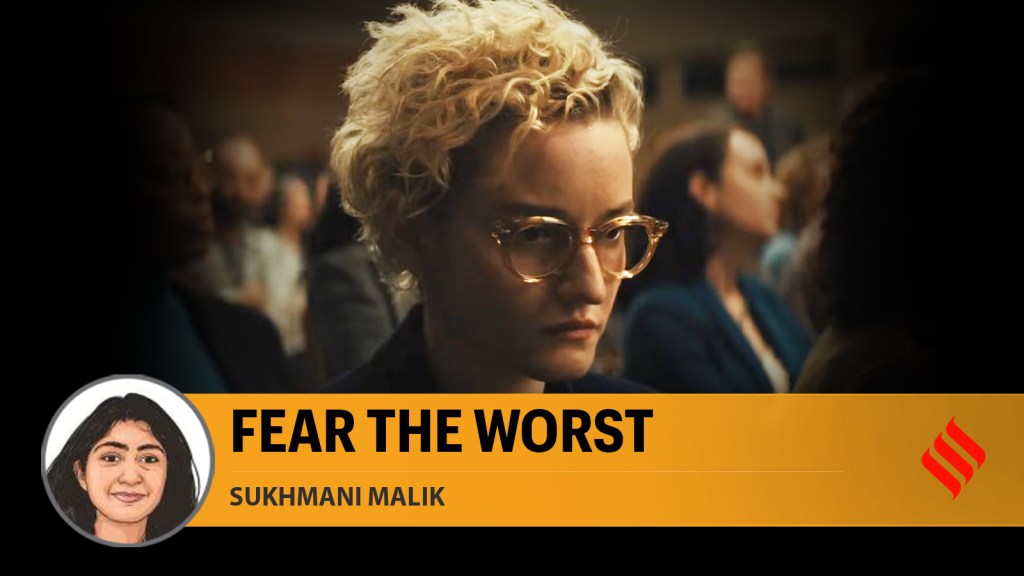 Julia Garner in a still from Weapons, directed by Zach Cregger.


 Share


