Walking means different things in different societies. The act of walking in India brings with it political and personal meaning. In the personal health category, medical science is undivided in its assessment of the health benefits from walking. Walking improves overall health. A 30 minute walk a day increases cardiovascular fitness, strengthens bones, reduces excess body fat, and boosts muscle power and endurance. This reduces the risk of heart disease, type 2 diabetes, osteoporosis and certain kinds of cancer.
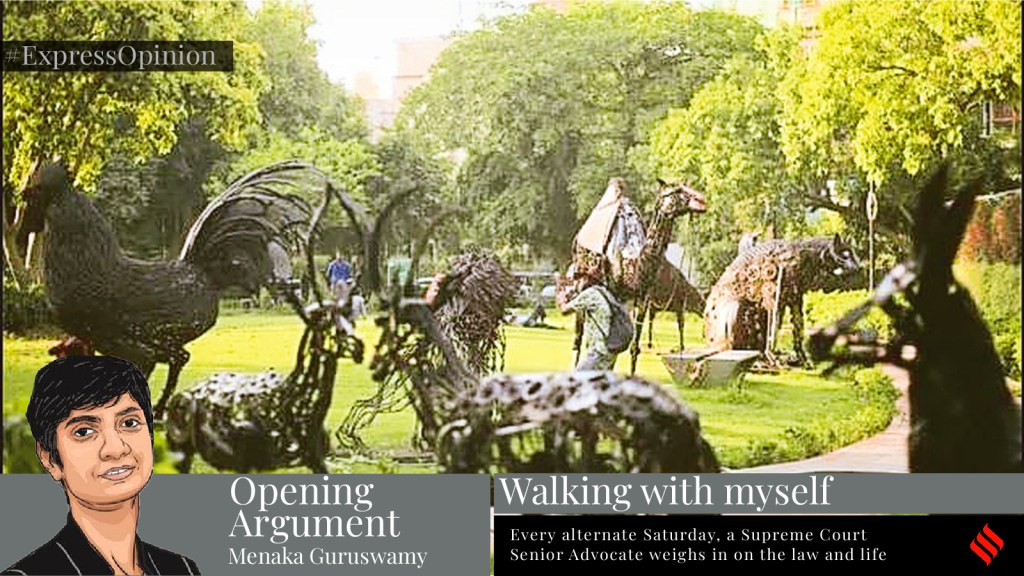
Then there is the unmitigated joy that a walk can induce, and the benefits it brings for mental health. One of life’s simplest pleasures is a walk amid lush greenery. It’s also a perk of living in Delhi, a city that has a commitment to maintaining some of its parks. Delhi’s parks are legendary — Lodhi Gardens, Sunder Nursery, Deer Park, the Ridge, Astha Kunj, Roshanara Bagh are among the many. Reports indicate that 23.6 per cent of Delhi comprises green cover or forests and trees — the largest percentage amongst any of the big Indian cities.

An undisturbed walk free from smart phones is a meditative activity — a conversation with oneself. For writers walking is part of the writing process. Merlin Coverley has a great book, the Art of Wandering. His thesis is that walking and writing are two facets of the same activity. He illustrates his point by using examples of walker-writers like the poets William Blake and John Clare, to the thinker Jean-Jacques Rousseau
The poet John Clare wrote what seems like a post-walk sonnet: “While grassy forest quakes surprise/And the wild wind sobs and sighs/My home rocks as like to fall/On its pillar green and tall/When the pattering rain drives by/Clock-o’clay keeps warm and dry.”
This could have been written of my walk through Lodhi gardens on Tuesday late afternoon this week. The gentle rains lashed the gardens, ducks swam by and monkeys glared fiercely at the falling rain drops. A lone walker was nonchalantly walking by, eating a packet of Lays chips, when a monkey walked up to him and demanded the chips. The now terrified walker handed over the chips and quickly walked away. The Lodhi tombs loomed large, framed by the dazzling blueish-gray skies that by now were seemingly throwing the rain drops everywhere, and washing the abundance of plants and trees in the gardens that were now a dazzling green. As I looked about, the stress of the court day faded away, and I wanted to write to capture this moment.
Walking in the Lodhi Gardens took me back to my childhood walks with my father there. Gyms were not a thing in the Delhi of the 1980s. People walked to burn fat, to have conversations with their children, to make sense of pre-liberalisation India where material choices were limited but attention spans were unlimited and focused.
Walking is also about meditating, having conversations with oneself, about life, about arguments in court, about my children, about observing the greenery and also about interrogating the work that one does and the choices that one makes. Most importantly, it is also about being without a smartphone. It is about holding one’s own attention.
Walking in India is not just a conversation with one’s inner self. It is also a political act. It is a symbol of political mobilisation and resistance — a revered instrument of peaceful resistance along with mobilising for one’s cause. India’s most famous “walker” is Mohandas Karamchand Gandhi. As a child I learnt about the Salt March, his rather effective instrument used to humble the British Empire.
What I was not taught was that the Salt March was a 240-mile march spanning 24 days. Bapu walked from Sabarmati Ashram to the coastal town of Dandi. This journey culminated in breaking the then government law by gathering natural salt found on the seashore and boiling seawater to produce salt. This inspired millions of Indians to engage in civil disobedience to break the British imposed salt taxes on Indians. Hence, this journey to resist an unjust tax is called the “salt satyagraha”.
ICMR’s project on Gandhi and Health@ 150 concludes that Gandhi walked almost 79,000 kilometres during the Independence Movement till his assassination. He had a body mass index of 17.1, weighed 46.7 kilos, and stood at 5 feet 5 inches. His good health is attributed to walking and a healthy diet. More importantly, Bapu understood the potential of the walk as a technique of mobilisation and for building a movement. This love that we as a polity have for our leader who engages in long marches and walking satyagrahas is unique to India.
Bapu’s deployment of the long walk as an instrument of political mobilisation has passed onto contemporary Indian politicians. Former Prime Minister Chandra Shekhar marched 4,200 kilometres in 1983 over four months. Former Chief Minister of undivided Andhra Pradesh Y S Rajsekhara Reddy walked 1,500 kilometres. Years later, his son Jagan Mohan Reddy would undertake a 3,648 kilometres walk to mobilise people in the new state of Andhra Pradesh. They are among the many Indian political leaders who have deployed the walk mobilisation technique.
Most recently, Rahul Gandhi’s Bharat Jodo Yatra is an example of using the walk as an instrument of resistance. He walked almost 4,080 kilometres over a period of almost 150 days. The yatra was launched on September 7, 2022, commencing in Kanyakumari and ending in Srinagar’s Lal Chowk. Despite the initial lack of significant coverage by the mainstream media, it enabled a refashioning of Rahul Gandhi as a political leader of heft. There is something that Indians love about the marching cerebral politician who will put foot to earth and take them on a journey.
Meanwhile, I will continue my solitary walks, have conversations with myself, dwell on the flowers and trees around me in Delhi’s perfect September — when the skies are blue, the air is breathable, the peacocks are out, the flowers have droplets of rain on their petals.
Guruswamy is a Senior Advocate at the Supreme Court

 I will continue my solitary walks, have conversations with myself, dwell on the flowers and trees around me in Delhi’s perfect September — when the skies are blue, the air is breathable, the peacocks are out, the flowers have droplets of rain on their petals.


 Share


