The alarming images and videos emerging from France in the last few days showing buildings on fire, charred carcasses of buses and cars, smashed storefronts and violent street clashes between heavily armed police and hooded youth seem to show a country caught off-guard. And yet, this violence involving citizens and the state has been brewing for a long time.
The match that sparked the widespread unrest was the fatal, point-blank, traffic-stop shooting of a 17-year-old French boy of Algerian descent, Nahel Merzouk, following a car chase in the Paris suburb of Nanterre. Rugby-playing Nahel was studying to be an electrician, but dreamt of becoming a mechanic. Allegedly driving without a licence, Nahel, the only offspring of his mother, ignored the police warning to stop. He paid for this decision with his life.

Following a change in the law on the use of firearms by the police in 2017, the French police are permitted to shoot if the driver refuses to stop or in any way poses a threat to the life of the officer or any other person. This was the third such shooting this year. Thirteen people, mostly of Arab or Black origin, were shot last year according to Reuters.
Nahel’s death triggered spontaneous violent protests in Nanterre where the incident occurred. It quickly spread to other towns and cities, with France getting sucked into a whirlpool of rioting and anarchy. The government responded by deploying 45,000 policemen across the country and authorising the use of armoured vehicles, drones, and helicopters. Thousands of rioters, including many in their early teens, were arrested.
The unwarranted shooting of the teenager has touched a raw nerve among the north and west African immigrant population. They live for the most part in grim, high-rise, suburban housing estates that are hotbeds of drug dealing and crime, where everyday life is a struggle. Young men and boys are reportedly being subjected to numerous and repeated, abusive identity checks. The Nanterre shooting unleashed the pent-up frustration and deep-seated anger with, not just the police but the state in general, resulting in the arson and trashing of government and municipal buildings.
While the violence, damage to property and looting cannot be condoned and the culprits must be severely punished by law, France needs to re-examine its methods of policing. In the wake of last week’s violence, the spokesperson of the UN Human Rights Office, Ravina Shamdasani, called on France “to seriously address the deep issues of racism and racial discrimination in law enforcement” and “to ensure the use of force by police to address violent elements in demonstrations always respects the principles of legality, necessity, proportionality, non-discrimination, precaution and accountability.” However, in a parallel statement released the same day, French police unions declared they were “at war’ with “savage hordes of vermin”, lending credence to the concern expressed by the UN body.
Distrust of the police runs deep in immigrant circles. The people in question are third and fourth-generation immigrants, still living in the same ghetto-like, rundown, lower-income housing estates in the banlieue that housed their grandparents or great-grandparents in the 1950s and 60s. Unemployment in this segment is high, poverty is rampant and life prospects are bleak.
Over the years, with the influx of immigrants from its former colonies as well as other parts of the world, the nature of French society has changed, reflecting its colonial legacy. However, in contrast to the “melting pot” model, France’s model of cultural assimilation does not make room for the growing linguistic, cultural and religious diversity of its population. This has left the immigrant communities feeling marginalised and discriminated against.
It is important to end systemic discrimination against and ethnic profiling of the Black and Arab immigrant communities. Measures to erase the mutual distrust that exists between these citizens and the police are needed. Blaming video games and social networks for the “copycat violence” that engulfed France is to misread the fury of those involved. For, as of today, the slogan on the protesters’ placards and lips is “The police kill” and “No justice, no peace”.
For all round healing, justice for Nahel must be delivered and seen to be delivered. In addition, and more importantly, there has to be an end to institutionalised discrimination. The first step would be an acknowledgement of the problem, followed by measures to address it. This would include working with law enforcement to change their mindset – not an easy task as the police have hardened their stance even more after the latest wave of riots. But unless this is done, more violent flare-ups are likely to occur in future.
Some Indian media channels and right-wing Islamophobic handles on Twitter see the mayhem in France as proof that Muslims need to be kept in line. Others feel vindicated that now France, and by extension, the West, have lost the right to lecture us on the treatment of minorities.
However, the recent events in France should serve as a warning for other countries, including India. Isolating and marginalising minorities results in a severe backlash. The solution, obvious though it may be, is to ensure the inclusion and economic and social progress of all sections of society. Unless this is done, economic and social divisions will deepen and society will be even more fractured. The recent wave of rioting in France should serve as a wake-up call to all.
Radha Kapoor-Sharma writes on politics, culture and current events

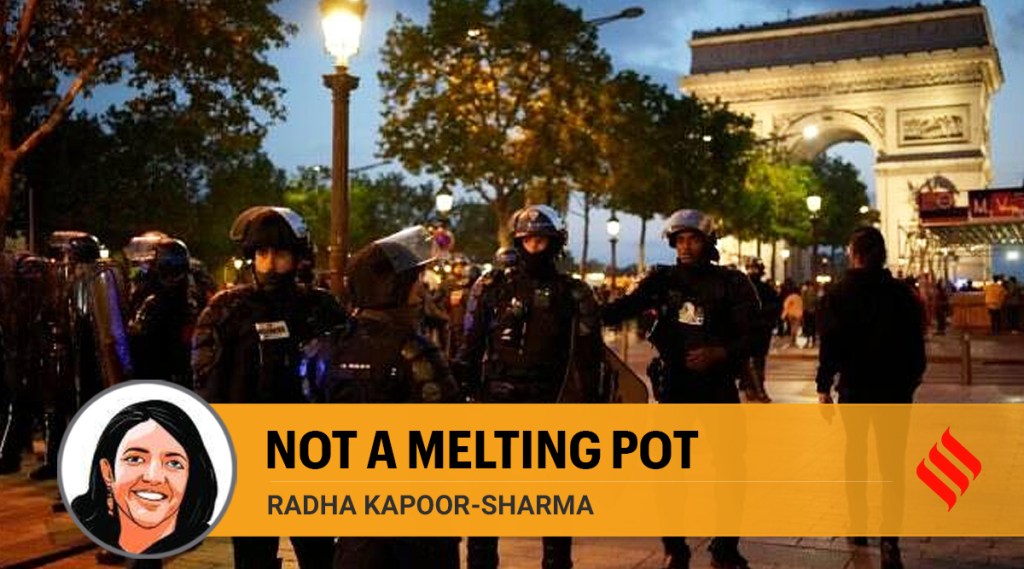 The unwarranted shooting of the teenager has touched a raw nerve among the north and west African immigrant population. (AP)


 Share


