4 min readNew DelhiSep 30, 2025 05:29 AM IST
First published on: Sep 29, 2025 at 08:27 PM IST
Written by Karthikeyan Damodaran
The tragic death of 41 people, including women and children, who had gathered to get a glimpse of matinee-idol-turned politician Vijay, has revived the debate about hero-worship of film stars and politicians. Inscriptions and sources indicate that the concept of a “hero” has been part of Tamil culture since early times. As shown by Stuart Blackburn, this includes both regional/local folk heroes who represented their class interests, and at the other end, kingly figures. Scholars like K Kailasapathy have worked on Tamil heroic poetry and the folklorist N Vanamamalai has written about hero stones, ballads and folk beliefs among the Tamils. All these indicate that celebrating fallen heroes through multiple forms of literary and oral practices or through visual markers has been part of the Tamil tradition. Should one accept that the adulation of film stars/politicians today is an extension of such a cultural practice?

Despite evidence of hero worship through literary and other oral forms from the past, one has to delve deep to understand the thorough institutionalisation of a culture of deification under the Dravidian movement. As against its foundational principles of atheism and rationalism, the Dravidian movement — in its political avatar, the Dravida Munnetra Kazhagam (DMK) — carefully nurtured a culture of deification where both film stars and politicians became demigods. Initially films (songs and dialogues) had become a central vehicle to promote the DMK’s ideology and take it to the masses. MGR was the lynchpin of this form of political communication; his presence both helped the DMK and enabled him to build a unique career uniting politics and cinema. He went on to become the Frankenstein and nemesis the DMK was never able to overcome during his lifetime. Attacking him, the party claimed that an actor’s rule had kept the whole state in darkness just like a cinema hall. However, the DMK itself never stopped trying to dominate the cinema field. Party chief M Karunanidhi’s own son, M K Muthu, was made to enter films as an answer to MGR; some of his grandsons also entered the industry later but were never able to attain superstardom. MGR’s success in both the film and political worlds inspired many to attempt to emulate him; almost every major star with a strong fanbase tried their hand in politics but none was able to repeat his success. Vijay, who seems to be the latest entrant, is already facing a major backlash as a result of the Karur tragedy.
This deification and a culture of veneration was a significant feature of Dravidian politics, whether it was Karunanidhi or MGR or Jayalalithaa, who all had their early career in films and were venerated and celebrated as the “Chola King”, “Paari Vallal” and “Idhayadheivam Amma” respectively. Both the Dravidian parties always wanted to be closely connected with the film world. This prevented the state from forming a public culture independent of the film culture. Film stars became a common feature of major events, and all cultural references in Tamil Nadu came to feature an element from films, whether songs or dialogues. More than it did elsewhere, it became a quintessential element of public culture in Tamil Nadu. In every election, a galaxy of film stars is found campaigning for the Dravidian political parties, a feature now being emulated by other national and regional parties. Even in the recent event “Tamil Nadu that Excels in Education” — to promote the state’s achievements in the field of education — film stars were among the speakers.
Though there is evidence of the concept of the hero in the Tamil cultural milieu of the past, the hero worship seen in modern times is nothing short of sycophancy and does not augur well for a democracy. One has to remember the words of B R Ambedkar, who wrote that hero worship is bound to happen in a democracy. He cautioned that, while bhakti in religion may be a road to the salvation of the soul, hero worship in politics is a sure road to degradation and to eventual dictatorship.
The writer is an assistant professor of social sciences at NLSIU, Bengaluru

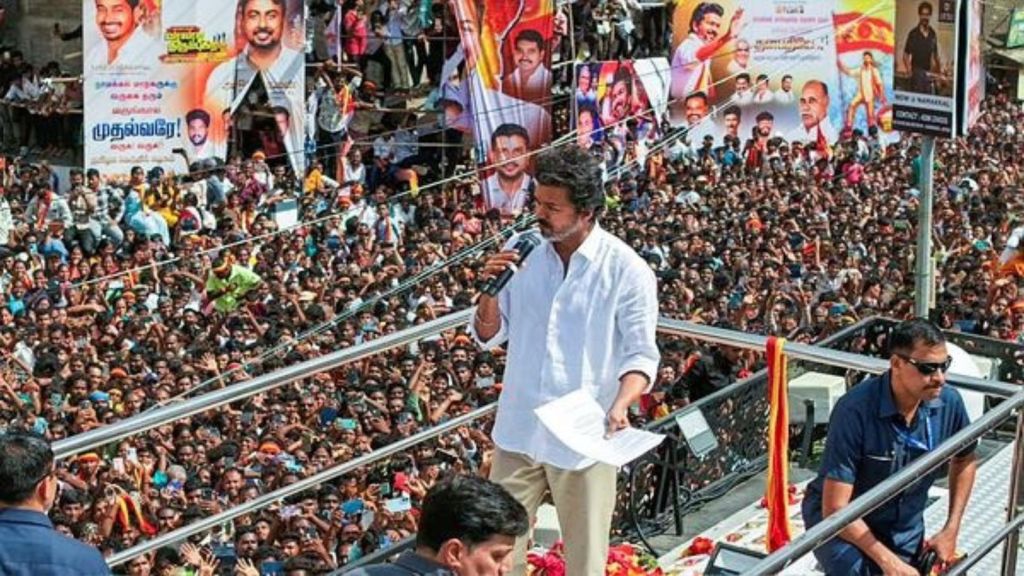 41 people died in a stampede who had gathered to get a glimpse of Vijay. (File)


 Share


