The unexpected violent protests in Kazakhstan and the crackdown that followed last week, which saw more than 160 deaths and 6,000 arrests, are part of a larger turmoil that has enveloped Eurasia that runs across the great steppe from Central Europe to Manchuria.
Each of the current crises in Belarus, Ukraine, the Caucasus, and Kazakhstan might have a specific logic and trajectory of its own, but together they are reshaping the geopolitics of Eurasia. Russia, with its geographic spread across Eurasia, is at the very centre of that restructuring. Moscow’s military intervention in Kazakhstan and its negotiations with the US this week on European security underline the Russian centrality in Eurasia. Five broad themes stand out in the potential for rearrangement of Eurasia — the bumpy internal political evolution of Eurasian states, the weaknesses of economic globalisation, the limitations of regional institutions, the constraints on powers to shape the post-Russian space, and Russia’s shifting great power relations.

First, the idea that the post-communist states have settled into a stable and sustainable political path has been increasingly tested in recent years. The collapse of the Soviet Union in 1991 marked the failure of the grand project for the socialist modernisation of the Eurasian landmass, opening the door for new political models in the region. In Central Europe and the Baltic states, the transition to liberal democracy appeared quick while many of the former Soviet Republics drifted into rule by strong men. Both models are coming under some stress. “Democratic backsliding” in Hungary and Poland is a major concern for the West as the governments in Budapest and Warsaw challenge the presumed norms of the European Union.
In Kazakhstan, the anger of the protestors was directed against the autocratic rule of Nursultan Nazarbayev, who has led the country since the breakup of the Soviet Union. He formally stepped down in 2019 but has sought to retain control. In Belarus, mass protests last year challenged President Alexander Lukashenko, who has ruled the nation since 1994; he has survived with Kremlin’s support.
If the Western project of promoting democracy in the post-Soviet space has run into multiple problems, the Islamist agenda for the transformation of Central Asia may have a great fillip with the triumphant return of the Taliban in Afghanistan. Meanwhile, religion has returned with some force in Europe as well — orthodox Christianity in Russia and the Roman Catholic church in central Europe exercise considerable political influence.
Second, although much of Central Asia embraced economic globalisation, it has failed to prevent massive economic inequality and curb the kleptocratic elites. For a country with large natural resources, especially hydrocarbons, and a small population of 19 million, Kazakhstan could have easily ensured an equitable society. But Nazarbayev chose otherwise, and the consequences are now playing out. The problem is not exclusive to Kazakhstan or Nazarbayev. Autocracies inevitably breed corruption and erode the capacity for self-correction that is so critical for any society.
Third, the hope that regional institutions would contribute to the stability of the post-communist states has not been fully met. Two decades after former communist states joined the EU — the world’s most successful regional institution — the eastern and western halves of Europe continue to look vastly different and are ill at ease with each other. Although the post-communist states embraced the EU whole-heartedly, several issues today — relating to rule of law, migration, refugees, energy, and geopolitics – divide the two halves. There is deep resentment in the eastern half about the domination of the western half on EU policymaking. While the West European leaders talk of European “strategic autonomy” from the US and China, many in east and central Europe speak of claiming greater autonomy, if not national sovereignty, from Brussels.
The struggle to develop credible regional institutions has been harder in the former Soviet space. Moscow has launched the Eurasian Economic Union and the Collective Security Treaty Organisation to reestablish its primacy in Eurasia, but it is some distance away from making these into credible institutions. Moscow has also joined Beijing in setting up the Shanghai Cooperation Organisation that was to jointly stabilise the Central Asian region.
Many former members of the Soviet Union value their newfound sovereignty and are not ready to hand it back to Moscow. It is for that reason most countries have sought to pursue variants of what Nazarbayev called “multi-vector diplomacy” — engaging all major powers to strengthen their strategic autonomy. At the same time, geography, history, and institutional inertia continue to bind them to Russia. When the crisis erupted in Kazakhstan, Almaty inevitably turned to Moscow for help. But the tension between dependence on Russia for security and the political aspiration for autonomy is an enduring one.
That brings us to the fourth theme — the constraints on the ambitions of other powers to shape the post-Soviet space. Two great forces that have risen since the dissolution of the Soviet Union — the EU and China — have been unable to shape the political and security dynamic in Eurasia.
Despite their massive economic power, Brussels and Beijing have not been able to lead in the resolution of the regional crises next door — Europe in Ukraine and China in Kazakhstan and Afghanistan. In Ukraine, Moscow prefers to negotiate with Washington rather than Brussels. In Kazakhstan, Russia has shown it remains the main security provider despite the considerable economic salience of China. Several other powers, including Turkey, Saudi Arabia, Iran, Pakistan, India, Korea, and Japan have sought to develop some influence in Central Asia. They all bring some unique advantages, but none of them has been able to transcend their multiple limitations.
That brings us to Russia’s great power relations that have complicated Moscow’s capacity to reinforce Russia’s natural primacy in Eurasia. The rapid deterioration of Russia’s relations with the West in recent years can’t be compensated by Moscow’s growing political warmth and economic depth in relations with Beijing. This week’s talks on European security between Russia and the West signal a fresh attempt at finding common ground.
Although pessimism pervades the outlook for the talks, the Eurasian turmoil presents new imperatives for both sides. The West can continue to challenge Moscow’s efforts to reclaim regional primacy, but it is not in a position to secure Russia’s Eurasian periphery against the Kremlin. Cutting Russia some political slack in Eurasia might help the West to stabilise Europe and focus on multiple other challenges, including those from an increasingly assertive China.
Although Russia is the weightiest actor in Eurasia, it can’t simply reconstitute the former Soviet space unilaterally. An accommodation on European security with the West — covering such areas as Ukraine’s independence and neutrality, the de-escalation of the military confrontation in the heart of Europe through arms control, and the development of a cooperative agenda on global security — would significantly improve Moscow’s chances of leading a new Eurasian geopolitical order.
This column first appeared in the print edition on January 11, 2022 under the title ‘The Eurasian turmoil’. The writer is Visiting Research Professor at the Institute of South Asian Studies, National University of Singapore, and contributing editor on foreign affairs for The Indian Express

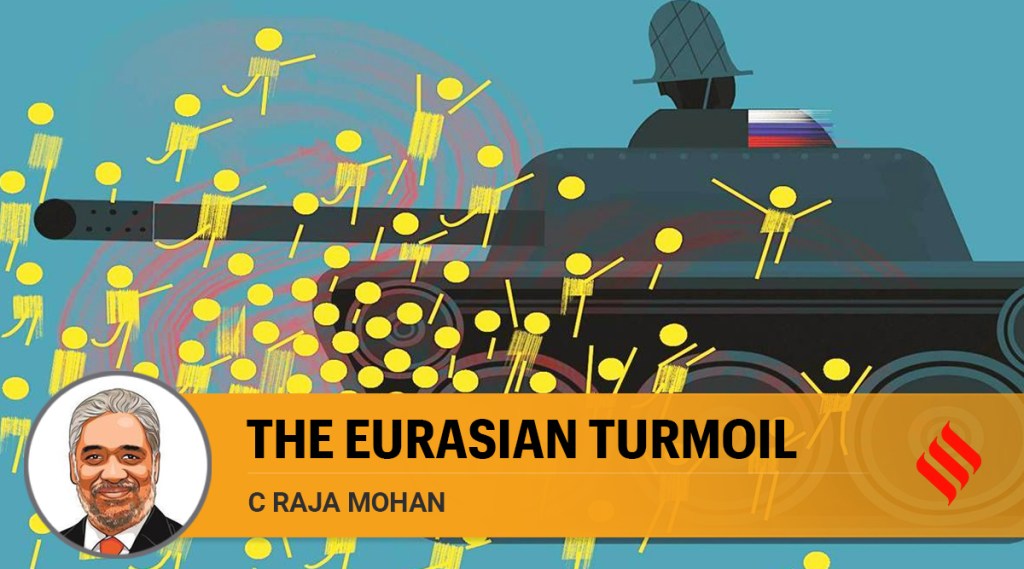 Despite their massive economic power, Brussels and Beijing have not been able to lead in the resolution of the regional crises next door — Europe in Ukraine and China in Kazakhstan and Afghanistan. (Illustration by C R Sasikumar)



 Share


