5 min readOct 30, 2025 05:03 PM IST
First published on: Oct 30, 2025 at 05:03 PM IST
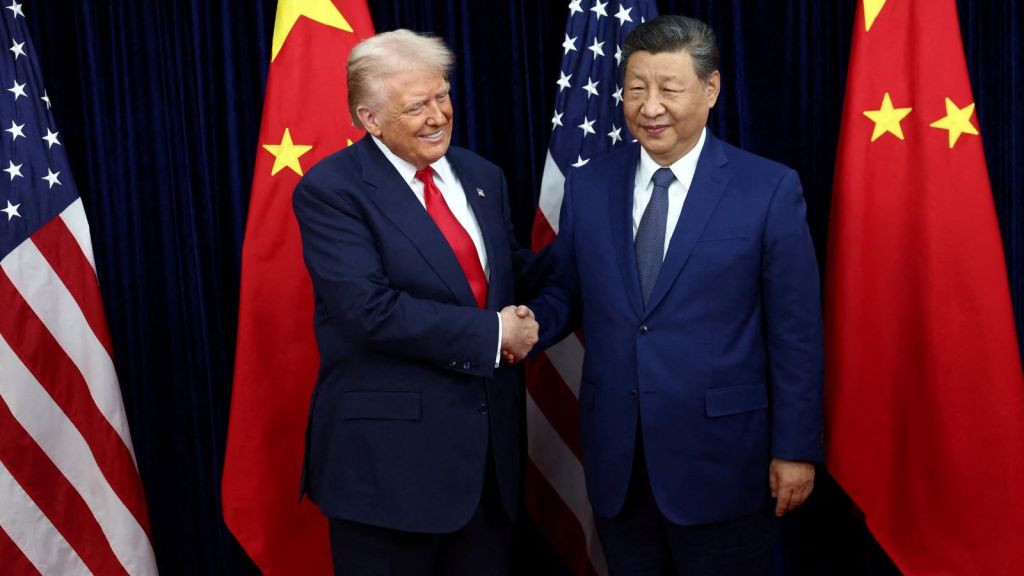
The much-awaited meeting between China’s President Xi Jinping and US President Donald Trump took place in Busan, South Korea, as both leaders travelled to the country for the APEC (Asia-Pacific Economic Cooperation) Summit. In discussions lasting over two hours and involving seven delegates from each side, the two seemingly discussed the length and breadth of the economic and technological issues plaguing the US-China relationship.
The only official confirmations, if one defines “official” liberally, on any concessions that may have been made from either side during the meeting, have come from Trump’s media interviews onboard Air Force One. A few of his claims, if accurate and if confirmed in the press releases from both the White House and the Chinese Foreign Ministry, will truly be significant in bringing about an ice-breaker in tense US-China relations. For starters, he has claimed that China’s April and October 2025 export controls on rare earth elements shall no longer apply to the US. Secondly, he has confirmed that in exchange for a 10 per cent reduction in the US’s active tariff on China, from 57 per cent to 47 per cent, Xi himself has agreed to stop exports of “hard fentanyl.” Thirdly, he has argued that China will resume soybean imports from the US and mark a return to normalised trade on that front.

And yet, in the readout of the Chinese foreign ministry, there seems to be no yield. While they do admit that there was a “consensus” reached on resolving “key trade issues,” the concessions themselves were not a point of discussion. The readout is an exercise in grandstanding, and revolves more around China’s capability to be resilient and handle any risks thrown at them, than around hailing the successes of the tête-à-tête.
There are three things of note in this whole affair, and the developments leading up to the meeting. The first is that both sides have a vision for their national economies, and they seem to be clashing. This makes granting meaningful concessions harder. For Trump, it is vital that the US not be mooched off of, that jobs and manufacturing return to it, and that economically and technologically, it remains the dominant power. To that end, his administration finds logic in curbing the flow of critical goods and technologies to China, but that will not be enough unless the curbs also imposed on the import of talent and affordable consumer goods to the US are relaxed.
For China, this is a matter of equality with the US and the West, but also of national rejuvenation and ensuring smooth-sailing of its domestic economy, which remains reliant on manufacturing and exports, and is yet unable to kickstart enough consumption to sustain overcapacity. While Beijing desires that trade be a “propeller” and not a “roadblock” in US-China relations, there is no doubt that for years, it has flooded markets and artificially disrupted prices. Clearly, for anything meaningful to be conceded by either side, mutual mistrust and the sense of wrongdoing on both sides must go away, and that is much easier said than done.
Secondly, there is the issue of rare earth element export restrictions from China, which has two sides. It is understandable for Washington to desire concessions on that front in the next few months, given that sustained reliance on China for rare earths that go into automobiles or phones, can lead to immediate-term disruptions for American manufacturers and downstream suppliers. But in the longer term, the focus on alternatives is vital, given that Xi does not seem to have conceded to any removal of restrictions, despite rumours that a one-year exemption from restrictions may be in the works vis-à-vis the US. In fact, Beijing’s October 9 export controls, which deem as less as 0.1 per cent of Chinese-origin rare earth use in foreign-exported products a national security vulnerability, make the world more starkly aware of China’s ability to weaponise its dominance in many global value chains. Hence, the geoeconomic situation is simply not suitable to have such intensive concentration of supply chains in any one economy or geographic region.
Thirdly, the issue of semiconductor chips has seemingly not been overplayed by neither side, but that does not mean Beijing is happy with continued American restrictions. On the issue of the cutting-edge AI Chips, Nvidia’s “Blackwell”, Trump said that Beijing and Nvidia must handle it between themselves. But after years of wrangling American companies to look inward and shift gears toward de-risking, it may be that Trump is assured that Nvidia is not looking to export the chips to China, despite Jensen Huang’s concerns surrounding harm to the firm’s China market. Yet, amid discussions that the supply of some relatively lesser-quality Nvidia chips may soon be continued to China, Beijing has called for an all-or-nothing – it does not seem to desire the stripped-down chips. Hence, as much as the Trump-Xi meeting is a useful stepping stone to resolving a large set of long-standing issues, political will and egos are at a crossroads with entrepreneurial profitability and great power stability.
The writer is staff research analyst, Indo-Pacific Studies Programme, the Takshashila Institution, Bengaluru

 On the issue of the cutting-edge AI Chips, Nvidia’s “Blackwell”, Trump said that Beijing and Nvidia must handle it between themselves. But after years of wrangling American companies to look inward and shift gears toward de-risking, it may be that Trump is assured that Nvidia is not looking to export the chips to China, despite Jensen Huang’s concerns surrounding harm to the firm’s China market.


 Share


