
Waste-to-Energy plants that use solid waste as feedstock pose threat to environment
WtE plants in India burn mixed waste. The presence of chlorinated hydrocarbons like PVC results in the release of dioxins and furans when the waste is burnt at less than 850 degree C. Appropriate filtering mechanisms need to be installed to control such dangerous emissions.
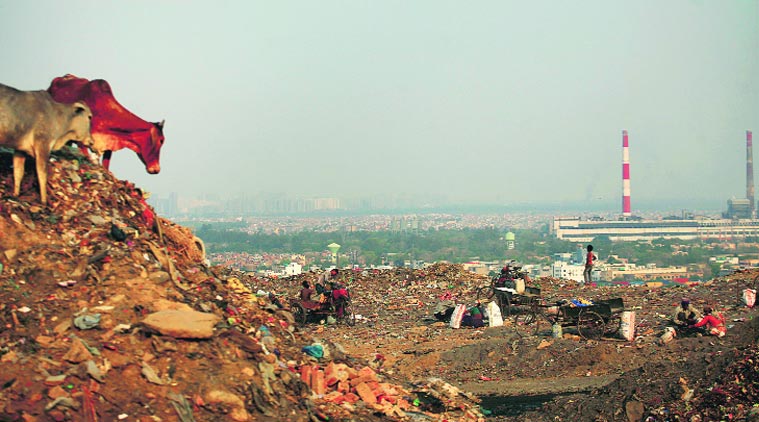 The Okhla landfill is fast approaching capacity. (Source: Express Archive)
We wish we could scream loud enough for our readers and the municipal authorities to hear that Waste to Energy (WtE) plants in our cities, using inadequately segregated municipal waste as feedstock, are highly dangerous because of the toxic gases and particulates they spew when they burn mixed waste in the process of incineration.
Residents of Okhla and surrounding areas in Delhi have been protesting that the WtE plant in their vicinity is not complying with the stipulations of National Green Tribunal (NGT). Is it too much for an urban locality with houses, hospitals, schools and shops to want no industrial polluter in their midst? With its location within 30 metres of the residential areas, emissions remain a major issue with the residents. The plant was slapped a fine of Rs 25 lakh in February 2017 by the NGT but many questions about air quality standards in the area remain unanswered, including why the plant spews soot and ash in the neighbourhood.

To rub salt on the wound, we understand that the authorities are considering the expansion of this WtE plant from 16 MW to 40 MW. The latest protests by the residents at a public hearing were reported in the press only a few days ago. The residents claim that the plant’s original Environmental Impact Assessment (EIA) — issued to IL&FS — bears no resemblance to the plant now in operation. A new EIA has been filed for the proposed expansion, and they are apprehensive about the proposal to add two boilers.
There are five municipal WtE plants operational in India with a total capacity to produce 66.4 MW electricity per day, of which the lion’s share — 52 MW per day — is generated in Delhi by its three existing plants. There is also talk of setting up a new WtE plant with a capacity of 25 MW at Tehkhand in South-East Delhi. The bandwagon is rolling on with cities across different states vying for WtE plants as a quick and lazy solution to the complex challenge of solid waste management.
WtE plants in India burn mixed waste. The presence of chlorinated hydrocarbons like PVC results in the release of dioxins and furans when the waste is burnt at less than 850 degree C. Appropriate filtering mechanisms need to be installed to control such dangerous emissions. Dioxins and furans are known to be carcinogenic and can lead to impairment of immune, endocrine, nervous and reproductive systems. They are extremely difficult and costly to measure, as the experience of Okhla shows. In the past, joint inspections involving the residents have shown that the plant was being operated without the adequate use of activated charcoal to filter out dioxins, furans and mercury from the emissions.
Even when incineration takes place under optimal conditions, large amounts of flue gases, mercury vapour and lead compounds are released, and there is always about 30 per cent residue from incineration in the form of slag (bottom ash) and fly ash (particulate matter), which are also known to be serious pollutants of air and water. Even people living in the neighbourhood of the best-maintained plants in the West are said to be prone to higher levels of cancer and other illnesses. That is why WtE plants are being phased out in the West. Unfortunately, while the clamour for WtE plants is growing in India, their operations are neither strictly maintained nor adequately monitored.
SWM Rules 2016 require that PVC be phased out in incinerators by April 2018. But it is impossible to identify and remove PVC beverage labels, for example, from mixed waste streams. As a preventive measure, the NGT directed the Ministry of Environment and Forests to consider the phase out of such single-use short-life PVC and issue appropriate directions by July 2017. Their failure to do so till date is inexcusable.
WtE plants in India are also inefficient in generating energy. Municipal waste in India has a very high biodegradable (wet) waste content ranging anywhere between 60 and 70 per cent of the total, compared with 30 per cent in the West. This gives our waste a high moisture content and low calorific value. Also, since Indian households have traditionally been recycling their waste such as paper, plastic, cardboard, cloth, rubber, etc, to kabadiwalas, this further lowers the calorific value of our waste.
India’s Solid Waste Management policy requires that wet and dry wastes should not be mixed so that only non-compostable and non-recyclable wastes with at least 1,500 kcal/kg should reach WtE plants. Such waste comprises only 10 to 15 per cent of the total waste. The challenge of segregation at source is compounded by the municipal governments themselves when they use compacters to reduce the transport cost of the waste. Compacting compresses the waste and makes even gross segregation at the plant site impossible. In the absence of adequate feedstock of non-compostable and non-recyclable waste, it becomes necessary to use auxiliary fuel, adding to the cost of operating the plants.
Private companies (mostly foreign) are keenly hawking “waste to energy solutions” to handle our growing volumes of urban waste. Our urban local bodies, which bear the responsibility for solid waste management in our cities, are easily misguided into adopting these “solutions”. They are themselves reluctant to make an effort at keeping wet and dry wastes, recyclable and non-recyclable wastes, unmixed. They find WtE plants an easy option to legitimise the burning of mixed waste.
Municipal authorities should be made aware that WtE technologies are being phased out in the West. They should not be allowed unless the waste offered meets the criterion specified by the SWM Rules 2016. A crucial element of enforcement will be to first ensure that the waste is not mixed at the source of generation and then that the handling of waste is in unmixed streams. Even where outsourcing contracts clearly specify that handling must be in unmixed streams, there should be strict penalties for non-compliance.
To summarise, WtE plants using municipal solid waste from Indian cities as feedstock pose a serious threat to our health and environment. We do not even have the municipal waste of the quality prescribed by our own SWM Rules to run such plants, let alone the regulatory and monitoring capacity to ensure their safe operations. We must seriously explore low cost options such as composting and bio-methanation. First things first: No mixing of waste at the point of generation.
This article first appeared in the January 30, 2019, print edition under the title ‘Toxic plants’
Ahluwalia is chairperson, ICRIER and former chairperson of the high-powered committee on urban infrastructure and services. Patel is member, Supreme Court committee on solid waste management,
 Share


