Two major leaps are underway in India’s services sector that could define the trajectory of the country’s growth. One has to do with fast-evolving services exports to the rest of the world. The other is the rapid transformation of domestic services. They are both changing in shape and form as they modernise. And it doesn’t end there. We are also seeing signs of these new services rising up the value chain and crossing over into manufacturing. This is where we think it starts to get very exciting.
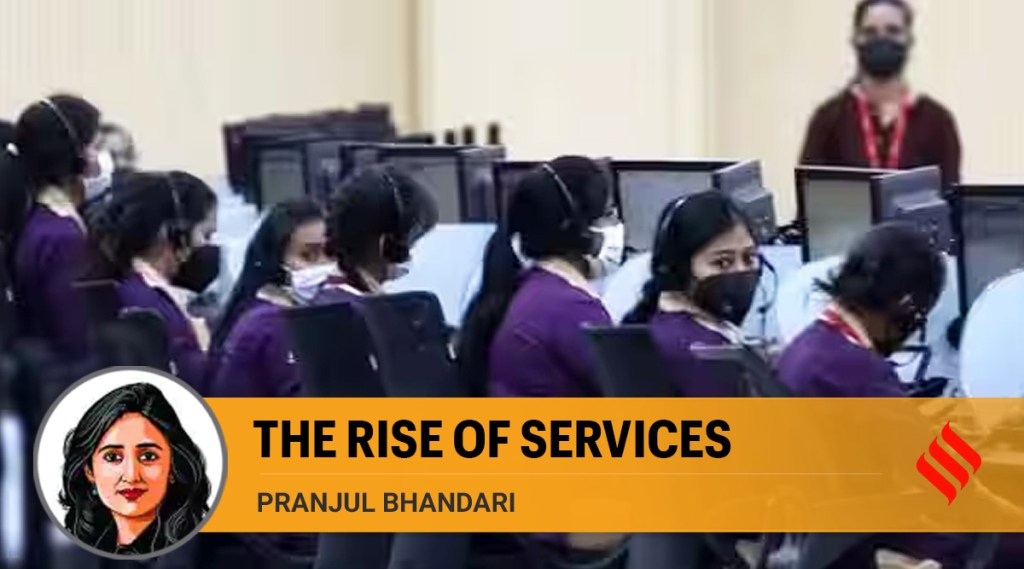
Let’s start with services exports. On a net basis, they are now raking in $60 billion a year more in revenues than three years ago. The pandemic period was a shot in the arm for IT services. Work from home increased the demand for tech capability across firms. And the exuberance continues, with a broadening out in both the services provided and the service providers. India is no longer the call centre of the 1990s. It’s not even the software solution provider of the early 2000s. It has moved up the value chain and is now selling a host of professional services, ranging from accounting, legal, HR, to business development, design, and R&D. And the list is only increasing.

At least four different service providers are dominating the scene. While large IT firms continue to grow, they are not the only engines of growth. Mid-sized IT firms have been gaining market share and consulting firms are growing their services export books. And finally, India can now boast the world’s largest share in Global Capability Centres (GCCs).
What are GCCs? GCCs have traditionally provided tech and IT support to their parent MNC companies, but have gradually moved up the ladder to higher-value-added services like legal, audit, design and R&D. In 2022-23, around 1,600 GCCs made up a market of $46 billion, employing 1.7 million. When looking through India’s services export data, it is no surprise that even though professional and consulting services exports are still just a quarter of IT services exports, they have grown the fastest, at a 31 per cent CAGR (compounded annual growth rate) over the last four years, followed by computer services (16 per cent) and R&D (13 per cent).
Will it last? After a terrific run, it is possible that the pace of increase in India’s IT services exports moderates over the next year or two. After all, slowing global growth is likely to squeeze tech budgets. However, we believe that the growth has a structural element to it. Once global growth bottoms out, India’s services exports can begin to gather pace again.
There are several reasons for this. One, there is a seemingly permanent change in attitude about getting more work done from “home”. Two, India can offer a skills portfolio which is able to produce a gamut of services, ranging from engineering to design. Impressive internet penetration, young and digitally savvy demographics, and improving education attainments have made this possible. Three, India offers cost-competitiveness. For instance, in value terms, Indian IT services exports make up 18 per cent of global trade, but in volume terms, this doubles to 36 per cent. Finally, we believe India is at a tipping point, from which growth trends in services exports will tend to be even stronger. This is important; let us explain.
We take a look at the economies whose share in global services exports is much higher than India’s, like the US, the UK, Germany, and Ireland. We find that India is at a point where other countries were able to take off and grow their services exports even more quickly than before. Much of this, we believe, has to do with scale. Once a country’s exports in a specific sector reach a certain size, there are both pull and push factors that lead to even higher growth.
This is not where it ends. We find evidence that many multinationals are increasing their footprint in India. Those which started with producing services, for instance via GCCs, are increasing the range of services. And some, especially in sectors such as medical equipment, electronics, and precision manufacturing, are even crossing over into manufacturing. After all, there is much complementarity between manufacturing and services.
Next, we look at domestic services. India has an impressive digital public infrastructure. Many tech start-ups have plugged into it using a variety of business models. Most are focused on the services sector but over time they could become more ambitious and move into manufacturing and agriculture. In one sense, rather than be confined to growing “new India”, they could take on the challenge of lifting “old India” up. What exactly could they do?
Let’s start with the manufacturing sector. Digital infrastructure can be used to solve many of the daily problems that small manufacturers face. Start-ups could help small firms gain access to formal credit, cheaper raw materials, bigger final markets, better warehousing and logistics, and enhanced quality checks.
By enabling small manufacturers to gain the advantages larger ones benefit from (that is simulate scale), they are incentivised to expand. Indeed, we are already finding evidence of the “new” domestic services sector companies, for instance in the transport services, procurement support, and ecommerce sectors, making forays into manufacturing. Why is this important? At the heart of India’s jobs problem is a sluggish low- and medium-tech manufacturing sector. Too many manufacturing firms remain too small for too long, so they never enjoy economies of scale or create enough jobs. What India needs is a slew of reforms which remove many of the impediments manufacturers face.
While policy action is critical, we believe the rise in modern services can energise manufacturing. It is, therefore, heartening to see examples of multinationals crossing over from producing services to manufactured goods in India. Domestically, it is encouraging to see how the services start-ups are venturing into manufacturing. This could well be the start of a trend that will drive growth and jobs in the economy. Don’t miss it.
The writer is chief India economist, HSBC

 While policy action is critical, we believe the rise in modern services can energise manufacturing. (Representational Photo)


 Share


