6 min readFeb 15, 2022 08:41 AM IST
First published on: Feb 15, 2022 at 03:00 AM IST
Comments by economists about the budget explain the condition of the Indian economy. They also reveal ideological divisions about how the health of an economy should be measured and the prescriptions to improve it. The finance minister’s rectitude has been commended: There are no “populist hand-outs” nor have taxes on incomes and wealth increased. There is agreement that investments in physical infrastructure will benefit the economy in the long run, and in the short run too, by creating more employment. However, there is fear that the way the money will be used by the Centre will disempower the states further, just when they must do most of the heavy lifting on public welfare. And, there is disappointment that allocations for health and social security remain grossly inadequate.
Former Finance Minister P Chidambaram summarised the budget as, “No work, no welfare, only wealth”. Large “wealth creators” are made free to create wealth for themselves — wealth which, supposedly, will trickle down to the masses. Evidence from around the world is that the economic policy paradigm, of first increasing the overall size of the pie by reducing taxes at the top and then “redistributing” the wealth, has not delivered benefits to people. Trickle-down has dried up while gushing up has increased, with policies to make it easy for investors to do their business of making more profits for themselves. Gandhiji had declared that he was not against wealth creators. He lauded wealth creation. However, it must not be at the cost of workers and welfare. Wealth creators must be trustees of the wealth they create, not its exclusive owners.

The Indian economy is suffering from a chronic “demand-side” problem that is becoming worse with misguided economic policies. Young people who have been getting educated in larger numbers than before, even learning vocational skills, cannot find jobs. They are dropping out of the job market seeing no hope in it. The CMIE estimates that in UP, the number of persons of working age who have a job has decreased in the last five years from 43 per cent to 33 per cent; in Punjab from 49 per cent to 30 per cent; in Goa from 49 per cent to 32 per cent; and in Uttarakhand from 40 per cent to 30 per cent. If people don’t earn, demand will not increase, and investments in businesses will not be attractive. Moreover, frustrated youth are tinderboxes for social unrest.
Around the world, there is reaction to the financial globalisation of the last 30 years. Speaking to leaders of the Confederation of Indian Industry (CII) in May 2007, then Prime Minister Manmohan Singh, celebrated as the freedom provider for business with the 1991 reforms, had warned: “The time has come for the better-off sections of our society to understand the need to make our growth process more inclusive; to eschew conspicuous consumption; to care for those who are less privileged.” He invited corporate India to “be a partner in making ours a more humane and just society”. Business feared he was returning India to “socialism”—a bogey for neo-liberal economists and their “Washington Consensus” of “minimum government”, “ease of doing business”, and lower corporate and wealth taxes.
In his book, Davos Man, Peter Goodman explains how the wealthiest people have influenced economic policies in democratic countries from the 1990s to make themselves wealthier. Thomas Piketty has documented how wealth inequalities have increased alarmingly in Capital and Ideology. Wealth has accumulated at the top, with regressive tax policies along with deregulation. Government expenditure on social reforms has been crimped. Piketty reveals how the most inclusive periods of economic growth — when a rising tide lifted all boats — have always coincided with periods of high taxation of wealth to fund public education, health, and social security. He also reveals that when inequalities increase intolerably, governments divide to rule and persecution of minorities increases with politics of national identities.
Goodman says the “Davos Man” has propagated the “cosmic lie” that “cutting taxes and deregulating markets will not only produce extra riches for the most affluent but trickle benefits down to the lucky masses — something that has, in real life, happened zero times.”
He says the Davos Man “would have us believe in a false binary choice as a defence of the status quo, that we either accept globalisation as we have known it for decades or we throw in our lot with Luddites operating in the thrall of backward ideas”.
The global economy must move on from hyper-financial, deregulated capitalism, which has given easy money too much freedom. Neo-liberal Indian economists also frighten us with false binary choices: That we must carry on the way we are, or we will go back to the pre-1991 control era. They must move out from their ideological ruts. One, that until the economy grows there will be no resources to invest in human development — whereas China invested in human development before its economic take-off. Two, that an unprepared industrial sector will thrive in global free trade — whereas the UK and US (and Japan and China too), grew their industrial sectors behind walls of protection, and then demanded that the rest open their markets to the might of their enterprises.
Political divisions by religion and caste are tearing India’s social fabric again. The Indian economy must grow inclusively to repair it. To grow, it must make up for shortfalls in human development, and build domestic industrial capabilities. Until then, it will remain a colony for stronger countries to expand their enterprises with their intellectual property. India will remain strategically vulnerable against its mighty neighbour across the border, which did not adopt Davos Man’s theories. Indian policymakers must urgently discover India’s own, contextually appropriate model of development and shed defunct economic theories.
This column first appeared in the print edition on February 15, 2022 under the title ‘Myth of the trickle-down’. The writer is a former Planning Commission member

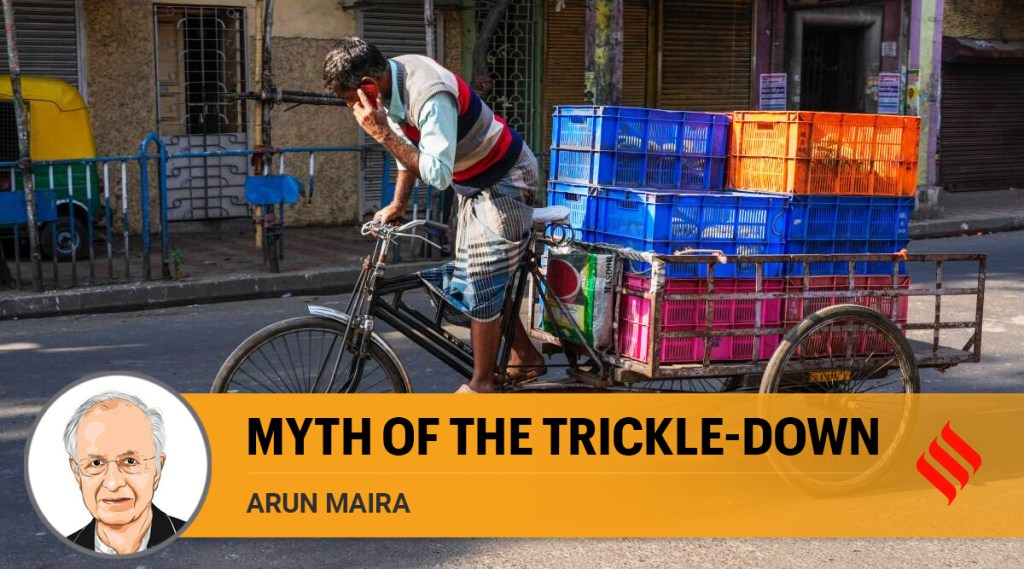 A delivery man on a tricycle pedals while talking on his mobile phone in Kolkata. (AP Photo/Bikas Das)



 Share


