6 min readApr 16, 2022 09:13 AM IST
First published on: Apr 16, 2022 at 03:40 AM IST
On April 11, Imran Khan, Pakistan’s then prime minister, lost a no-confidence motion against his leadership and was forced to leave office. This was the culmination of a week-long, riveting political crisis, unfortunately, all too familiar in Pakistan. First, a sitting prime minister tried to dissolve parliament when faced with a resurgent opposition.
Subsequently, the Supreme Court of Pakistan intervened to hold the dissolution unconstitutional and ordered parliament to proceed with the vote of no-confidence. Imran Khan’s Tehreek-e-Insaf lost the vote, with the opposition gathering 174 votes in a 342-member House. Imran Khan’s dismissal continues a long and inglorious tradition — no Pakistani prime minister has ever completed their constitutionally sanctioned five-year term. Khan is the first PM to be voted out of office by a no-confidence vote — a constitutionally-sanctioned method. Others have been executed, displaced by military coups, sent into exile, or imprisoned. What explains this instability of the Pakistani executive?

All elected governments in Pakistan must contend with the military and the judiciary to survive. Let’s start with the role of the military. Apart from being a professional army, the military is also the wealthiest commercial player in Pakistan. In her influential book, Military Inc., Ayesha Siddiqa notes that the military is one of Pakistan’s largest landowners, controlling about 11.58 million acres of land. It is involved in a range of profitable activities — wheat storage, fertiliser production, oil and gas exploration and production, sugar, rice and ginning mills, fish farms, and bicycle manufacturing plants. These and many other commercial ventures have made the military financially independent from other branches of the state. Siddiqa argues that the Pakistani military has a commercial incentive and fiscal independence to wield political influence.
Pakistan’s military has had this power since the country’s inception. The Pakistan army’s first intervention into politics was as early as 1958, led by General Ayub Khan, who abolished the constitutional regime established by the 1956 Constitution and established what K J Newman terms a “preventive autocracy”. Subsequently, the military would stage three coups in October 1958, July 1977, and October 1999. These coups inevitably resulted in the unconstitutional and unceremonious dismissal of elected prime ministers and the obvious breakdowns in constitutional functioning.
Yet, it is not only the military that has contributed to the unstable parliamentary form of government in Pakistan. The judiciary has also contributed to the fragility of elected prime ministers in the country. Soon after the founding of Pakistan, on October 24, 1954, the governor-general dissolved the Constituent Assembly (an elected body). The governor-general had earlier dismissed the East Bengali prime minister who enjoyed a majority in Parliament. The federal court (which would later become the supreme court) upheld the dissolution in Maulvi Tamizuddin Khan v Federation of Pakistan. Chief Justice Muhammad Munir found in favour of the governor-general, concluding that the latter needed to give his assent to provide legal authority to the actions of the Constituent Assembly.
In 1977, the supreme court faced another occasion to test constitutionalism in the context of a military regime in the case of Begum Nusrat Bhutto. Prime Minister Zulfiqar Ali Bhutto was imprisoned by Ziaul Haq, the chief of staff of the army, who quickly declared martial law. Begum Nusrat Bhutto, Zulfikar’s wife, filed a petition before the supreme court challenging the prime minister’s detention on highly suspect charges of murder. The court not only found the military coup to be legal, but also did not prevent the execution of PM Bhutto by the military regime.
In contemporary times, Imran Khan’s predecessor Nawaz Sharif was dismissed from his position as prime minister by the supreme court, in the case popularly called the Panama Papers Scandal. The Panama Papers, you will recall, listed the names of many influential persons alleged to possess secret bank accounts with enormous amounts of money. Nawaz Sharif and his family members allegedly had such bank accounts. Hence, petitions were filed — including by Imran Khan and his party — that Nawaz Sharif was not “honest” or “ameen” as warranted by Article 62 (1) (f) of the 1973 constitution. This constitutional provision would disqualify any member of parliament who was found to be dishonest by a court of law.
During the hearings, the supreme court directed the setting up of a joint investigation team (JIT), with nominees from various executive institutions. Eventually, the court accepted the JIT conclusion that Nawaz Sharif “is not honest in terms of section 99 (f) of the Representation of People’s Act and Article 62 (1) (f) of the Constitution” and disqualified him from membership of parliament. Hence, Sharif also lost the position of prime minister.
Article 62 (1) (f) of the constitution itself is a remnant from the days of General Zia, who seized power through a military coup in 1978 and remained president till his death in a mysterious plane crash in 1988. He instituted many constitutional and statutory provisions apparently against corruption and Islam. Surprisingly, civilian political parties chose to retain this provision, not displaying foresight that it could eventually be used against them.
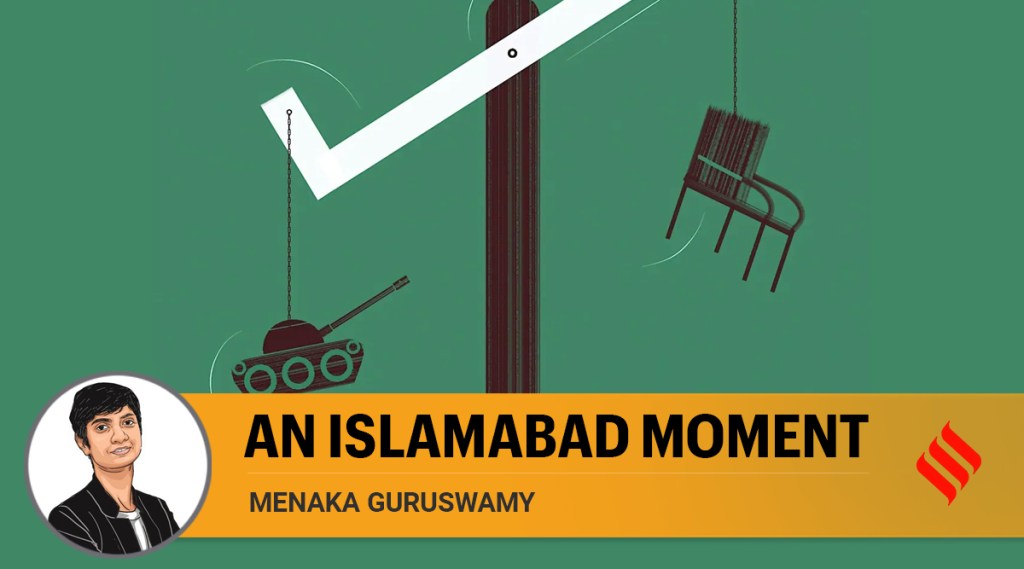
In Imran Khan’s case, the supreme court clearly played a constitutionally appropriate role, even if some critics allege that it may have been influenced by the wishes of the military. Whether this is the beginning of an era of more constitutionally appropriate judiciary and military in Pakistan remains to be seen.
This column first appeared in the print edition on April 16, 2022 under the title ‘An Islamabad moment’. The writer is a senior advocate at the Supreme Court of India

 Whether this is the beginning of an era of more constitutionally appropriate judiciary and military in Pakistan remains to be seen. (Express Photo)


 Share


