5 min readDec 30, 2024 12:49 PM IST
First published on: Dec 26, 2024 at 01:22 PM IST
The meatatarians of Mandya scored a small victory on Sunday, December 22, the last day of the 87th Kannada Sahitya Sammelana. More than a lakh people who attended the last day’s programmes were offered boiled eggs as a token concession to the clamour for meat to be served on all days of the three-day annual event. The demand came from many groups who claimed that meat-eating, particularly in the Vokkaliga heartland of Mandya, is a cultural inheritance and practice that had long been denied an equal place in what is arguably one of Karnataka’s most important cultural events. Even Kannada literature that focuses on or talks about meat, some progressive groups claimed, was a taboo subject in previous sammelanas. On Saturday night, defiant meatarians, who sported badges about the “historic” step towards equality between themselves and vegetarians, brought “baadootta” — “maamsahaari” food including home-cooked egg and chicken biryani and other meat dishes for distribution at the meal counters to over 500 participants.
A hard-boiled meatatarian would justifiably question the egg as a substitute for the real thing. But even such a pyrrhic victory may be a giant symbolic step forward. The mathadishas of several important mathas in northern Karnataka had in 2021 expressed strong opposition to the introduction of eggs as part of the midday meal scheme in seven districts. At that time, the mathadishas cited data proving that a large proportion of children are not accustomed to eggs, and preferred to serve bananas, or peanut chikkis in schools. As a 16 to 17 per cent sizable minority of the Karnataka population, the Lingayats, combined with Brahmins and Jains, chose to oppose the (ironically, BJP) government scheme, despite all evidence pointing to the urgency of altering the stunting and wasting index of the seven northern districts through this nutritional change. Tamil Nadu has successfully introduced eggs to turn its nutritional status around since 1989, and as studies have shown, BJP-ruled states have increasingly resisted this nutritional innovation.

It is another matter that better sense has prevailed, and with the additional support of the Azim Premji Foundations, eggs are now provided to all government and aided schools throughout the week. But well-entrenched prejudices continue, even as all evidence points to increasing meat consumption across the country, covering, as K S Singh’s Peoples of India project had it, about 83 per cent of the population. Of course, in India that is Bharat, this varies, from those who eat meat only on Sundays, or all days except Tuesdays, or outside the home, but not inside, to only boneless chicken, or when cooked by a family member or just when they drink. Karnataka even boasts of a self-confessed “chicken-eating Brahmin” (Gundu Rao). All these caveats would prove a headache to colour code on a map.
But the protesters were not merely claiming equality: They were pointing to the deep-seated value attached to vegetarianism, that puts the “shameful” meat on a segregated counter, and sees meat eaters as unclean, if not criminal. Only in Kerala have I seen a sign that promised “pure non-vegetarian” food; even here, the negative connotation of “non” was hard to jettison.
The attachment of purity to food items, their producers, or consumers, has segued into subtly branding products of everyday use in overtly caste terms. Where else would “Brahmins” become the unique selling point of a mere sambar masala? Where else would “Sankethi” suggest a reliable and tasty brand of snacks? And of course, the colloquial “bhattaru” for cook also implies a Brahminical monopoly of public cooking.
We cannot imagine a similar public brandishing of food cultures from the opposite end of the caste spectrum. Food preferences are many and varied: Aravind Malagatti in his unforgettable autobiography, Government Brahmana, recalls the revulsion he felt when he first entered a house that used the “devil’s dung” (asafoetida/hing) in cooking. But food preferences need not be prejudices, and our young need to be urgently taught this distinction.
Even 75 years after Independence, and long after India has conquered food scarcity, traces of the civilisational anxiety about eating remain. “Ootaayithaa/Have you eaten?” is the standard greeting in Karnataka. As some accounts have it, the Chinese too opened their conversations with this query, but, after the revolution of 1949, and following the pushback against the severe privations of the early post-revolutionary decades, it has faded from everyday use. This is not only a significant nutritional shift, but equally important, a linguistic one.
So it may be no coincidence that this small victory has happened at the Kannada Sahitya Sammelana. Apart from making the aroma of “meat” more acceptable, it strongly suggests that nothing short of a linguistic revolution is necessary. Shedding the negative connotations associated with meat eating, and cultivating toleration — in schools, colleges, public events — would go a long way in making the plurality of food cultures acceptable, a feature of our diversity to be celebrated. Perhaps nothing less than a revolution will ensure this, but meanwhile, the small triumphs should suffice.
The writer is a Bengaluru-based historian and was Professor of History at JNU, Delhi

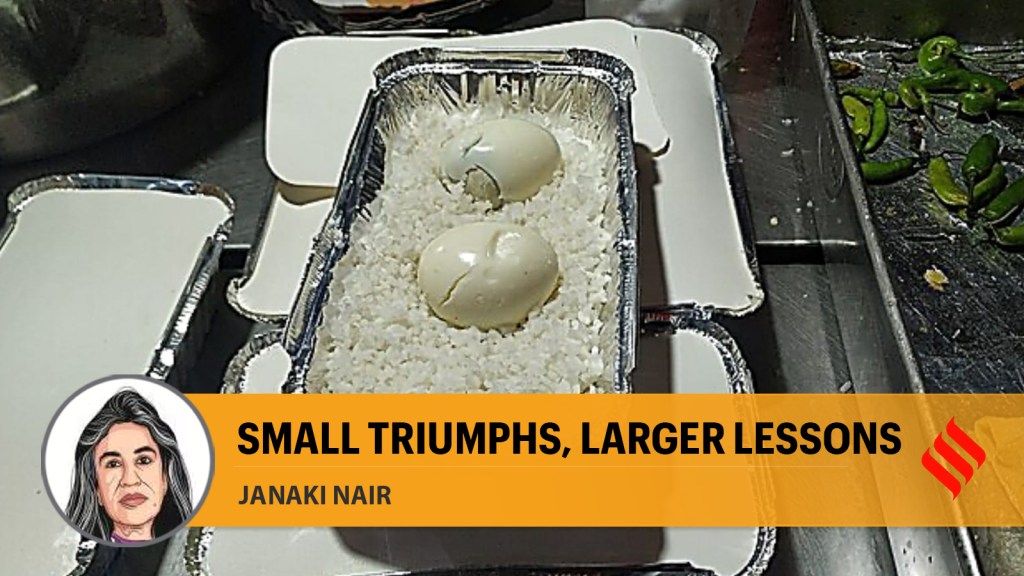 Food including home-cooked egg and chicken biryani and other meat dishes for distribution at the meal counters to over 500 participants. (Wikimedia commons)


 Share


