Written by: M Suresh Babu
6 min readOct 29, 2025 01:23 PM IST
First published on: Oct 29, 2025 at 01:23 PM IST
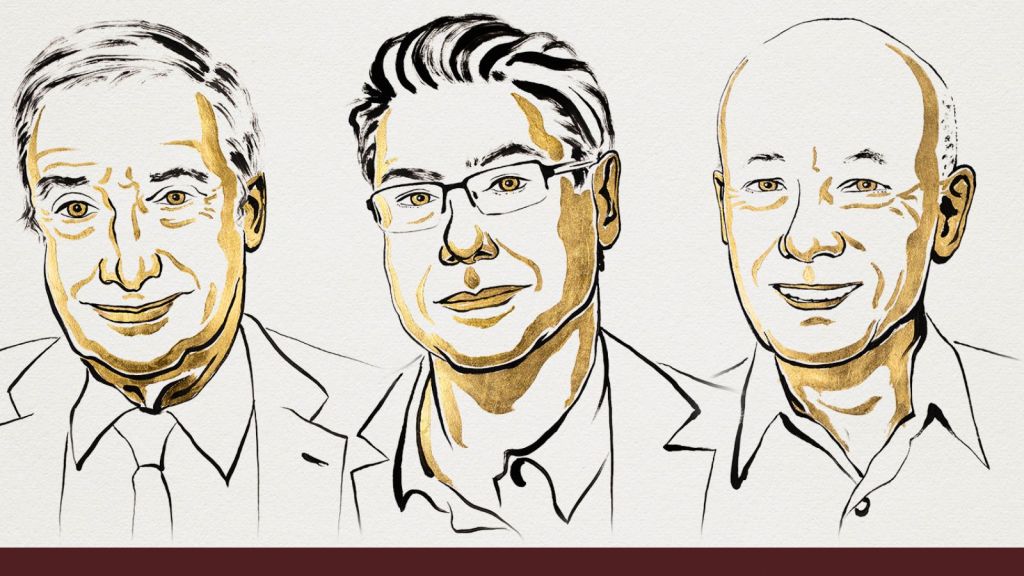
The 2025 Nobel Prize in Economics (Sveriges Riksbank Prize) has been awarded to Joel Mokyr, Philippe Aghion and Peter Howitt “for having explained innovation-driven economic growth”. Their works contribute to a large body of literature which tries to explain the proximate and ultimate sources of economic growth. The early growth models emphasised the role of physical capital as the key driver of growth, treating technology as exogenous. The next generation of models broadened the definition of capital to include human capital and endogenised technical change and technological progress, that is, postulating it as something happening within the system. This opened up possibilities for locating the drivers of technological change and devising policies targeted to harness the factors that drive innovation and technological progress. This year’s winners follow the lineage of Robert Solow, Joseph Schumpeter and Karl Marx in their analysis of growth. They identify factors driving long-term growth as technological progress in line with Solow, innovations-driven creative destruction as noted by Schumpeter and the ability of capitalism to create conditions that drive innovations as theorised by Marx.
Understanding ‘creative destruction’
Mokyr’s contribution is in identifying the key ingredient for sustained growth, that is, generation, spread, and utilisation of knowledge. He distinguishes between two types of knowledge — propositional knowledge and prescriptive knowledge. The former is general theoretical knowledge, which forms the epistemic base for the latter. Prescriptive knowledge is akin to technique. In other words, one is science theory and the other is technology application. Propositional knowledge classifies a phenomenon, its underlying principles and natural laws with analytical sophistication and mathematical rigour. Prescriptive knowledge deals with the skill of producing things. Growth accelerations take place when both these converge and build upon each other, which he demonstrates using the case of the Industrial Revolution. The marriage of two types of knowledge requires certain social conditions, which accepts it as a routine, with openness and mental aptitude; this implies that the mere spread of literacy and numeracy is not enough for societies to advance technologically and grow.

Aghion and Howitt explored the stable nature of growth in advanced economies in the post-World War II period. They note that technological change is a disruptive process in which successful innovators enter new markets or expand their production by making older products obsolete and by stealing business from incumbent firms. This implies that innovations do not magically lift all boats and systematically generate winners and losers. By modelling the disruptive nature of growth and technological change, Aghion and Howitt introduced the notion of creative destruction into the theoretical literature on endogenous growth. Their work laid out a mathematical model of how firms that invest in new products and processes outcompete incumbents. An important message from a policy perspective is the relationship between competition and innovation. Innovation and competition policies are inherently linked, and they cannot be studied in isolation — this has to be ingrained in the antitrust policies or in considerations of R&D subsidies.
Why the 2025 Economic Nobel matters
This year’s Nobel Prize generates wider discussions. First, it brings growth theory back to the central stage and acknowledges the role of economic growth in ushering prosperity. Unlike in some of the previous years when the Prize was awarded to works which had limited influence on the profession, this year’s winners have had a profound impact, as is evident from the follow-up studies on the themes. Second, it recognises the seminal contributions of predecessors in the same line of research, some of whom have also won the Nobel Prize. This would help in maintaining continuity and cumulative knowledge generation in important lines of research, such as understanding the process of economic growth. Third, it strikes a balance between elegant mathematical modelling and informed historical analysis in economics. While Aghion and Howitt use rigorous mathematical models in their exposition, Mokyr uses social and historical analysis to unravel the growth process. In an era when Economics has been invaded by data science and financial modelling, this year’s Prize serves to reclaim some of the lost space, if the quest is to provide answers to complex economic problems.
The India connection
In 1996, Mokyr presented a paper titled ‘Innovation and Its Enemies: The Economic and Political Roots of Technological Inertia’ at a conference organised by the Madras Institute of Development Studies (I thank Professor John Kurien for pointing this out to me). In a paper titled ‘The Unequal Effects of Liberalization: Evidence from Dismantling the License Raj in India’ in the American Economic Review in 2008, Aghion and coauthors study whether the effects on registered manufacturing output of dismantling the License Raj vary across Indian states with different labour market regulations. The relevance and impact of their works stretch beyond these as they raise important issues for achieving growth for an economy like India. Questions of appropriate social conditions that enhance technological progress and the openness of a society in accepting these are important for India to address. Equally important is the question of the ability of firms to innovate and drive growth, given the low levels of research and development expenditure in the economy. There has been much discussion regarding both these issues, and much more is warranted.
The works of this year’s awardees paint a picture of history in which openness to change, the interaction of theoretical and practical knowledge, and the continuous churn of firms lead to long-term economic growth. There is, however, less focus on whether this higher rate of growth leads to rising incomes and living standards for large sections of the population, especially in the context of developing economies. By contrast, last year’s prize included works which argue that technological progress does not automatically benefit the majority, unless people gain political power to take a share of the proceeds. A reading of these two together provides a more holistic picture on economic growth and how hard it is to attain. In Mokyr’s words, “economic change in all periods depends, more than most economists think, on what people believe”.
The writer is Director, Madras Institute of Development Studies. Views expressed are personal

 This year’s Nobel Prize generates wider discussions. First, it brings growth theory back to the central stage and acknowledges the role of economic growth in ushering prosperity.


 Share


