In my small circle of friends and family in Delhi, where Diwali has increasingly become a festival of planning “pollution holidays”, those of us who can’t afford to run away, end up finding or faking good cheer. The past few weeks have been punctuated by hospital visits, with many of us suddenly called on to care for ailing parents. Through all the triumphs and tragedies of hospital corridors, we experienced everyday forms of care and concern — health professionals trying their very best, unexpected phone calls of encouragement, strangers offering blood and platelets in response to open calls for help.
Beyond merriment and markets, the air around Diwali has rearranged itself to ask us tough questions about the state of care and civic connection. Last fortnight, while there was much reportage on what Diwali and Dhanteras signaled about the health of consumer spending, the world also marked the second UN International Day of Care and Support on October 29. “Care” and “support” encompass all direct and indirect ways we nurture each other and respond to our needs for emotional, physical and psychological nutrition. Of course, every day is a day of care and support. But celebrating the quiet work of care in India is hardly as eye-catching as celebrating boisterous consumption growth.

If we recognise that economic behaviour — spending, saving, investing, working — is underpinned by our social nature, our vital human desire to enjoy love and connection, the care economy and the consumer economy should hardly be disconnected islands.
Yet, many of us worry about the exaggerated emphasis on one domain over the other in how modern Indians derive their sense of self and meaning. At a time when our culture instructs us to be “too cool to care”, to compete and self-maximise incessantly, can policy and institutions help dignify the labour of caring for others? What would an economy that centred care look like?
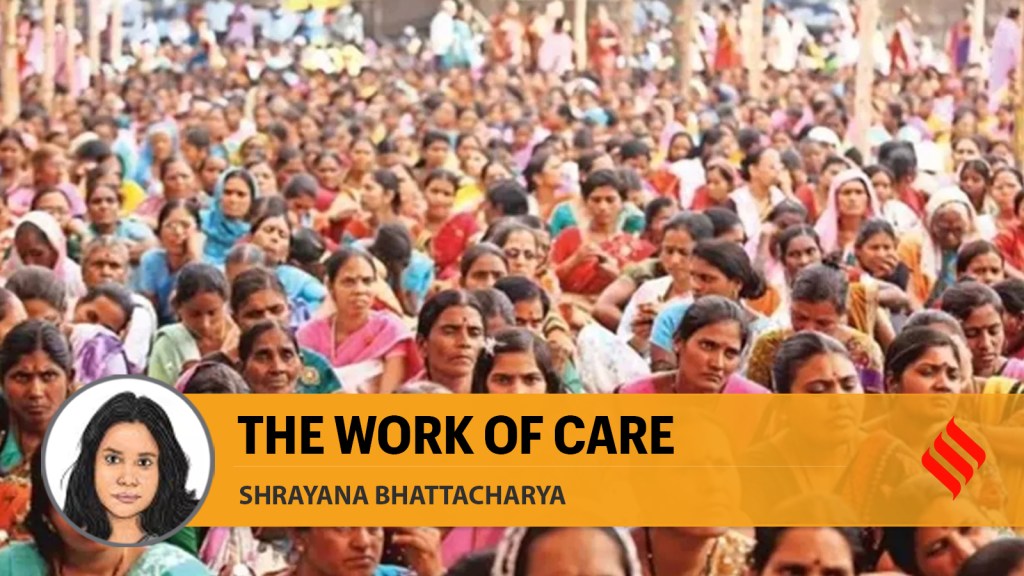
First, it would credibly reward those engaged in care work. UNFPA estimates suggest the demand for care is daunting — nearly 360 million children and 147 million elderly people require care in India. Overwhelmingly, it is women who respond to this demand, supplying 5.6 hours of unpaid work daily. Men supply 30 minutes. Women with paid jobs face the most acute time-poverty, performing six times more unpaid care labour than employed men. It is high time the tax brackets, wage rates and retirement ages of women were adequately reformed to compensate for this trade-off between care and career.
Government care workers on the frontlines (ASHAs, Anganwadi workers), home-based carers and domestic workers will always bear the burden of the health fallout of pollution or pandemics. Surely, they deserve victory in their continuing fight for social security packages and fair wages.
Second, an economy centred on fostering caring relations and capacities between people would be more creative in how individuals are cared for by public and private institutions. For most people, coupledom and traditional family structures are the path to secure caregiving. However, as many elder persons’ groups and activists highlight, the romanticised Indian family is hardly a sure-shot provider of emotional or economic support for an ageing society. Adequate social pensions for the elderly, stronger public infrastructure for childcare, subsidies and incentives for business or cooperatives providing care can go a long way.
Finally, no policy fix can truly help without a radical revolution in how we value the work of care as a society. This revolution is not about hollow sloganeering or tweets of appreciation. The great scholar of care, Nel Noddings, saw practical education and experience of caregiving as being central to the cultivation of caring in society. People who cared for another person through a specific series of routinised one-on-one encounters could also be persuaded to care about wider injustices and inequality in public life. She defined this “education” as “a constellation of encounters, both planned and unplanned, that promote growth through the acquisition of knowledge, skills, understanding and appreciation”.
Care is not a commodity; it is an interpersonal relationship that defies standard transactional economic frameworks of buying and selling. And as Diwali firecracker bans remind us each year, carrot-and-stick approaches are hardly sustainable or easy to implement at scale. Moreover, I don’t buy a worldview that thinks we are all small-spirited, where the threat of punishment is the dominant pathway to make us care about the public good. Each of us has the urge to care about and care for someone or something. Some of us, often women, are encouraged to nurture the caring instinct, while others, largely men, are not given the skills or social sanction to comfortably inhabit these roles. In my interviews with elite middle-aged men from all-boys boarding schools, their capabilities at fatherhood remained a chief lament. Most gained strong skills for being economic providers, but this was often coupled with a belief that boys derived self-worth, love and meaning largely from their ability to signal their place in the market of real estate, status or wealth. All their lives, they had been taught to care about competing. We need a different curriculum, especially for men — both at home and in educational institutions.
The famous last paragraph of the novel Middlemarch offers a tip for care-centred policies: “For the growing good of the world is partly dependent on unhistoric acts; and that things are not so ill with you and me as they might have been, is half owing to the number who lived faithfully a hidden life…”
If politicians and policy makers wish to incentivise more child births, if they want a productive and healthy workforce, if they want cleaner air, they will need to care about encouraging and rewarding our intrinsic instincts to perform such unhistoric, hidden acts of care. Beyond the economy propelled by consumption and costly penalties, there is one propelled by love, desire, care, concern and connection. Take the latter more seriously.
Bhattacharya is an economist and author. All views personal

 Economists estimate that the contribution of care ranges from 15 per cent to 17 per cent of the Indian GDP.


 Share


