5 min readMar 26, 2024 02:24 PM IST
First published on: Mar 25, 2024 at 08:12 AM IST
On March 20, 1927, B R Ambedkar led the famous Mahad Satyagraha to forcibly implement the 1923 resolution of the Bombay Legislative Council which stated that the Depressed Classes should be allowed to freely use public places. The resolution could not be implemented in Mahad due to opposition from upper-caste Hindus. In a radical act of defiance, Ambedkar, along with thousands of members of the Depressed Classes, drank water from the Chawder tank. This resulted in a violent response from the upper castes who argued that the tank had been defiled by the untouchables.
Almost a century later, on March 19, Zomato, a popular food delivery app, announced the introduction of a “pure vegetarian mode and a pure vegetarian fleet” for its vegetarian customers who want to order food from “pure vegetarian restaurants” and do not like their food to be contaminated with “spills” and “smells” of meat-based food. Zomato certainly did not imagine that its announcement would land so close to the anniversary of the Mahad Satyagraha, but history can be unforgiving. Hindu society has always attempted to brush caste out of sight and away from discerning noses.

But caste continues to remain embedded in the quotidian practices, as the Zomato incident demonstrates.
Ambedkar was a forceful proponent of inter-dining and inter-caste marriage as ways to annihilate caste. Eating together is a powerful act, especially when conducted across social identities. University messes, public programmes like school lunches, eating together in workplaces, use of public utilities like water taps and dispensers and occasional visits of politicians to Dalit households are the test cases for understanding social hierarchies and equality. Tragically, often in these instances, equality and dignity are compromised. The Zomato decision stands in line with this larger trend, veering towards segregation rather than the spirit of inter-dining. Where does this segregation find sanction from?
Caste fundamentally enforces norms of purity and pollution through distancing — a calibration of sensory engagement with the “other”. The touch, smells, sounds, taste and sights of the “other’s” body, food, language, clothes can potentially pollute those higher in the caste hierarchy. With Brahmanical sanction behind vegetarian food, meat becomes the stinky, distasteful other.
It is telling that Zomato’s vegetarian customers seem to be concerned not just about the spills from meat-based food which might touch their food during delivery, they are also concerned about the transference of the smells of meat. Smelling is not just a physical phenomenon involving the transfer of odorants from source to nose. Much like John Berger’s famous “ways of seeing”, and the different kinds of touch we educate children about, odours also carry meanings and significations.
The smell of meat denotes impurity and pollution in a caste-ordered society.
Odours are also notoriously hard to control, unlike sights, sounds and touch. They will linger in the delivery boxes, long after the meat-based food has been delivered. A physical barrier between the vegetarian and meat-based food will also not stop pollution through odours. The anxiety about smells, voiced by Zomato’s customers, thus exposes deep concerns about caste purity, much more than spillage. “Pure” vegetarianism, therefore, connotes an excess over vegetarianism – food which is not meat but more importantly, which has not been contaminated by the touch and smells of the “other”. Zomato’s dogged insistence on “pure” in multiple announcements reinforces the conclusion that caste is the trigger for the demand for a vegetarian mode and fleet.
However, the question of segregation does not end at separating food alone. The workforce delivering this food will also be segregated. Ambedkar had perceptively argued that caste is a system of graded hierarchy between labour and labourers. The Zomato case is a perfect illustration of this definition of caste. Due to widespread social media criticism, the company has rolled back the visual segregation of delivery persons into red and green uniforms – a decision which would have been truly disastrous in a society where food choices are routinely subjected to violent and discriminatory consequences – yet the actual segregation of workers persists. One is forced to ask, who will be eligible to deliver a “pure vegetarian” order? Whose touch and smell will be “pure” enough to not contaminate this food?
Assignment of workers based on their caste and religious identity — whether done through human or AI intervention — will not just be unethical but also unconstitutional. However, this demand is also not unheard of, not just in traditional labour contexts, but also in the neo-liberal gig economy. What is even more worrying is that no one within the company found this policy to be problematic, hinting at the lack of diversity in hiring and decision-making processes.
The Mahad Satyagraha is remembered as an iconic moment in the demand for a casteless society where basic human needs and dignity are met irrespective of the silos of identity. Years after Mahad and following social and political movements to mitigate and compensate for the ills of caste, the pitfalls of such a policy should have been obvious. Yet, the fact that Zomato could confidently roll out a discriminatory policy is reason for pause and contemplation.
The writer is associate professor, O P Jindal Global University. Views are personal

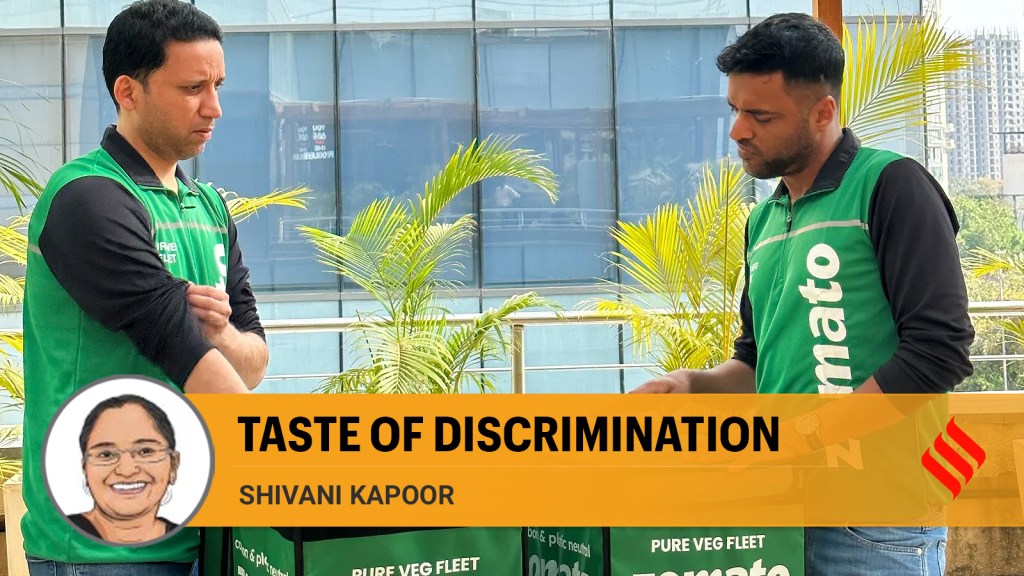 Zomato had recently launched a green uniform for its ’Pure Veg’ fleet, a move it scrapped a day later. (Photo: X/@deepigoyal)


 Share


