
Opinion In Tamil Nadu case, SC right to curb governors’ powers but went overboard with directions to president
The Court appears to be directing the president to act in a certain way. Could presidential defiance of such a directive mean that the SC could potentially haul up the president for contempt of court? The Court may have done well to refer matter to a larger bench
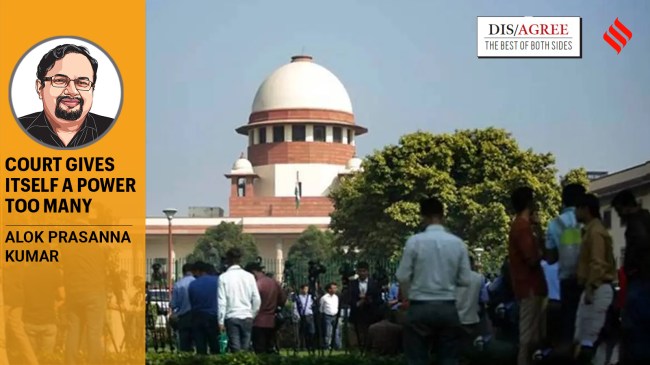 SC to hear on Apr 16 matter related to tree felling in Hyderabad's Kancha Gachibowli forest (Source: Express photo)



In trying to put an end to the unconstitutional shenanigans of Tamil Nadu Governor R N Ravi and his ilk, the Supreme Court of India in State of Tamil Nadu vs Governor of Tamil Nadu may have unwittingly created new and problematic constitutional issues.
The Court’s judgment on April 8 is unprecedented in at least three ways. First, it has laid down detailed guidelines for how a governor ought to act in refusing assent to a bill or referring it to the president, and given itself the power to issue a mandamus to the governor for failing to act.

Second, it has exercised its powers under Article 142 to hold that the bills the TN governor did not assent to have become law. Third, it has given itself the power to issue a mandamus to the president when a bill has been referred to the president by the governor.
Of these three unprecedented acts, the first two are welcome — they are the Court’s latest attempt to check the unconstitutional behaviour of a governor who behaved more like a colonial viceroy than a constitutional authority.
The circumstances in which the Tamil Nadu government was forced to bring this case were extraordinary. The governor simply refused to give assent to 12 bills lawfully passed by the state legislature. When pushed by the court in an earlier round of litigation, he referred two of the bills to the president for her assent and simply returned 10 to the state legislative assembly without giving assent. When the 10 bills were passed again in the Assembly, he referred all of them to the president for her assent raising various grounds of constitutionality.
One hopes the Court’s actions will send out a message to other governors as well and give relief to future state governments. However, the Court giving itself the power to issue a mandamus to the president does raise some disturbing questions.
The power to issue a writ of mandamus has its origins in the power of the British monarch to direct the performance of a legal duty. Courts exercised this power to get officials to carry out their duties when no other legal remedy was available to the person aggrieved. In India, while courts have used it for a range of purposes, this is perhaps the first time that the Court has given itself the power to do so in the context of the president.
The President of India is no ordinary public official. She is the head of state and is in most ways like the British monarch. The Government of India is carried out in her name, and she is a symbol of constitutional rule in India. Like the British monarch, she is supposed to act only on the “aid and advice” of the prime minister and the Council of Ministers. As such, she has less discretion than the average district magistrate in the country.
A mandamus to the president would subtly change the constitutional position that the president acts only on the aid and advice of the prime minister and the cabinet. It would mean that in certain circumstances, the president also acts on the order of the Court. This raises a discomfiting question: Can the Court direct the president to ignore the aid and advice of the PM and the cabinet?
A reading of the judgment suggests that this is not necessarily the case. The Court is only directing the president to act, not to act in a certain way. Even then, when no aid and advice is forthcoming, the court is creating a new constitutional scheme for the president. Could presidential defiance of such a directive mean that the SC could potentially haul up the president for contempt of court? A difficult question, especially since the president cannot be made personally liable in court for her actions.
This new constitutional position is worrisome. More so when it has come from a two-judge bench of the Court instead of a larger Constitution Bench as a case of this importance merited. While no one doubts that the Court was anxious to curb the governor’s discretion in some way, one could argue that it has gone overboard in restricting the president’s as well. The “pocket veto” of a president has not always been used for malicious purposes — Giani Zail Singh used it to push back against the Rajiv Gandhi government’s controversial postal bills.
And yet, one cannot find fault with the court for acting to respond to a breakdown in constitutional order. It is not just governors’ intransigence that the court has had to deal with. Another bench of the SC is considering petitions seeking a direction to the Telangana speaker to decide disqualification petitions in time without rendering the anti-defection law moot.
In such circumstances, it is difficult to be harsh on the SC for going overboard. It is responding to a general, wider disregard of constitutional norms for partisan considerations. An SC that simply throws up its hands in helplessness is far less preferable in such situations.
The court is aware of the unprecedented nature of its judgment in this case. One gets a sense of this from the judgment’s quotation of B R Ambedkar’s famous last speech in the Constituent Assembly, where he pointed out that no matter how good a constitution, its success or failure depends on whether those who are called to work it are good or bad.
In 2025, one can say that the threat to the Constitution comes not from attempts to amend it, but from attempts to render it irrelevant.
The writer is a co-founder of the Vidhi Centre for Legal Policy. Views are personal

 Share
Share


