5 min readNov 14, 2024 12:52 PM IST
First published on: Nov 14, 2024 at 04:20 AM IST
The Indian Express (‘SC affirms minority rights, sets aside its verdict that rejected AMU status’, November 9) succinctly outlined the two tests that the Supreme Court applied while overturning its 1967 ruling that denied Aligarh Muslim University (AMU) the status of a minority institution. They were: “What’s the institution’s origin? Purpose? Is there a minority role in its setting up? Does its administration affirm minority character and serve minority interests?” In short, the apex court wanted to uphold the purpose for which AMU was created.
Syed Ahmad Khan, the inspiration behind AMU, belonged to a feudal Muslim family, joined the East India Company in 1838 and retired in 1876. During the First War of Independence in 1857, he was loyal to the British and earned their trust. In 1869, Khan visited England where he was awarded the “Order of the Star of India.” In 1887, he was nominated by Lord Dufferin to the Civil Services Commission. The following year, he founded the United Patriotic Association at Aligarh to promote political cooperation with the British and secure Muslim participation in the British government. For his unwavering loyalty, Khan was honoured with the “Khan Bahadur” title and was knighted by the British government in 1888. He was also awarded the “Knight Commander of the Order of the Star of India” (KCSI).

Khan displayed remarkable flexibility in his rhetoric. However, his core agenda was to deepen the divide between Hindus and Muslims while strengthening the bond between his fellow Muslims and the British rulers. In this context, Khan’s speech delivered in Meerut on March 16, 1888, is significant. Here are some excerpts:
“Now, suppose that the English community and the army were to leave India … who then would be the rulers of India? Is it possible that under these circumstances, two nations — the Mohammedans and the Hindus — could sit on the same throne and remain equal in power? Most certainly not. It is necessary that one of them should conquer the other…
“God has said that no people of other religions can be friends of the Mohammedans except the Christians… Therefore, we should cultivate a friendship with them and adopt the method by which their rule may remain permanent and firm in India and may not pass into the hands of the Bengalis.” Khan expressed his disdain for Congress leaders by dismissively referring to them as “Bengalis”.
During the last 13 years of his life, Khan established educational institutions for Muslims, including Madrasatul Uloom Musalmanan-e-Hind and Muhammadan Anglo-Oriental College. These institutions eventually evolved into AMU, 22 years later, after his demise in 1898.
Has AMU lived up to Khan’s expectations? In January 1941, the Students’ Union resolved that “the best way to achieve India’s freedom and to bring about lasting peace in the country is to strive for the establishment of independent states in the regions of Hindu and Muslim majorities.” On March 10, 1941, Muhammad Ali Jinnah described AMU as the “arsenal” of Pakistan. “Aligarh is the arsenal of Muslim India (Pakistan), and you are its best soldiers”, he told the students of the University. Muslims, who opposed the demand of the Muslim League for Pakistan, were vilified by AMU students. In 1941-42, Maulana Azad was attacked while passing through Aligarh on a railway train by the AMU students.
F A A Rehmaney, the biographer of Fakhruddin Ali Ahmed (fifth president of India), has this to say about Aligarh’s role in Partition, “…from 1940 and onwards, the Muslim League made this University a convenient and useful media for the spread of its political ideology, of sowing the seeds of the venomous two-nation theory… teams of students and teachers of the University spread all over the country explaining the virtues and aims to the Muslims in case Pakistan was formed…”
Before Independence, then, there was an undeniable severance between India’s national aspirations and AMU’s agenda.
After August 1947, a newly independent India aimed to empower marginalised sections of society that had faced historical injustices. As part of affirmative action, the Constituent Assembly introduced reservation for Scheduled Castes (SCs) and Scheduled Tribes (STs). However, AMU has consistently refused to extend reservation to the targeted sections.
The core issue is whether institutions funded by independent India should continue to promote the “purpose” for which they were set up by colonialists or be realigned with the aspirations of a new inclusive India. The Supreme Court has missed this vital issue while adjudicating this case. Its split verdict seeks to turn the clock back.
The writer is former chairman of the Indian Institute of Mass Communication

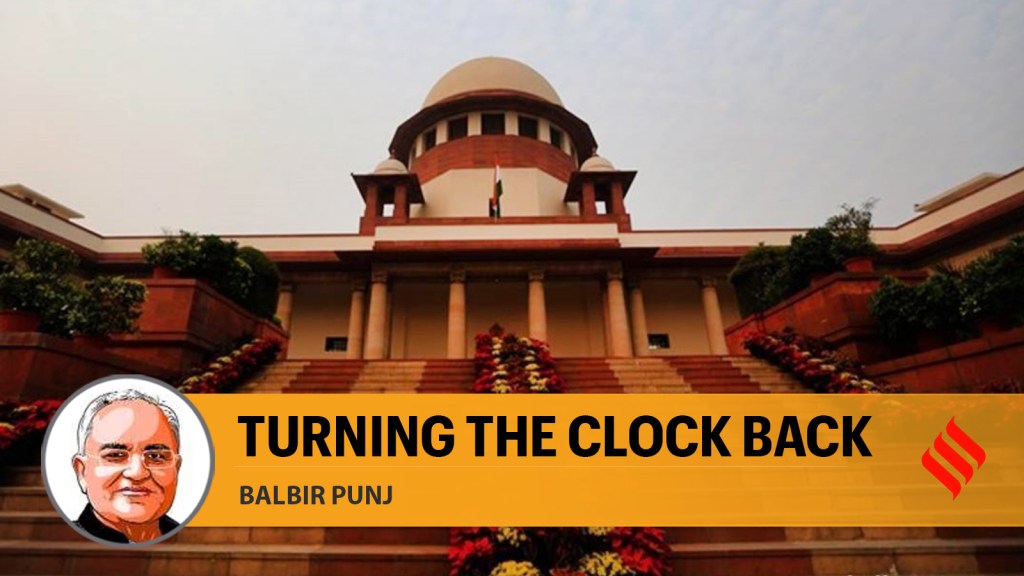 The Supreme Court has missed this vital issue while adjudicating this case. Its split verdict seeks to turn the clock back.


 Share


