
SC vs Government: For judiciary to remain independent, appointments of judges should be left to SC collegium
Sriram Panchu writes: Leaving the dominant power in appointment of judges to the executive could leave India without an independent judiciary. But judiciary should address concerns regarding opacity of the collegium.
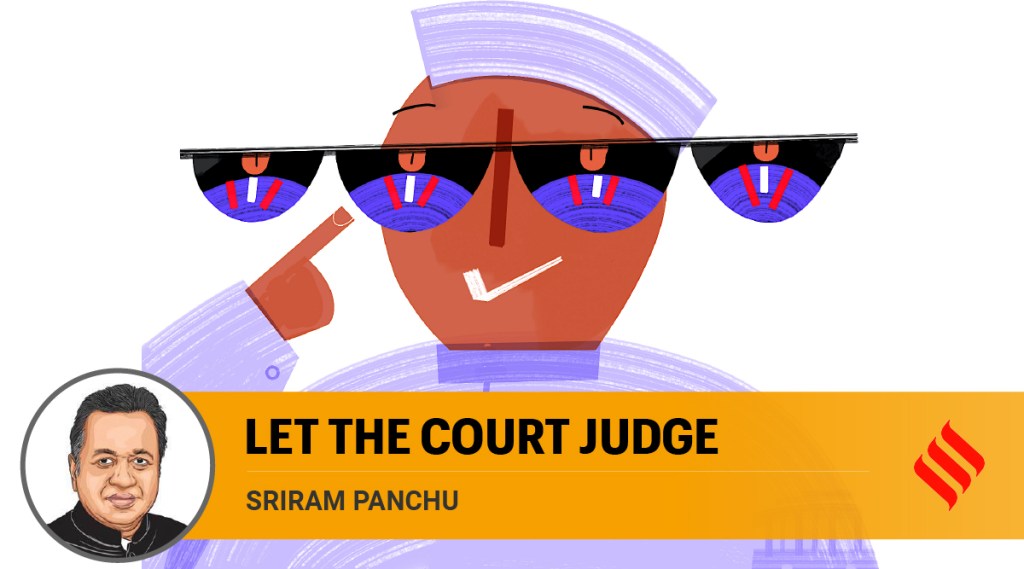 If one employs a limited vision, and a black-and-white filter to thought, the straight answer to the straight question is that the collegium is not a creature sanctioned by the Constitution. (Illustration: C R Sasikumar)
The Supreme Court’s collegium does not fade easily from the news. First came the Union law minister’s outburst during the Constitution Day celebrations. In response to criticism that the government was sitting on the proposals of the collegium, he reportedly asked what then prevents the Court from going ahead and making the appointments. This was more petulance than good sense, since the Memorandum of Procedure giving effect to the collegium system requires the government to respond to the collegium’s recommendations. He was firmly put in place by Justice S K Kaul who promptly read him the riot act. More surprising was the outburst of Vice President Jagdeep Dhankhar, a lawyer by training, who took exception to the Court striking down the National Judicial Commission Act as though it was outside the Court’s powers. He was offside there; it is very much within the domain of the Court to strike down provisions of an enactment or the Act as a whole if it offends the basic structure of the Constitution, the superior document. It is, of course, open to Parliament to think of another method to select judges, but till that is done and passes constitutional scrutiny, the present system holds the field and no amount of political muttering is going to change that.
If one employs a limited vision, and a black-and-white filter to thought, the straight answer to the straight question is that the collegium is not a creature sanctioned by the Constitution, and it has upset the method envisaged by the founding fathers to select judges, which was that the President would consult the Chief Justice of the Supreme Court and other judges before making the appointment. For many years since the inception of the Constitution that worked well enough, with the President largely going by what the CJI and his colleagues thought fit. Indira Gandhi rudely upset that balance in 1973 by superseding Justices Shelat, Grover and Hegde to pitchfork A N Ray into the top seat on the heels of the Kesavananda Bharati judgment, which curbed Parliament’s power to amend the Constitution. Her legal assaults on the document and the institution shattered the faith between the judiciary and the executive that must be the fulcrum of constitutional functioning, and it has never recovered since. When nine judges, including J S Verma and Kuldip Singh, authored the Second Judges case judgment in 1993 holding that consultation should be read as concurrence and, therefore, giving the last word to the Chief Justice, they were hearkening to more subtle notes of constitutional music, and picturing a landscape of myriad colours of complexity. Basically, the major premise in their judgments, unmistakably running through lengthy paragraphs, was that leaving the dominant power to the executive would leave India without an independent judiciary. It is an argument not lacking in appeal.

 Share


