In the last couple of weeks, many Indian liberals have turned their ire inward, accusing those of us who have not condemned the government’s silence on the US-Israeli war against Iran of moral cowardice. In the American phrase, it has become a “circular firing squad” — shooting on ourselves. They want us all to demand that India should have taken the moral high ground, denouncing the war as a flagrant violation of international law.
Let me state clearly: I concur that the war cannot be justified under international law. It violates the very principles India has historically stood for — respect for sovereignty, non-aggression, and peaceful resolution of disputes. Nor, as I have explained earlier, is there a case for pre-emptive self-defence either. And yes, we should have promptly issued condolences on the death of the Supreme Leader of Iran, as we had done when its president was killed in a helicopter crash. I am free to say so, and so are my liberal friends in the Opposition or the commentariat. But I will not condemn the government for choosing silence over confrontation.

India’s diplomacy has always been about balancing principle with pragmatism. Jawaharlal Nehru’s policy of non-alignment was not a refusal to take moral positions, but a recognition that India’s sovereignty and survival depended on avoiding entanglement in Cold War hostilities. Today, in an increasingly multipolar world, India practises “multi-alignment” — engaging with diverse powers, sometimes in tension with one another, while keeping our national interest paramount.
The objective has remained constant: Protect India’s sovereignty while speaking for global justice. No one holds a monopoly over patriotism, nor over the interpretation of the values taught by Gandhi or Nehru. The true tribute to their legacy lies in applying their values wisely to the realities of our time, not in self-gratifying denunciations that could jeopardise our interests.
Critics forget that India has often chosen silence when principles collided with national interest. We were reluctant to condemn the Soviet Union’s flagrant violations of international law in Hungary (1956), Czechoslovakia (1968), and Afghanistan (1979). Why? Because we rightly judged that we had too much at stake in our relationship with Moscow to antagonise it with a moralistic stand. The Soviet Union was our principal arms supplier, a crucial diplomatic partner, and a counterweight to Western hostility.
That silence did not mean we endorsed Soviet aggression. It meant we understood the costs of confrontation and chose prudence over posturing. Today, the same logic applies to our stand on the Russian invasion of Ukraine and the Israeli-American assault on Iran.
India has far too much at stake, not only in the US, but in the Gulf Arab states currently facing Iranian missile and drone attacks. Nearly $200 billion in annual trade flows through this region. Our energy security depends on Gulf oil and gas. And the well-being of some 9 million Indian workers and residents in the Gulf is directly tied to regional stability.
To indulge in sanctimonious moralising by condemning the US-Israeli war on Iran would risk destabilising these relationships. It would jeopardise remittances that sustain millions of Indian households, energy supplies that fuel our economy, and trade ties that underpin our growth. Silence, in this context, is not cowardice. It is a sober recognition of the interconnectedness of our national interests with the realities of the region.
We must also acknowledge the nature of the government in Washington. Today’s United States does not prioritise international law in the way we might wish. President Donald Trump is often willing to lash out at those who obstruct his objectives. While the war violates tenets we stand for, jeopardising the many other strategic interests we have with the US would be unwise.
Our defence cooperation, technology partnerships, and shared concerns about China’s rise all depend on a stable relationship with Washington. To antagonise the US with a moralistic denunciation of its war would risk undermining these vital interests. Loud lecturing combines poorly with low leverage. Foreign policy is, above all, about the protection of sovereignty, the pursuit of prosperity, and the preservation of peace. Our interests are not served by indulging in the gratification of grandstanding— unless we are confident that we can comfortably withstand the consequences. And today, we cannot.
To acknowledge reality is not to kowtow to anyone. India has often spoken for global justice in multilateral forums. But we have also known when to hold our tongue. That balance is the essence of responsible statecraft.
Silence, in the absence of leverage, can be a strategy. It allows us to preserve our interests while keeping open the possibility of quiet diplomacy. It avoids unnecessary confrontation while preserving the channels of communication with both sides that might permit constructive action in favour of peace.
Indian liberals who demand condemnation of the war mistake moral absolutism for moral courage. They forget that foreign policy is not an academic seminar. It is the arena where principles meet power, and where choices have consequences for millions of lives. To insist on denunciation without regard for consequences is to indulge in the luxury of rhetoric at the expense of responsibility.
Yes, Gandhi taught us the power of moral witness. Yes, Nehru spoke of international law as the foundation of peace. But both also understood the imperatives of national interest. Their legacy is not one of rigid dogma, but of wise adaptation.
The war on Iran is unjustifiable under international law. India’s silence is not an endorsement of that war. It is a recognition that our national interest requires prudence, not posturing. If I were advising any Indian government, therefore, I too would counsel restraint. Restraint is strength: The strength to balance principle with pragmatism, to honour our values while safeguarding our interests, and to navigate a dangerous world with wisdom rather than bravado.
For a government to recognise geopolitical realities and weigh consequences for India’s economy and strategic position before taking a public stand is not “moral surrender”. It is responsible statecraft.
The writer is Member of Parliament for Thiruvananthapuram, Lok Sabha, and chairman, Parliamentary Standing Committee on External Affairs

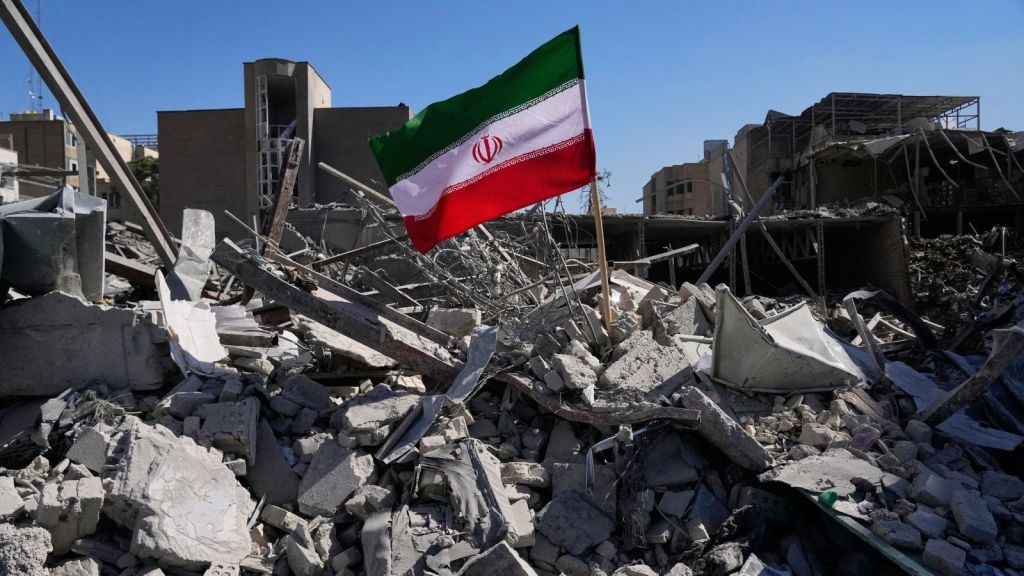 An Iranian flag is placed among the ruins of a police station struck during the U.S.–Israeli military campaign in Tehran, Iran. (AP Photo/File)


 Share


