Justice D Y Chandrachud’s reported comment that the law on sedition needs to be looked at, especially in the context of increasing incarcerations of mediapersons under this law, is both welcome and troubling.
It is welcome because this is the first time in recent memory, to the best of my knowledge, that a sitting judge of the Supreme Court has publicly “questioned” this questionable law. It is troubling because of two things: One, His Lordship wishes to deal with a limited aspect of this law — concerned with its misuse against the media — and two, because such a course ignores the history of the law in India where, in spite of repeated categorical clarifications by the Supreme Court and continuous reading down of the law, police officers, politicians and all lower courts continue to incarcerate people under it.

Higher courts may read down laws but a police officer is more concerned with the law as it exists on the book.
Section 124A of the Indian Penal Code, or the sedition law, is the illegitimate child of two fathers — one is monarchy and the other a fixation with “order”. Monarchies rule not by consent of the population but in spite of it. A monarch lives in perpetual fear of an overthrow — hence the desire to quash dissent by not permitting it to be even uttered. Democracies, on the other hand, are creatures of confusion, complexity and difference. Democracies thrive on chaos but an authoritarian mind seeks control, and the overarching quest for order is primarily anti-democratic. The fixation with order is, therefore, primarily an intolerance of difference — of opposing points of view, of dissent.
It ought to follow, therefore, that sedition should have no place in democracies which thrive on criticism of an existing government. It ought to have no place in societies that recognise that states of existence are temporary, that truth is not one-dimensional, that versions are merely interpretations.
And so, not just mediapersons, but writers and thinkers, artists and poets, cartoonists and naysayers, protesters desperate to be heard, activists hoping for a better world, and the millions who are voiceless, who would but cannot speak, either out of fear or poverty must be protected from this regressive law.
In June, the Supreme Court quashed sedition charges against mediaperson Vinod Dua. However, more than six months ago, a journalist from Kerala, Siddique Kappan, was charged with sedition (among other things) by the UP police. Vinod Dua is high profile, unlike Kappan, so calling him “media” and releasing him is easier to do. Dua was never arrested while Kappan has not yet been granted bail. The UP police can easily circumvent the Supreme Court’s newly-found sensitivity about sedition by saying he was not a journalist at all — as will smaller courts with the tens of thousands of activist journalists who have been incarcerated under sedition for years now.
A decade ago, Binayak Sen was convicted of sedition and imprisoned. His case clearly did not meet the requirement of the Supreme Court’s reading down in Kedar Nath Singh vs State of Bihar. Yet, neither the district nor the High Court thought it prudent to grant him bail, pending the hearing of his appeal in the Chhattisgarh High Court. Thankfully, the Supreme Court granted him bail.
Sedition was retained in Kedar Nath, citing, “This species of offence against the State was not an invention of the British Government in India, but has been known in England for centuries. Every State, whatever its form of Government, has to be armed with the power to punish those who, by their conduct, jeopardise the safety and stability of the State, or disseminate such feelings of disloyalty as have the tendency to lead to the disruption of the State or to public disorder.”
But things have changed. The UK has done away with sedition as has the US and most of the world. In 1962, India was a newly independent state and was paranoid about fissiparous tendencies. Today, it is armed with a spate of laws that can deal with the issues that the sedition law was supposed to deal with. Why then continue with a law which requires reading intent into words? Why be more concerned with words instead of actions?
For half a century after independence, our highest court fought against authoritarian tendencies in the state, successfully, except for a brief period. The past decade has seen a clear reversal of this and the protector of the people has turned increasingly statist. Justice Chandrachud’s remarks can be read two ways — it can be seen as heralding a new era of faith in institutions, desperately needed right now, or it can be seen as a harbinger of a more subtle but final nail in the coffin of individual rights.
This column first appeared in the print edition on July 10, 2021 under the title ‘How to fix arbitration slump’. The writer is a Delhi-based filmmaker.

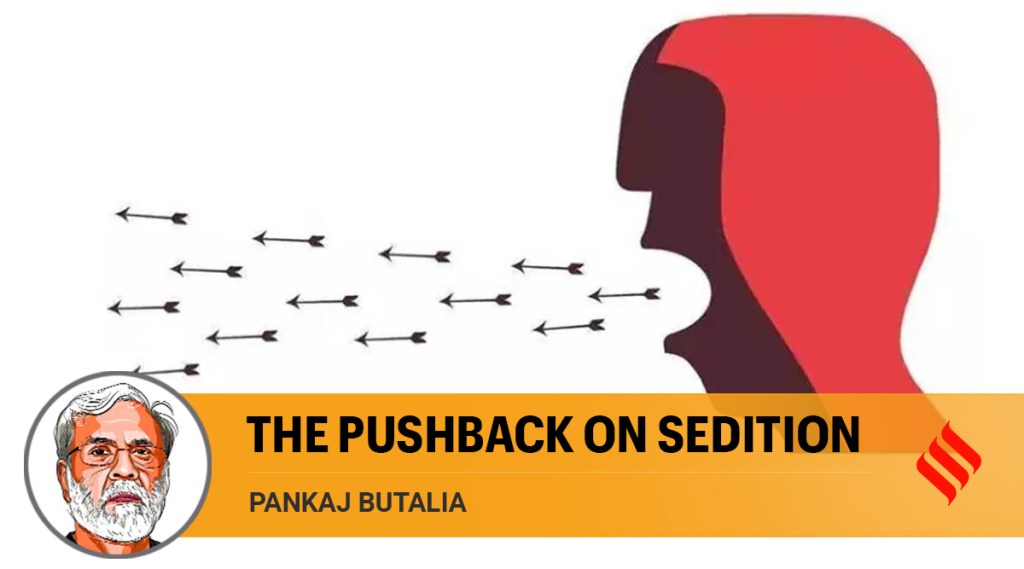 Section 124A of the Indian Penal Code, or the sedition law, is the illegitimate child of two fathers — one is monarchy and the other a fixation with “order”. Monarchies rule not by consent of the population but in spite of it.



 Share


