When he wrote “I will bring my time” in a love letter to Janine Mongillat, a French artist who became his life-companion in 1959, Sayed Haider Raza was not making an aesthetic boast but a gentle assertion. He had been in Paris for about a decade, a young struggling artist who eventually remained there for six decades, the longest that any Indian artist has lived and painted in France. Raza did not change his nationality and retained his Indian passport till the end. He returned to New Delhi for good towards the end of 2010 and died on July 23, 2016. He was buried, as he wanted, in Mandla next to his father’s grave, close to the river Narmada, which he always mentioned with deep regard as Narmadaji.
Having experienced beauty and fear in the thick jungles of Mandla, the two became his life-long concerns. Fear was superseded as he pursued beauty through his art. He attained a rare but vitally creative fusion, of French la sens plastique and Indian metaphysical concepts such as bindu, prakriti, kundalini, ankuran, etc. He used to say that he learnt how to paint from France and what to paint from India. Raza searched for a visual language in painting, which could enact his celebration and affirmation of life and reveal sensuously the vibrant colours and dynamic form of his spiritual reality. Living in the West for nearly six decades, Raza explored in his iconic work an alternative modernity of consonance, celebratory and cerebral, of affirmation and silence, of germination and rejuvenation, of the fusion of the sensuous and the spiritual.

Raza’s early French-period works were largely cityscapes and he later painted “inscapes”. He termed his art as “roop adhyatam” — spiritual form — underlining that for art beauty is both physical and metaphysical simultaneously. There are no visible traces of the post World War II history in his painting though he was in France then. Once, I told him that he was more concerned with eternity rather than history. He joyously agreed.
For a couple of decades, life was not easy for Raza in France. He was accepted as a painter of the Parisian School which gave him some recognition but it made him unhappy about his artistic identity. It is then that he, through a lot of agonising self-questioning, recalled the “bindu”, which a rural primary school teacher had told him, a boy with a way-ward mind, to concentrate on. Bindu as a source of energy, a point of entry and exit, and a still centre, became the central image for Raza.
In the 1980s, Raza’s love for poetry became an element in his paintings. He is perhaps the only modern artist in India, maybe the world, who has inscribed in nearly a hundred canvases lines and words of Sanskrit, Hindi and Urdu poetry. Also, most of his canvases from the 1980s have titles in Hindi. The poets he drew from included the creators of the Upanishads, Kabir, Tulsi, Sur, Mahadevi Verma, Agyeya, Muktibodh, Faiz and Sahir Ludhianvi. Even though his gaze was fixed on eternity, history seeped in through these poems, a reinvention of some miniature painting conventions. His paintings can be gainfully read as love letters to the world, as prayers for grace. While there are works which express agitation and fury, largely Raza chose peace, tranquillity, resonance and silence as the leading motifs or emotions his art would evoke.
Widely acknowledged as a master colourist, Raza realised during his numerous visits to India from France, “that colour was the essence of my work. I wanted to create a musical harmony in colour: Colour as density, as expression, as a state of emotion, as sentiments, as time”. In his Itinèraire (itinerary) he concludes: “But whether it is literature, music, painting, one always comes back to life, to the daily life in the most ordinary things, and it is ultimately always nature which is the culmination point.”
A half-done canvas is still on the easel as he left it in early 2016, before he fell terminally ill, in his Delhi studio which the Raza Foundation has kept it as it was, naming it The Last Studio.
He also asserted, “I have no apology for my repetition of the form of the Bindu. With repetition, you can gain energy and intensity as is gained through Japmala, or the repetition of a word or a syllable until you achieve a state of elevated
consciousness.”
Recalling his days of youth, both in Bombay and Paris, he wanted to be of some support and assistance to the young artists, poets, musicians and dancers of India. The Raza Foundation was set up as a charitable trust and is today perhaps the largest trust set up by an Indian artist. It has been organising art shows, talks, lectures, concerts, recitals and publications, largely featuring the younger generation.
Raza spoke and wrote in Hindi, English and French. A Muslim, he visited mosques, temples and churches regularly. With F N Souza and M F Husain, he established the Progressive Artists Group in 1947. Raza remained in touch with most of his Progressive friends including Ram Kumar, Akbar Padamsee, Tyeb Mehta, Bal Chhabra, Gaitonde, Husain, Krishen Khanna, etc and the Raza Archives contain more than 20,000 letters. Raza’s birth centenary year will begin from February 22, 2021, and the Raza Foundation will also celebrate Raza’s close artist-friends suitably. A major show of Raza is being planned in Paris in 2021.
Raza was full of love and lure of the world, especially nature but he also enacted his gratitude to the world and civilisation he belonged to. He was a grateful heir to the plurality, richness and depth of Indian civilisation.
In 2002 when Raza turned 85, I concluded a poem, Raza’s Time, with the following words: In the soul’s heat/desires still exist despite turning to ashes/words still exist despite being used up in paintings-/the heart’s call still exists despite having vanished in prayer-/we consecrate with what is left/with what will persist beyond time/despite attempts of death-/with hands wounded by time/we consecrate/him who is outside of time.
This article first appeared in the print edition on July 24 under the title “Raza’s time.” Vajpeyi is a Hindi poet and critic.

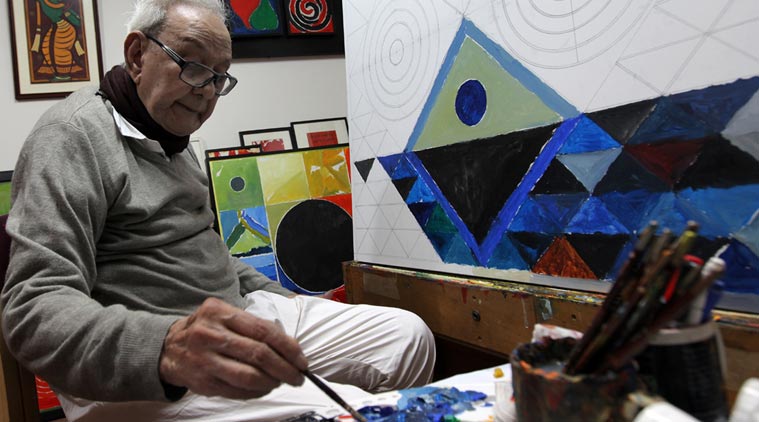 Raza’s early French-period works were largely cityscapes and he later painted “inscapes”. (Express photo: Ravi Kanojia/ File)


 Share


