World War II ended in the summer of 1945, which was also when India’s leaders, imprisoned from 1942 for their Quit India call, were released. Less than two years thereafter, on February 21, 1947, Premier Attlee announced in London that power would be transferred from British to Indian hands. He added that Mountbatten would replace Wavell as viceroy in India and work out the details of Britain’s departure.
On June 2, 1947, Congress leaders Nehru, Sardar Patel and president Kripalani, Muslim League leaders Jinnah (president), Liaqat and Nishtar, and Akali representative Baldev Singh gave their assent to Mountbatten’s plan for independence and partition. On June 3, this plan was publicly announced. On June 14, the AICC ratified what had been signed by Kripalani and agreed to by Nehru and Patel. On July 18, King George VI signed the Indian Independence Act, which embodied the plan’s far-reaching features.

Following this Act, power descended to two Constituent Assemblies already activated by this time, one for an area comprising today’s Pakistan and Bangladesh, the other for post-Partition India. Princely states were given the option to join either area.
All this is well-known, but some currently popular notions about what was agreed upon in 1947, and about who accepted or opposed Partition, need demolition. The claim that the two-nation theory was accepted in 1947 is entirely incorrect. It is true that the Hindu Mahasabha from 1937, and the Muslim League from 1940, had held that Hindus and Muslims were two different nations, but the rest of India didn’t go along with that theory, and the 1947 agreement scrupulously refrained from endorsing it.
The division agreed upon in 1947 was of areas, not of communities. The Independence Act did not say that two nations, one Hindu and the other Muslim, were being created. Neither the June 3 Plan nor the Independence Act even mentioned “Hindus” or “Muslims”. The separating Pakistan area no doubt had an overwhelming Muslim majority, the area that remained India had an overwhelming Hindu majority, and from 1940 to 1947 the Muslim League had indeed campaigned for Pakistan as “a Muslim homeland”.
Nonetheless, the free India that Nehru greeted at that mid-August midnight with his Tryst with Destiny speech was an India for all, not a Hindu India. Even the Pakistan that Jinnah hailed in his speech of August 11, 1947, was not an Islamic Pakistan. And although Pakistan quickly began its “religious” journey, the Indian Constitution, finalised by 1949, underlined the equality of all Indians of every religion or none. In free India’s first general elections, held in early 1952, political outfits asking for a Hindu state were resoundingly defeated. In short, in 1947, an overwhelmingly Hindu India had successfully launched a secular and pluralist state.
False, too, is the current chatter that Gandhi and Nehru agreed to Partition in the teeth of Patel’s opposition, because, so goes the chatter, the former was “pro-Muslim” and the latter vulnerable to “the charms of Lord and Lady Mountbatten”.
The story of Patel’s shift from opposing Partition to enthusiastic acceptance has been told in more than one account, including in my large 1990 biography of the Sardar. There is solid evidence that by December of 1946 — nine months before the 1947 Partition — Patel had swung round in favour of separating Pakistan. In his view, separation would enable the vast India that remained to have a strong central government; it would also remove the League’s capacity to obstruct.
On March 8, 1947, following violence against Sikhs and Hindus in western Punjab, the Congress Working Committee passed a resolution (with Kripalani in the chair) urging the division of Punjab into two halves, a West Punjab where Muslims predominated, and an East Punjab where Hindus and Sikhs outnumbered Muslims. This was the first public signal that the Congress was willing to accept Pakistan if Muslim-minority areas demanded for Pakistan by the Muslim League, namely East Punjab, West Bengal and Assam, remained in India. This signal was offered before the Mountbattens arrived in India.
Opposed to Partition, Gandhi, who was in Bihar at this time, asked both Patel and Nehru for an explanation. Patel replied (March 24): “It is difficult to explain to you the resolution about the Punjab. It was adopted after the deepest deliberation… Nothing has been done in a hurry or without full thought.” Nehru wrote back (March 25): “Indeed this is the only answer to partition as demanded by Jinnah. I found people in the Punjab agreeable to this proposal except Muslims as a rule.”
To preserve a united India, Gandhi then responded by proposing a Jinnah premiership backed by the Congress majority in the central legislature. Except for Khan Abdul Ghaffar Khan, no Congress leader supported the idea, and Gandhi didn’t pursue it.
An Indian today has every right to say that Gandhi, Patel, Nehru and everyone else who accepted Partition or acquiesced in it, including, it would appear, a great majority of Indians at the time, were mistaken. However, no one has the right to whisper, WhatsApp or tweet that Gandhi and/or Nehru overrode a Patel opposed to Partition. That suggestion is an out-and-out falsehood.
Rewriting history might (or might not) influence today’s politics. It cannot change what happened yesterday. And a question survives: Do we today want all of Pakistan and all of Bangladesh, the areas and their populations, to be rejoined to India?
This column first appeared in the print edition on October 30, 2021 under the title ‘Why Sardar Patel supported Partition’. The writer is a research professor at the Centre for South Asian and Middle Eastern Studies, the University of Illinois at Urbana Champaign and the author of Patel: A Life. Patel’s birth anniversary falls on October 31.

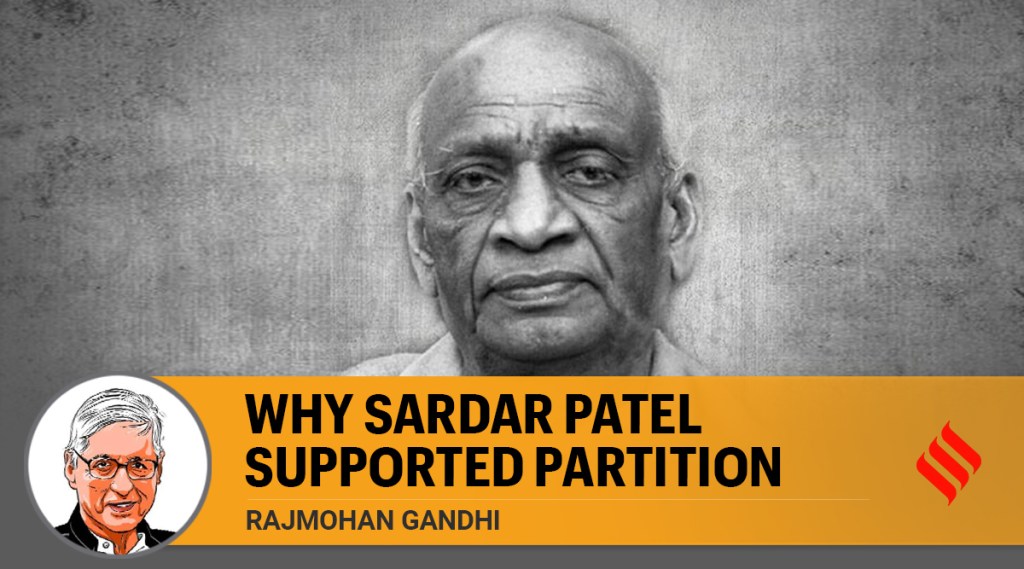 Sardar Vallabhbhai Patel



 Share


