5 min readNov 24, 2021 07:15 AM IST
First published on: Nov 23, 2021 at 04:10 AM IST
The Covid-19 pandemic has tested our patience and resilience. The frontline workers have laboured with unrelenting grit in the face of obvious health hazards. Many of them, especially the sanitation workers, had to face greater risks, in addition to challenges they routinely face. The pandemic should lead to urgency in addressing issues related to their safety and welfare.
Sanitation work in the country is inextricably tied with caste-based occupational roles. The bulk of such work is done by people from Scheduled Caste communities, and Scheduled Tribes in some areas. Sanitation workers have, for long, been subjected to discrimination, stigma, and, even, untouchability for years. The most stigmatised among them are those engaged in the manual cleaning of sewers, septic tanks, pits and drains. Despite the Prohibition of Employment of Manual Scavengers Act, 2013, the practice continues unabated. Although local government bodies do not directly engage manual scavengers, the practice continues because sanitation work is subcontracted to private businesses and informal labourers. The Sixth Economic Census, 2013 reported “that from the roughly 1.7 lakh recorded businesses under the broad activity of water supply, sewerage, waste management and remediation activities, 82 per cent of the businesses are in the private sector”.

The demand for sanitation work, which had already been growing due to urbanisation, has witnessed a steep increase following the successful construction of toilets in the first phase of the Swachh Bharat Mission. The flagship programme has led to the construction of toilets with on-site sanitation systems such as septic tanks and pits in both urban, peri-urban and rural areas. There has been an emphasis on larger sanitation infrastructure such as sewerage networks, sewerage treatment plants and faecal sludge treatment plants through the Atal Mission for Rejuvenation and Urban Transformation. However, with the focus largely on 500 cities out of the 4,041 statutory towns in India and because of inadequate sewerage network and treatment plants, the safe treatment and disposal of waste lags behind toilet construction. Much of the demand for desludging and other sanitation services is met through private vacuum truck operators who are known to flout the ban on manual scavenging and violate safety standards. The Manual Scavenging Survey, conducted by the Ministry of Social Justice and Empowerment, counted 66,692 scavengers till October 2020. However, given the extent of informality in the sector, it is challenging to arrive at an accurate estimate of the number of manual scavengers and sanitation workers.
The latest National Sample Survey data, 2019, shows that more than 65 per cent households in the country have toilets with septic tanks and pits. The corresponding estimated figures for villages and cities with less than 1 million population were nearly 73 and 68 per cent respectively. These figures underscore the need to augment the sanitation value chain, particularly in terms of mechanised cleaning and treatment of waste. The extension of the Swachh Bharat Mission (Gramin and Urban) and Atal Mission for Rejuvenation and Urban Transformation to their second phases, entailing the prioritisation of safe treatment and disposal of waste, along with building sanitary toilets, is, therefore, salient. Such efforts should be complemented with welfare measures for sanitation workers.
The Ministry of Social Justice and Empowerment has been taking measures for the rehabilitation of sanitation workers under its revised Self-Employment Scheme for Rehabilitation of Manual Scavengers. The scheme provides one-time cash assistance, loans at concessional rates, subsidy and skill development training.
The National Safai Karamcharis Finance and Development Corporation is building capacities at the local government level, equipping these government agencies with mechanised desludging trucks and providing financial assistance to sanitation workers, manual scavengers and their dependents.
The proposed National Action for Mechanised Sanitation Ecosystem plans to set up units at the district and local government levels to monitor sanitation services, including the activities of private sanitation service organisations. Mechanisation of sanitation will be synchronised with decentralised monitoring of violations of sanitation protocols and informal education campaigns. These schemes could pave the way for eradicating manual scavenging and ensuring welfare of all sanitation workers.
This column first appeared in the print edition on November 23, 2021 under the title ‘A question of dignity’. The author is Monitoring and Evaluation Lead at Development Monitoring and Evaluation Office (DMEO), NITI Aayog. Views are personal

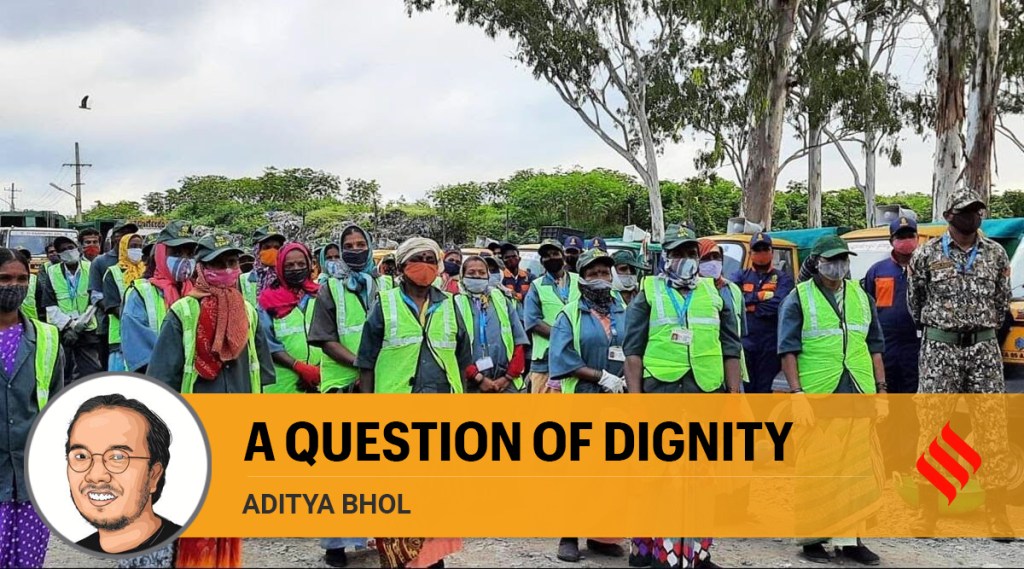 Sanitation work in the country is inextricably tied with caste-based occupational roles. (File)



 Share


