
Opinion A brand beyond the founder: Lessons from Rohit Bal Designs, a year after his death
The team that leads the fashion house is young, driven and doesn't come from privilege. Their hunger – and training by Rohit Bal – keeps a legacy alive
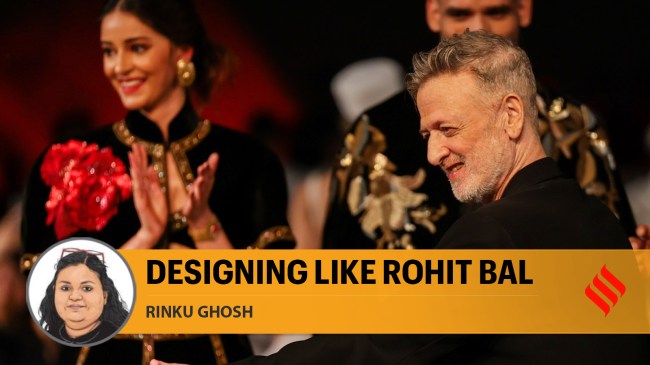 The colonialists had wiped out every folk imprint in our weaves, textiles and craftsmanship (Express archive photo by Chitral Khambati)



When couturier Rohit Bal, who drew the contours of Indian fashion with a unique cultural imprint and a well-cut European elegance, died last year, the sorrow quickly turned to many questions. The most important one that bothered the fashion fraternity was: Would his brand survive, considering that fashion houses in India are personality rather than brand-driven? A boy from Bihar’s Hajipur, a graphic designer from Delhi, a girl from Meghalaya’s Shillong, and many dream-chasers from middle India upended all the assumptions.
This creative core team of Rohit Bal Designs scripted another chapter in India’s fashion history at the just concluded couture week organised by the FDCI (Fashion Design Council of India). They proved that just like Chanel and Prada — each of which took about a 100 years to transform into a sustainable legacy brand despite the aura of its founders — Rohit Bal Designs could well become a legacy brand in a far shorter time. This becomes a point of critical discussion at a time when the untimely death of another of India’s maverick designers, Wendell Rodricks, left his label rudderless. Of course, it was bought over by retail entrepreneur Abhisek Aggarwal and now has an external creative director, who is deep-diving to understand Rodricks’ essence. But that oeuvre seems to be missing.

What then is different with Rohit Bal Designs, which many in the industry still feel would be a prime pick for a corporate takeover? It is the talent pool that Bal had democratised and expanded in his lifetime with pan-Indian and cross-cultural participation and fair play. It’s the human capital he built with his craftsmen and weavers as stakeholders, sitting by their side and sharing food with them for 25 years and more, all of whom are keeping his legacy to date. Rather than naming a successor, he has bequeathed and imprinted his DNA in an artist’s collective of youngsters who not only think and imagine like him but feel incentivised to give their own spin on his work.
The boy from Hajipur and Rohit Bal Designs’ creative director and CEO, Fraze Tasnim, began as a design intern whom Bal selected from Symbiosis, Pune. When Tasnim wanted to acquire knowledge of merchandising and retail, Bal hand-held his way to IIM-Ahmedabad. Growing with Bal and learning the ropes, Tasnim learnt to think like his mentor. So did Ayaz, who was a backroom graphic designer and became part of the design team by sheer dint of talent. As did Manbha Diengdoh, who learnt to refine designs besides sharing passionfruit and smoked chicken from Shillong with the late designer. Little wonder, then, that their all-new collection kept to Bal’s grammar and interpretations, although the designer himself didn’t leave behind a lookbook.
Their design narrative was absorptive and inclusive, and carried a distilled Indianness and disciplined grace. This was because of the equal opportunity Bal exposed them and built the most important asset that cannot be ignored by any investor or buyer — brand heritage. That is a real luxury because of its rarity. It doesn’t come because of entitlement or privilege, but a hunger to prove a point, a self-starter’s excitement to stand out. That comes from allowing crosswinds to blow through the elitism that has far too long held the fashion industry hostage.
Many wondered why Bal had never thought about setting a succession plan in place despite his failing health. He knew best that the karigar could also innovate if allowed that space and respect. That’s how John Galliano, a plumber’s son, Alexander McQueen, a taxi driver’s son, and Vivienne Westwood, a factory worker’s daughter, became leading lights in a fickle industry looking for the next big thing.
Indian fashion is young, all of 35-40 years old, compared to legacy brands in the West. And succession becomes a challenge as the business is pivoted around the founders, most of whom had been born to privilege. But thanks to Rohit Bal or now even Tarun Tahiliani — whose talented design team and head of couture are youngsters who interned with him from across the country — there’s a participatory expansiveness in Indian couture. In fact, one of the pioneers in this area is designer Ritu Kumar, who toured the country extensively to unearth our lost crafts, document and archive them in her research and books and even train traditional craftspersons in contemporary design vocabulary.
That’s why even a Zain Khatri from Ajrakhpur, a tiny village in the craft-rich Kutch district of Gujarat, has his own label at 21, retails on Instagram and scorched the ramp at the Lakme Fashion Week in Mumbai earlier this year. He has combined block printing with batik. The colonialists had wiped out every folk imprint in our weaves, textiles and craftsmanship. But if we want a Made in India legacy, then our fashion labels have to begin looking beyond the easy family business trap, create professionally managed enterprises and be representative of real skill and talent.
rinku.ghosh@expressindia.com

 Share
Share


