“Can the one who drained a tank to build a house now fear the flood?” The Kannada poet Sarvagna had the prescience to ask this in a 17th-century vachana. Can we dream of a better Bengaluru without its tanks and tank beds? Or is that a contradiction in terms?
Among the excellent jokes generated by the recent watery debacle were the unintended ones. Why journey through Bengaluru’s challenging road network for Ganesha visarjan when the flood water obligingly came to the doorstep? Meanwhile, the government and its trusted spokespersons, including some leading architects, were at pains to point out that all of Bengaluru was not affected by the floods, and this was, anyway, an extreme climate event. Yet if this disaster should teach us anything, it is about dogged and growing inequalities. Year after year, areas like Eijipura and National Games Village in Koramangala face the brunt of the monsoon fury. Nothing is learned from these annual events because they are areas inhabited by the poor, or relatively less well-off.

For long, the rich and powerful took refuge behind the gated enclave. In what Mike Davis described so aptly as the “archisemiotics of class war”, it was planning itself that was on offer here, a retreat from the uncertainties and sensory assaults of democracy. That is, until the waters rose. Among those beleaguered techies interviewed at length on TV was a man who claimed to have walked down several floors with his wife to take water from his swimming pool up to his flat. Tough.
At least 26 of Bengaluru’s 28 MLAs have listed “business” or “real estate” as their sources of income, and they are among the richest in the country (according to the Association for Democratic Reforms). We have come a long way from the 1950s and 1960s when working-class housing was a key concern in city planning documents. We have travelled far away from the 1970s and 1980s, when M S Krishnan of the CPI represented working-class interests in the Mysore/Karnataka Legislative Assembly and donated all his personal funds to the party. We inhabit the moment when “claims” to the city by people like ‘Layout’ Krishnappa and M T B Nagaraj are rewarded with seats — and ministerships — in the Assembly. IT and BT uber alles but the bourgeoisie does not seem able to run this city.
Clearly, we cannot expect our political class to adhere to the first principle of town planning — inter-generational responsibility. Consider the most important feature of the elevated city of Bengaluru, which is not close to a natural water source — its human-made tanks. There has been a legendary link between the tank, the temple and the market garden in this city, from its very inception in the 16th century. This link is symbolically consecrated and remembered every April in the city’s most important civic festival — the Karaga. Yet, only mushrooming, illegal shrines and temples remain as a deformed element of that urban form. Sampangi “tank”, which the Karaga must visit at the start of the festivities, is a tiny symbolic waterhole.
Both market gardens and tanks/tank beds – valuable sponges and sinks of the city — have been relentlessly occupied: When by the poor, they are ruthlessly evacuated in favour of “layouts” for the richer citizen. The linguistic topos occasionally records that transition — some colonies are still called “tank bed” colonies — but otherwise, the memory of the large tanks, which have been converted into stadia, bus depots, tech parks, golf clubs and colonies has been erased.
Sustaining this link between the city and tank building – which was recognised even by the erstwhile princely Mysore government (though damming of the Arkavathi was also undertaken ) — is another principle of town planning that has been buried in concrete. Since 1947, tank building and maintenance have been jettisoned in favour of pumping Cauvery water up to a height of 3,000 metres from nearly 100 km away. No amount of knowledge about the vital role played by tanks and tank-beds in sustaining the city — generated by NGOs, government-sponsored reports, citizens’ groups, scientists — has reoriented this bull-headed city-building.
So, not for want of knowledge was the city lost. What about the place of law? In courses on the history of the modern city, I have often asked students to reflect on an important question: Why is there such widespread disrespect for planning and building law in the Indian city? When “illegality” is the norm — indulged in not merely by the poor, but the rich and even the state — is there an alternative to the law as an instrument of socially-just and environmentally-sustainable city planning? Post hoc “regularisation” is, we well know, the way in which the Indian state compensates for its failures to build housing for the poor.
But the law is by no means toothless: Legal compliance is inflicted only on the poorest and the weakest in the city. Take Bengaluru. The poor are “legally” deprived of their water sources and places for bodily relief as middle-class residents assert their rights. They are denied entry by vigilant RWAs into parks that dot the city in homoeopathic doses. Packs of feral dogs that roam the city are better protected by the law than their victims. For fear of a Forest Department fine, taxpaying homeowners cannot trim or cut a tree even if it threatens their built structure.
Have we grown gigantic too fast? Premila Nesargi, a BJP supporter, was among those who thundered on television that Bengaluru should not have been allowed to grow beyond the four pillars that Kempegowda had planted in the four quarters of the city. Our infrastructure stalwart, Nitin Gadkari, proposed “skybuses” as an answer to Bengaluru’s woes. And now the waterlogged companies on the Outer Ring Road demand a municipality of their own.
Dialling back to a time when one could fish in the Mud Tank at Langford Town, sail in Hesarghatta, or swim in Yediyur (all memories of my youth) is visiting Lala Land.
Or is it?
The best way for us to honour Kmpegowda, the founder of the city, is not to build a 108-foot statue at Devanahalli (which is, alas, underway). Let us instead revive the intertwined tank and market garden model in every locality, and may no person put it asunder. Let the map of Bengaluru sparkle once again with blue water bodies. Let us impose a heavy congestion tax on four-wheeler users in the city centre, as in most world metros. Let there be a 150 per cent tax on car ownership, as in Singapore. Let us build, (as London, the world’s oldest and most stable metropolises, has done during Covid), a dedicated cycle track throughout the city. Or introduce year-round “odd-even” usage of cars. Let us possibly introduce the Curitiba model of making buses the only mode of transportation, at least on some days of the week. And let us redeploy the fervour and zeal that destroys the “anti-national” residence or the slum to bulldoze residences and offices of the rich and the powerful who have violated the law.
I can hear the bourgeoisie shudder. But into this dream (dreams are still, fortunately, our own), let my city awake.
The writer taught history at JNU
This article first appeared in the print edition on September 19, 2022, under the title, ‘Reimagining Bengaluru’

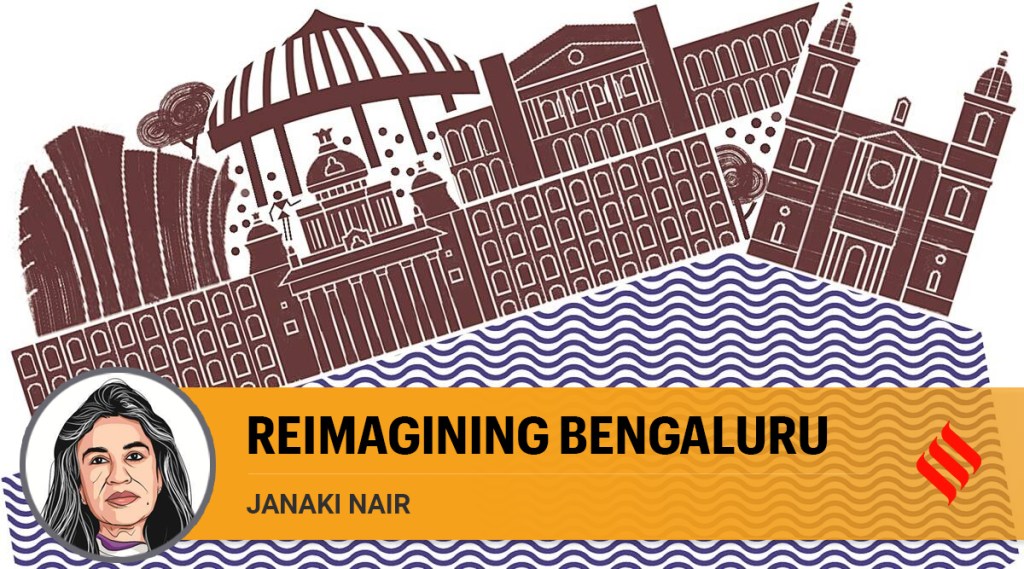 Sustaining this link between the city and tank building — which was recognised even by the erstwhile princely Mysore government (though damming of the Arkavathi was also undertaken ) — is another principle of town planning that has been buried in concrete. (Illustration by C R Sasikumar)


 Share


