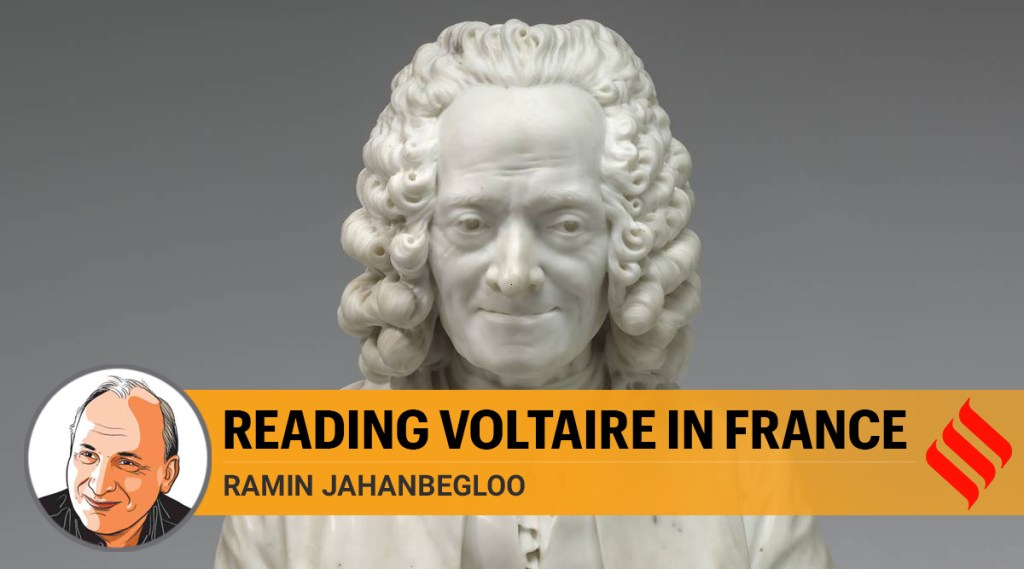
Nearly six years ago, on January 7, 2015, two French jihadists, the Kouachie brothers, assassinated eight employees of the satirical newspaper Charlie Hebdo and injured 11 others. That same day, many French people gathered at the Bastille Square and waved Voltaire’s Treatise on Tolerance. In the past several weeks, France has witnessed a new wave of terror attacks in the name of Islamic fundamentalism, taking innocent lives most horribly. The outrageous beheading of the well-meaning teacher, Samuel Paty, on October 16, and a similar attack on a 60-year-old woman and two others in Nice two weeks later were acts of deliberate violence and fanaticism. In his tribute to Paty, French President Emmanuel Macron referred indirectly to Voltaire, underlining the fact that “the Enlightenment will never grow dim”.
It seems that with the rise of fanaticism around the globe, the necessity of reading and re-inventing Voltaire is felt more than ever. Reinventing Voltaire means carrying out a two-fold reflection, in particular, by asking oneself what it means today to be committed against fanaticism in a global environment, and by reflecting on freedom of thought as a way of looking critically at our world away from stereotypes. What we can learn from Voltaire is that it is not the very thing we think that makes freedom, but the way we think about it.

Freedom of thought is, therefore, the common ground of all philosophical schools: They are philosophical only on this condition. Philosophy is, above all, an affirmation of the freedom to think. Fanaticism, for Voltaire, is opposed to the critical and philosophical spirit; it can’t lead to truth and justice. By definition, he or she who gives free rein to his idolatry and servitude of thought and comes to murder is a fanatic. That is why Voltaire waged a relentless war against the fanaticism that appeared in the Catholic Church. One of his concerns is the defence of those who have no voice and who are often victims of religious extremism. In the same manner, in the Treatise on Tolerance (1763), Voltaire takes the opportunity to criticise severely the intolerance of Catholics towards Protestants.
Opinion | PB Mehta writes: In defence of liberty: It is time to stand up for individual freedoms, against all challengers
Voltaire’s work is, in many ways, against fanaticism. In a dialogue between an Englishman and a Spaniard, published in 1764 in his Dictionary of Philosophy, Voltaire wrote the following in defence of freedom of expression, by taking England as an example: “We have only been happy in England since everyone gained the right to speak his mind freely.” Voltaire’s key point here is that it is necessary to express one’s disagreement in the public space, where divergences are allowed and welcome. This is the idea we have today of freedom of expression when Charlie Hebdo voluntarily criticises religions in a newspaper which exemplifies the public space. Voltaire practised this with regard to those he did not totally approve of. A good example is what he wrote about his contemporary, the French philosopher, Helvetius: “I loved the author of the book ‘De l’Esprit’. This man was better than all his enemies together; but I never approved of the errors of his book, nor of the trivial truths he emphatically spouted out. I took his side highly, when absurd men condemned him for these very truths.”
Maybe this is one of the reasons why we need to go back to our classics in all cultures, which taught us a more pluralist and dialogical approach to ideas that we do not share. Great figures of Indian independence like Gandhi, Tagore and Ambedkar were critics of secular and religious forms of fanaticism. Gandhi believed that “even the teachings themselves of the Quran cannot be exempt from criticism. Every true scripture only gains by criticism. After all, we have no other guide but our reason to tell us what may be regarded as revealed and what may not be”. Like Voltaire, he argued that a person who believes in truth and god cannot go to a mosque, synagogue, temple or church one day, and the next day foster hatred and violence.
Editorial | Stand with France: Nice terror strike should strengthen global resolve against extremist ideologies that use religion to terrorise and kill
Reading Voltaire today as a critique of religious violence helps us to evaluate strongly Gandhi’s philosophy against forms of religious fanaticism. After all, religions are not only about our beliefs but about what we do with our beliefs.
This article first appeared in the print edition on November 10, 2020 under the title ‘Reading Voltaire In France’. The writer is Noor-York Chair in Islamic Studies, York University, Toronto
Explained | France’s complex relationship with Islam, Macron’s recent remarks



 Share


