Did God exist? This question bothered the West for centuries. One of the earliest arguments for the existence of God, which Immanuel Kant called “ontology”, was given by the Archbishop of Canterbury, Anselm, in 1078 AD. “Id quo maius cogitari nequit”, Anselm argued, meaning “there must be that (thing), the greater than which cannot be conceived”. Since God cannot be conceived to be non-existent, he is deemed existent, was Anselm’s ontological argument.
This idea of an “inconceivable” God had led to conflicts over His interpretation, with various Semitic religions drawing daggers at each other. Crusades followed, tempting Napoleon to famously quip that “religious wars are basically people killing each other over who has the better imaginary friend”.

It led to the rise of Deism which insisted on having God, but not religion, and atheism which rejected both God and religion. Receiving French mathematician Pierre-Simon Laplace’s work, Napoleon asks, “They tell me you have written this large book on the system of the universe, and have never even mentioned its Creator”. Laplace defiantly replies, “Je n’avais pas besoin de cette hypothèse-la” (I had no need for that hypothesis).
But the deists and Enlightenment thinkers wanted a universal God. Spinoza, the 17th-century Dutch philosopher, equated God with nature, proclaiming “deus sive natura” (God or Nature). Voltaire, the French philosopher, despite being critical of the Catholic church, declared: “Si Dieu n’existait pas, il faudrait L’inventer” (If God did not exist, it would be necessary to invent him). “I shall always ask you if, when you have lent your money to someone in your society, you want neither your debtor, nor your attorney, nor your judge to believe in God,” he indignantly asked.
God was reason and ethics for the Enlightenment deists. But the medieval understanding of an inconceivable God, often jealous, continued. Managers of those medieval beliefs became merchants of death. God needed to be rescued. A new enlightenment became the need of the hour. “The need for spiritual guidance has never been greater. It is imperative that we double our efforts to spread the message of good neighbourliness based on our common humanity, a message shared by all faith traditions,” the United Nations said recently.
Can this enlightenment come from the eastern religious beliefs that offer universalism of divinity, respect for diversity and spirit of dialogue and accommodation as an ontology? “God is not inconceivable; He is omnipresent; there is not One God; there is Only God” — they say.
Two important Muslim organisations, coming from two corners of Asia, want to take the lead in this effort by launching the R-20 (Religions-20) forum on the sidelines of the G-20 summit. Indonesia is the chair of the G20 in 2022 and the leaders’ summit will take place in November in Bali. The Indonesian government has chosen “Recover Together, Recover Stronger” as the theme.
The keen interest taken by Joko Widodo, the President of Indonesia, has led to the inclusion of R-20 in the agenda as the G-20 Forum of Religions this year. Global issues like health, economy, climate and technology, besides issues like war, hatred and disharmony have, for a long time, been considered the concern of the political leadership. That religious and cultural leaders too can play a complementary role has not been fully appreciated. Politicians, technocrats and professionals are the new popes and power; economy and technology have become demigods.
It is in this context that the Indonesian government’s initiative to bring religious and cultural leaderships into active discourse acquires significance. The two organisations taking the lead in this endeavour are — the Nahdlatul Ulama (NU) of Indonesia and the Muslim World League (MWL) of Saudi Arabia.
The God/religion dichotomy is not fully resolved in the Western world with religions still competing with each other leading to theories like the clash of civilisations. The leadership of the Enlightenment era (17-18th century) had largely addressed this issue within the domain of Christianity. A similar enlightenment is dawning on the world’s second-largest religion, Islam. Countries such as Indonesia and Saudi Arabia, and organisations like the NU and MWL, are at the forefront of this development.
The NU, the largest Muslim organisation in Indonesia with over 90 million members, has been spearheading what it describes as Eastern Humanitarian Islam. Under the leadership of its dynamic chairman, Yahya Cholil Staquf, it has been working towards rejecting radicalism and exclusivism and bringing humanitarian values to the centre stage. The NU rejects concepts like kafir and insists on putting the love of country ahead of the love of religion.
The MWL, under the leadership of Mohammad bin Abdulkarim Al-Issa, is also actively seeking to promote a more humanitarian version of the Islamic worldview that rejects narrow and fundamentalist interpretations. The invisible hand of Crown Prince Mohammed bin Salman behind this progressive initiative cannot be missed. The MWL, despite the criticism it has endured in the last six decades, takes a strong stand against extremism today, emphasising that “Islam understands the existence of religions as a universal design that must be celebrated, since difference, diversity and multiplicity are characteristics of human nature”. At an interfaith forum conducted earlier this year at Riyadh, Al-Issa called for building a universal consensus on “common principles of human values, values of moderation and harmony, tolerance and peace, and rational intellectual frameworks to immunise against the dangers of extremist ideology and behaviour”.
The R-20 will be historic if it succeeds in building a God-centric value system in place of the current religion-centric one. Religion-centrism is no longer limited to the West today. Hatred, exclusivism and cancel culture have entered the eastern religions also as a reaction, diminishing the beauty of their universalist doctrines.
The R-20 will move from Muslim-majority Indonesia this year to Hindu-majority India next year and Catholic-majority Brazil in 2024. This process can help the three world religions, together with Buddhism and other important religions, evolve a universal value system and also become equal partners with the political, economic and technological leadership of the world in defining the destiny of mankind in the 21st century.
The writer is member, board of governors, India Foundation

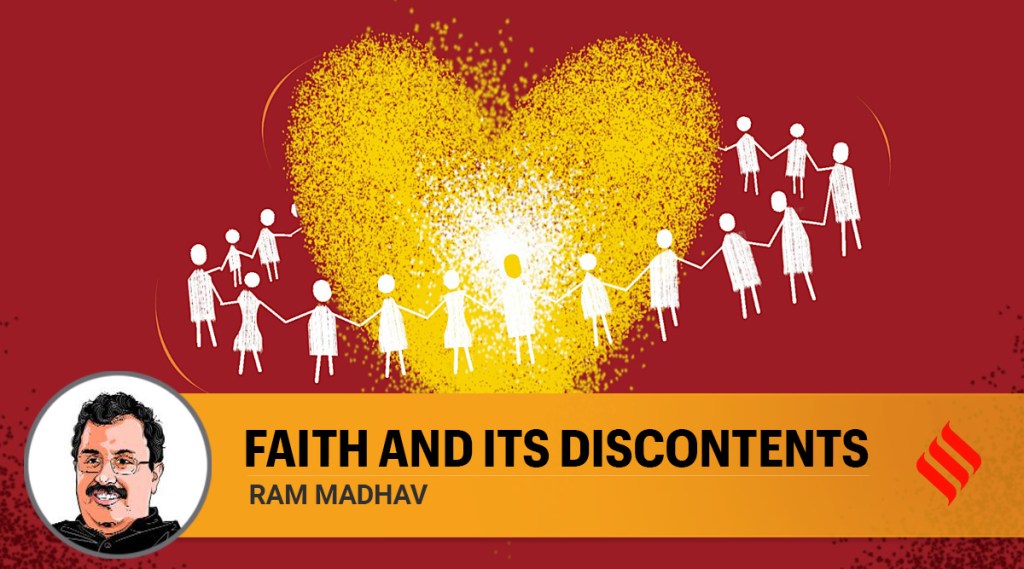 Ram Madhav writes: But the deists and Enlightenment thinkers wanted a universal God. Spinoza, the 17th-century Dutch philosopher, equated God with nature, proclaiming “deus sive natura” (God or Nature). (Illustration: C R Sasikumar)

 Share


