6 min readJun 29, 2024 09:18 AM IST
First published on: Jun 29, 2024 at 07:08 AM IST
India and the United States of America have been close allies for more than two decades. India recently elected the Narendra Modi-led government for the third consecutive term. In the US, the presidential elections are scheduled for November and a new government led by Joe Biden or Donald Trump will be in place in January next year. Either way, it will be a continuation of the relations built by Modi in the last 10 years. Jawaharlal Nehru had the opportunity to meet three presidents — Harry Truman, Dwight Eisenhower and John F Kennedy. In a decade of his tenure, Modi has already met three American presidents – Barack Obama, Donald Trump and Joe Biden. He waits to meet the one among the latter two who gets a second tenure.
Although India and the US established diplomatic ties soon after Independence, the relationship had to endure Cold War era distrust and American wrath over India’s nuclear programme. The Americans wanted the former British colony to become their ally. Nehru’s refusal to do so and his pursuit of an independent foreign policy of non-alignment didn’t go down well with successive US administrations. Although the Kennedy government was helpful during the Indo-China war of 1962, and the US extended assistance for India’s Green Revolution, President Richard Nixon openly sided with Pakistan and China during the crucial years of 1969-74. Indira Gandhi’s decision to test the first nuclear device in 1974 angered the American leadership, which continued through Bill Clinton’s years in office when India tested a more powerful device during Atal Bihari Vajpayee’s regime in 1998.

Credit for steadying the relationship goes to Vajpayee as the prime minister. Although the Clinton administration imposed serious sanctions in multiple areas after the Vajpayee government conducted nuclear tests, Clinton’s visit to New Delhi in March 2000 and Vajpayee’s deft diplomatic handling helped diffuse the situation. The first major breakthrough happened in the form of a vision document released jointly by the two leaders. “We are nations forged from many traditions and faiths, proving year after year that diversity is our strength. From vastly different origins and experiences, we have come to the same conclusions: that freedom and democracy are the strongest bases for both peace and prosperity and that they are universal aspirations, constrained neither by culture nor levels of economic development”, that statement read.
Later that year, Vajpayee was in New York for the UN General Assembly where he addressed the Asiatic Society. His famous statement that India and US were “natural allies” became the basis for the new relationship in later years. During his visit to the US in 2013, Prime Minister Manmohan Singh described the US-India partnership in the joint statement with President Obama as “a defining one for the 21st century.”
Under Prime Minister Modi, this relationship has acquired greater momentum. Modi is the only Indian prime minister to have visited the USA eight times in 10 years. In their joint statement last June, Modi and Biden affirmed a vision of the US and India as “among the closest partners in the world — a partnership of democracies looking into the 21st century with hope, ambition, and confidence”. From “natural allies” to “hope, ambition and confidence” is a great journey of the bilateral partnership, which Modi described as one spanning from the “seas to the stars”.
As the two governments embark on their new journeys, this relationship faces an important test. There are issues on both sides that cause unease. India’s insistence on “strategic autonomy” is raising hackles in foreign policy circles in the US. India’s steadfast refusal to consider the Quad as a maritime alliance, something like an Indo-Pacific NATO, too is making sections of the American establishment squirm. While there is palpable enthusiasm on the Indian side over the security and development potential of the Quad, the other side appears to see greater merit in pursuing the AUKUS agenda more vigorously.
Biden’s decision to pull out of the Quad summit in Australia last year and not visit India in January this year for another possible Quad summit led to commentators suspecting deliberate neglect of the arrangement by the US leadership. At the same time, AUKUS is rapidly growing as an area of greater strategic interest for Australia, the US and Japan. The latest Defence White Paper released by the Australian government speaks at length about cooperation in AUKUS but has a cursory mention of the Quad. The possible expansion of AUKUS will also redefine the partnerships among Quad nations.
India’s other concerns were highlighted in a speech by foreign minister Jaishankar at the UN last September. “From time to time, respect for the UN charter is invoked. But for all the talk, it is still a few nations who set the agenda and seek to define the norms. This cannot go on indefinitely”, Jaishankar lashed out in an address, which some called “bold” while others saw in it India’s growing “belligerence”. In a clear message to the West over the much-touted argument about “rules-based order”, Jaishankar cautioned that “rule makers should not subjugate rule takers” and “rules will work only when they apply equally to all”. Indirectly referring to the turn taken by the Khalistan issue in the US and Canada, he came down heavily, saying that “political convenience” is determining responses to terrorism and extremism. “When reality departs from the rhetoric, we must have the courage to call it out”, he said, highlighting the “sentiment of the Global South” that “without genuine solidarity, there can never be trust”.
Growing global challenges, including the rise of China and the unfolding new Cold War-like situation call for greater understanding and coordinated action between the US and India — two powers committed to the same ideals in two different geo-strategic locations. That understanding will decide the future trajectory of the relationship.
The writer, president, India Foundation, is with the RSS

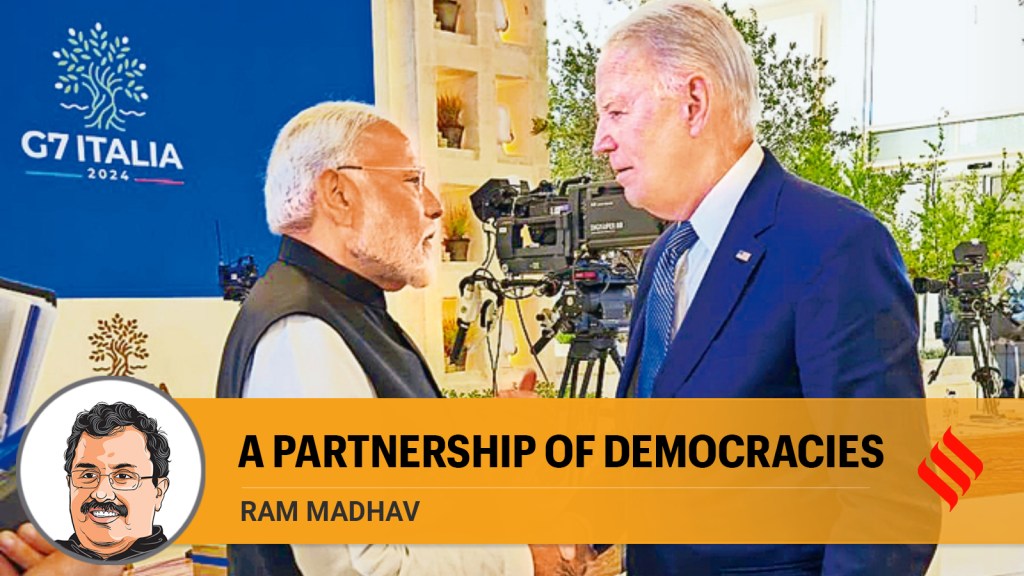 Prime Minister Narendra Modi meets US President Joe Biden at the G7 Outreach Summit, in Apulia. (ANI Photo)


 Share


