Singapore’s foreign minister Vivian Balakrishnan has opened a window into the future of diplomacy. In a Facebook post, he declared that “the diplomat who learns to work with AI will have a meaningful edge”. The remark accompanied his unveiling of a personal AI agent using open source software and a low-cost computer.
That a sitting foreign minister coded his own AI assistant is remarkable; that he published the entire architecture on GitHub is even more so. He has shown how accessible the new AI tools have become, how the entry barriers to using AI are lowering, and how profoundly they could reshape diplomatic practice.

The AI assistant that Balakrishnan built is not a regular chatbot. It connects to the minister’s communication channels, processes voice notes and images, schedules tasks, and — crucially — retains structured memory. Unlike conventional AI assistants that forget everything between sessions, his AI assistant extracts facts, synthesises them into a knowledge graph, and recalls them when needed. Balakrishnan describes it as an “invaluable” research assistant and admits, “I don’t dare switch it off”.
Diplomacy has always rested on two pillars: Institutional memory — the accumulated record of who said what, when, and why in the engagement between governments — and individual craft, honed through years of negotiation abroad and persuasion at home. A self‑learning AI system does not replace either; it reorganises and amplifies them. It makes institutional memory instantly searchable and aids the diplomat’s ability to assess the relevant context in real time.
Balakrishnan’s experiment is part of a wider trend. Foreign ministries across the world are beginning to embed AI tools into their workflows. The old machinery of diplomatic craft — slow, paper‑bound, and hierarchical — struggles to keep pace with the velocity of contemporary diplomacy and the growing weight of the cognitive load on its practitioners. AI tools will inevitably emerge as a force multiplier in modern diplomacy. A well‑tuned AI system can draft communiqués in minutes and cross-check decades of treaties for consistency. It could generate alternative formulations calibrated to different audiences and improve the choices for the political decision-makers.
In the past, diplomatic advantage often flowed from sheer manpower. Major powers could overwhelm smaller delegations by deploying large teams of experts. AI changes that equation. A five‑person delegation equipped with a sovereign AI stack could possibly match the analytical and drafting capacity of a 50‑person mission. This technological levelling empowers middle powers and small states to shape agendas rather than merely respond to them.
The deeper transformation lies elsewhere — in what AI removes. Much of diplomatic work is procedural drudgery — drafting, summarising, cross-referencing, and record‑keeping. AI eliminates this “documentary friction”, freeing diplomats to focus on the irreducible human dimensions of their craft: Deeper awareness of other societies, political judgment, and relationship‑building.
Balakrishnan himself has drawn a clear line between AI augmentation and AI automation in diplomatic work. Speaking at the UN Security Council last September, he warned that diplomacy has long assumed that one is negotiating with another human intelligence — “one with a brain and a heart”, each shaped by unique cultural, political, and economic characteristics.
If diplomatic decision‑making is outsourced to machines, that assumption comes under stress. The danger is not hypothetical. As AI systems begin to simulate negotiation outcomes, generate policy options, and model crisis responses, the temptation to let them decide will grow. While AI can scan vast archives and detect patterns, it can also make serious errors in interpreting history or assessing present circumstances. Assistants like NanoClaw, used by Balakrishnan, are getting better at contextual understanding, but they remain far from replicating the human ability to read political nuance, weigh competing interests, and judge the mood of a counterpart.
AI’s impact on diplomacy is not the first technological disruption of the profession. The telegraph in the 19th century collapsed physical distance, allowed capitals to instruct envoys in real time, and reduced the autonomy of “plenipotentiaries”.
The rise of mass communication and radio brought public opinion into foreign policy, forcing diplomats to operate under constant scrutiny. The internet revolution extended this transparency to every corner of global politics, accelerating information flows and constraining older systems of assessment. AI differs from these earlier technologies because it introduces a new kind of agency.
AI tools do not merely relay information; they interpret, predict, and simulate. They can act as an intellectual sparring partner — capable of parsing complex treaty language, forecasting crises, and identifying creative compromises that human negotiators might miss. But in the end, it cannot replace the essence of diplomacy: Empathy, trust‑building, and persuasion in pursuit of national interest.
As AI “second‑brain” tools spread through foreign ministries, the asymmetry between prepared and unprepared diplomatic corps will widen. And as media, academia, and civil society gain access to similar tools, the foreign policy discourse will broaden. This may democratise debate, but it also increases the cognitive load on foreign offices, which must now respond to a more technologically empowered audience — both friendly and hostile.
Like in so many other domains, AI is beginning to envelop one of the most conservative professions — diplomacy and statecraft. Balakrishnan’s AI assistant is only one of the several new tools that will emerge in the coming years. Foreign offices are among the most conservative, given the implications of their work. But they have no choice but to adapt to the AI revolution. The battle between the inertia of the national security bureaucracy and the speed of AI-driven technological change will be an absorbing one to watch in Delhi.
The writer is a contributing editor on international affairs for The Indian Express and is associated with the Motwani‑Jadeja Institute of American Studies at the Jindal Global University and the Council on Strategic and Defense Research, Delhi

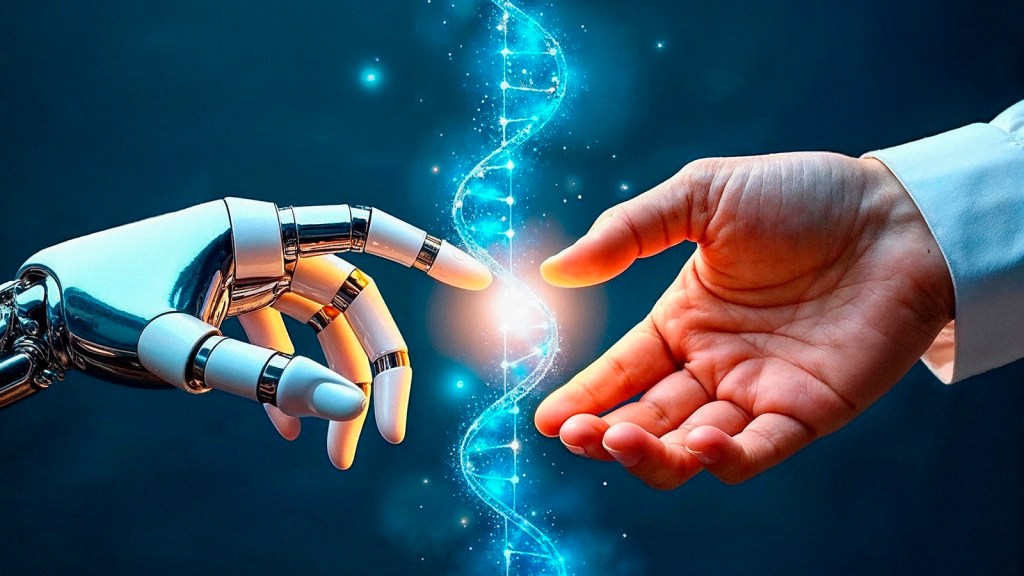 Foreign ministries across the world are beginning to embed AI tools into their workflows.


 Share


