
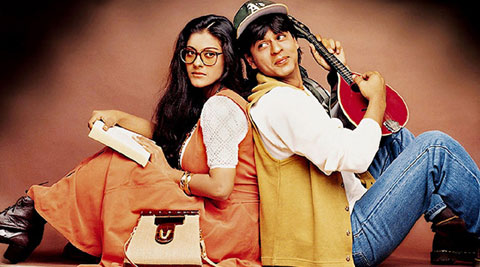
 The DDLJ-discouraged-dissent argument narrows the space for what dissent can be by demanding that it be obvious and “out there” in full view of TV cameras and Twitter.
In revisiting Dilwale Dulhania Le Jayenge (DDLJ), which just completed a record 1000-week run in Mumbai’s Maratha Mandir, several commentators have criticised it as a regressive cultural text. A key argument is that it encouraged middle-class youth to avoid active rebellion against the family as an institution and helped entrench patriarchy. Why didn’t Simran and Raj dump familial obligations and simply elope?
As a pre-teen in 1995, I loved DDLJ for indulging the fangirl in me, with Shah Rukh Khan’s arms cast open amidst pristine Swiss Alps and Indian mustard fields. I rediscovered the film eight years ago while collecting survey data on home-based textile workers as part of advocacy efforts by the Institute for Social Studies Trust, Sewa and partner organisations to improve their wages and work conditions.


During this time, many working women I encountered in the garments trade, from workers to business owners, would cite DDLJ as one of their favourite films. Indeed, in parts of rural Uttar Pradesh, garment workers who worked at home because they could not easily travel outside their own villages and lived in purdah would ask sub-contractors to organise screenings of the film during Id and smuggle posters, radios and audio tapes. Watching the film itself and independently purchasing iconography with their hard-earned wages had become a form of protest by prodding notions of how young women ought to behave. However, when asked, these women couldn’t imagine life without their families, despite being critical of their marital experiences and lack of choice in selecting partners.
Picture gallery: 1000 weeks of DDLJ; reliving the moments with Raj and Simran
The DDLJ-discouraged-dissent argument narrows the space for what dissent can be by demanding that it be obvious and “out there” in full view of TV cameras and Twitter. So, no act of protest short of elopement will suffice. Demanding such all-or-nothing actions doesn’t account for the costs that eloping and actively abandoning their families would impose on women and men from any economic strata. The way we express resistance is subject to our own personal calculus of risk and reward.
Commentators single out an exchange where Raj denies Simran’s plea to run away. He would rather gain support from her family. Many interpret it as conforming to oppressive patriarchy. I agreed — at least until microeconomics and the responses of women from diverse class backgrounds taught me to watch the film differently. To my surprise, DDLJ’s female fans pointed to the same scene as a demonstration of courage. Working- and upper-class women would insist that running away was an easy choice for men — more so when their families supported the match, as was the case in DDLJ. Women faced the brunt of breaking ties with their families. When financial difficulties or infidelity fuelled fights and violence, they had no monies, material resources or networks of their own as opposed to men, who could find jobs and live alone easily.

The police was scary, friends were far away, living alone implied risks to their safety in small towns or large cities. Irrespective of their economic circumstances, moving away from husbands and in-laws would create more shame and many struggled with going back home, as they were pariahs for their parents. As economists would say, eloping had made a woman’s “fall back” position in marriage weak relative to men. Beyond the economics of elopement, there are emotions. Parting from parents in an acrimonious fashion was considered too painful. That Raj avoided the easy route of running away and cared enough to stick around, compromise and fight for approval to ensure Simran wasn’t cut-off from her kin was seen as a measure of strength and maturity. In this light, Raj was radical. Where I earlier saw capitulation, I began to see bargains and trade-offs.
Also read: Only if daddy says ‘yes’
Those who study marriage and women’s work highlight the subtle yet strong changes that cascade as a result of women having access to property, an independent income or jobs across the class spectrum. Much of this highlights how the act of “rebelling” can look very different in the context of patriarchy in the northern belt of South Asia. Women pursue personal goals or survival outcomes amid harsh forces, such as segmented and discriminatory labour markets, powerful patrilineal family systems, violence and discriminatory customs and laws surrounding divorce, child custody, widowhood and inheritance systems that deprive them of assets. So, women are rendered dependent on the family for protection and provision. Expecting women in this landscape to demonstrate dissent by delinking from the family — the only institution that provides them any material security in the absence of the state or market doing so — is asking for too much. Scholars shed light on hidden acts that ought to be acknowledged as proper protest. For example, Simran’s mother articulates that she wants a different reality for her daughters and even asks her daughter to run away.

Simran seeking to marry someone other than the familial choice, her open disclosure of desire to her mother and the resultant bargaining between family members were acts of dissent. Women face serious economic and physical risks in abandoning families for sustenance. We know that female employment is exceptionally low and women continue to stay in violent and unhappy marriages as men control economic and sociopolitical capital. The film, set in the UK amongst Punjabi landed families in the 1990s, reflected this. None of the adult women worked. They all relied on men for resources. In this context, which seems pretty and pink on the outside, voicing desire for a different reality and exerting agency to achieve it — where you would strive to marry someone who loved and supported you as opposed to the appropriate family alliance — was, and remains, difficult. The film appreciated this reality (and added enough gloss, in classic Yash Raj style) and this is perhaps why its portrayal of romance and mother-daughter relationships touched many women.
There have been several movies in India where women express their desire to marry someone outside whom the family deems appropriate. DDLJ was different as it focused on the real and complex bargains involved in following through on such radical desires, as opposed to the past Bollywood approach of running away and setting up home in some tiny place or where the lovers commit suicide/ are murdered.
In DDLJ, Raj and Simran are united after the patriarch gives his permission. Work-life histories and ethnographies of working women and women’s collectives tell us that the role of familial “permission” is rampant in South Asia. What has changed — and the film demonstrated this — is that actions that were completely off-the-table for any negotiation on permissibility are now open for dialogue, such as whom you marry or women travelling alone with friends and no supervision. The fact that we must invest significant effort to bargain for these freedoms is sad, but also reflects our social realities across class. Many women’s groups and unions seek support from men in communities to help women organise. This allows for more effective mobilisation. Women work after their husbands are “ok” with it — even if this is a constant source of angst and battle. In our own families and personal relationships, we seek support for our choices. The idea is to cajole, argue, fight, convince. This is because many of us actually seek love and emotional support from our family in addition to freedom and choice. This is the way we resist and express disagreement in everyday, ordinary lives. Compromise can’t always be seen as cowardice.
DDLJ was probably not progressive but pragmatic in its approach to what dissent within families looks like. The film can be accused of meshing wooing and harassment. But despite its conservative exterior, it contained subversive elements. Asserting preferences different from what is socially ordained and bargaining with family members to gain support for these, in a context where women have limited assets of their own, is resistance. And Raj did the dishes.
The writer is an economist and author of ‘Desperately Seeking Shahrukh’ (forthcoming by Zubaan Books)
 Share


