The Kishkindha Kand section of the Ramayana narrates the story of Ram slaying the formidable monkey king Vali, son of Indra and elder brother to Sugriva.
Vali had pursued an asura into a cave, commanding Sugriva to wait at its mouth. After a long period of waiting, as blood flows out of the cave, Sugriva assumes that his brother has been killed. He returns to the kingdom of Kishkindha and is crowned king. It was Vali, however, who had killed the asura and on his return to Kishkindha, accused Sugriva of betrayal and usurpation. Sugriva is driven away and subjected to many indignities at Vali’s hands. Sugriva and Ram forge a friendship and the aggrieved brother asks his friend to avenge himself by killing Vali. Ram suggests that Sugriva challenges his brother to a battle, and Vali would then meet his end at his hands. A battle ensues, Sugriva is easily bested by Vali but no arrow leaves Ram’s bow.

Sugriva is puzzled. Ram explains that he was unable to fire his arrow, as both Sugriva and Vali look alike and he was afraid of killing the wrong person. Ram asks Lakshman to make a garland of the gajapushpi creeper and put it around Sugriva’s neck, to distinguish him from his brother. Sugriva once again challenges Vali who, naturally, accepts. This time the arrow from Ram’s bow finds its target – piercing Vali’s chest.
To deal with our fears, the story suggests, we must first identify them and articulate their presence. There is a middle-aged, t-shirt-donning politician who deployed the symbolism of fear in a Parliamentary speech, which suggests that he has learnt a thing or two about the potency of speaking about overcoming it. Politicians are neither gods nor asuras, but political success is as dependent on the here and the now as on deploying mythologies that move us. But two parliamentary speeches – one by the Leader of the Opposition and the other by the Prime Minister, are instructive in what they tell us about the peculiar nature of political symbolism after what can be considered a setback for the ruling party in the recent elections.
Let us start with Rahul Gandhi’s manner of naming fear to – after his own fashion – counter it. In what must be considered an extraordinary departure from convention and tradition for a leader of the Congress, Rahul Gandhi’s key strategy was to invoke a religious imaginary as the context for the re-fashioning of an opposition voice. He marshalled a variety of religious figures – Guru Nanak, Jesus Christ, Shiva – to his cause. The visage of the Lord of Dance made multiple appearances – albeit interrupted by human forces – in the parliamentary building. However, as Gandhi repeatedly flourished an image of the “destroyer” of the Hindu trinity, human limbs that may have been directed to alter camera angles could not erase the meanings that were sought to be conveyed.
The Prime Minister responded the next day. The beatific smile sported by the Speaker of the House could not, however, disguise the uncharacteristically this-worldly response by Narendra Modi. Quite in contrast to Gandhi, the opening lines of Modi’s speech referred to Indian history and the Indian people. This, from a political leader whose key electoral and political strategy has been the invocation of myths, including how “ancient” values and achievements continue to guide and make contemporary India a unique society. Rather than casting his arguments in the language of a direct connection with divinity, the PM presented comparisons and metaphors from everyday life. The Congress, he noted, is like the small child who has been injured in a bicycle accident and is being mollified that it’s not such a terrible tragedy. The Congress deploys a mythical mode and the BJP, a factual one to make sense of their respective post-election advantages. And the Speaker smiled away, whether in comprehension or bemusement, is not clear. Perhaps he had some sense of the epic – Ramayanic — proportions of the drama unfolding before him.
Let us now turn to another aspect of the two speeches. An important way in which Gandhi sought to make what might otherwise have been an entirely abstract idea – fear – into a concrete emotion was through excerpts from conversations with those, he said, he had met on different occasions. There was the woman who spoke of being beaten by her husband as she was unable to prepare a decent enough meal because of inflation; the family of the Agniveer who feared destitution because their son had lost his life and little or no compensation might be forthcoming; the fear expressed by a Manipuri woman at the possible future of her region; and the stories articulated by young women and men who had suffered in the recent NEET fiasco. Perhaps, most provocatively, he spoke of the fear within the BJP where dissent he said, is severely punished.
The PM responded – with an unprecedented chorus of the Opposition’s sloganeering in the background, including exhorting the PM to “have shame” – by quoting “facts and figures”. It was notable that Modi did not directly refute Gandhi’s invocation of fear as the dominant motif of BJP governance. He spoke of the Supreme Court’s warnings against the threats to nationhood – the Opposition’s sloganeering now echoed with “we want justice” – and the “warning” he was now offering to the Congress to not obstruct the country’s path to progress and development. The Opposition’s “anti-national conspiracies” that obstructed the very development that was happening in the country, he declared, would be unequivocally countered. A politician whose political mastery lies in presenting certain possibilities that may otherwise remain at the level of abstraction – fear, anxiety, unease, hostility — as concrete facts, had become the purveyor of facts and figures. On the other hand, the Congress’ key representative – who has unsuccessfully relied on “facts and figures” as a political strategy – now has recourse to the potency of mythological ideas.
We are now in a moment where the mythical narratives – of ancient glories and moral superiority – through which the dominant party had cast the efficacy and truth-value of its governance strategy have become ragged. There is the exhaustion of repetition, with repetition depleting the original power of the narrative. Simultaneously, the Leader of the Opposition has discovered that myths have no monopolists, and their potency lies in developing the appropriate languages of invocation.
Perhaps, the Speaker was expressing some mixture of bemusement and concern at the turn of events.
The writer is British Academy Global Professor, Department of Anthropology and Sociology, SOAS University of London

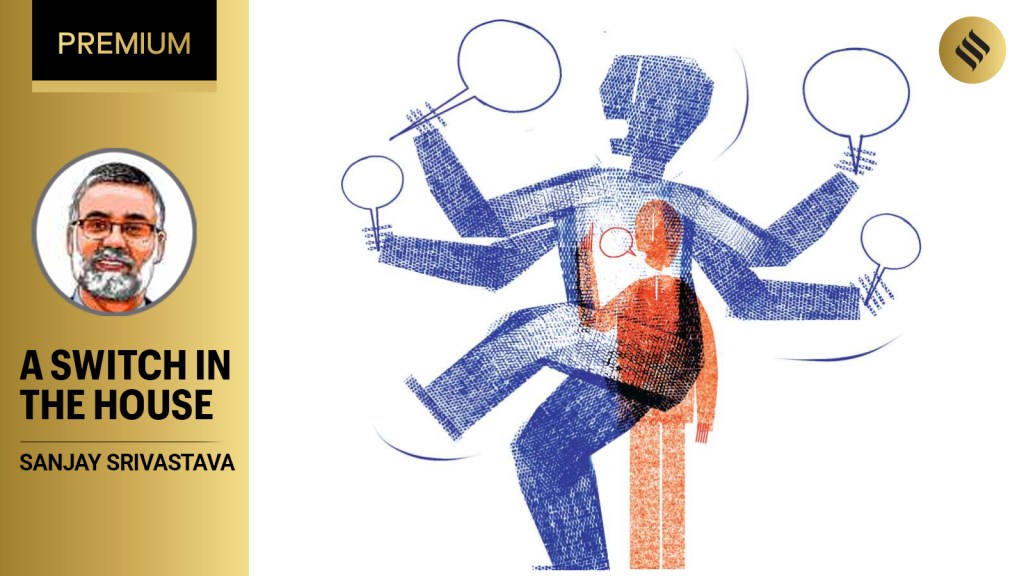 We are now in a moment where the mythical narratives – of ancient glories and moral superiority – through which the dominant party had cast the efficacy and truth-value of its governance strategy have become ragged, writes Sanjay Srivastava.


 Share


