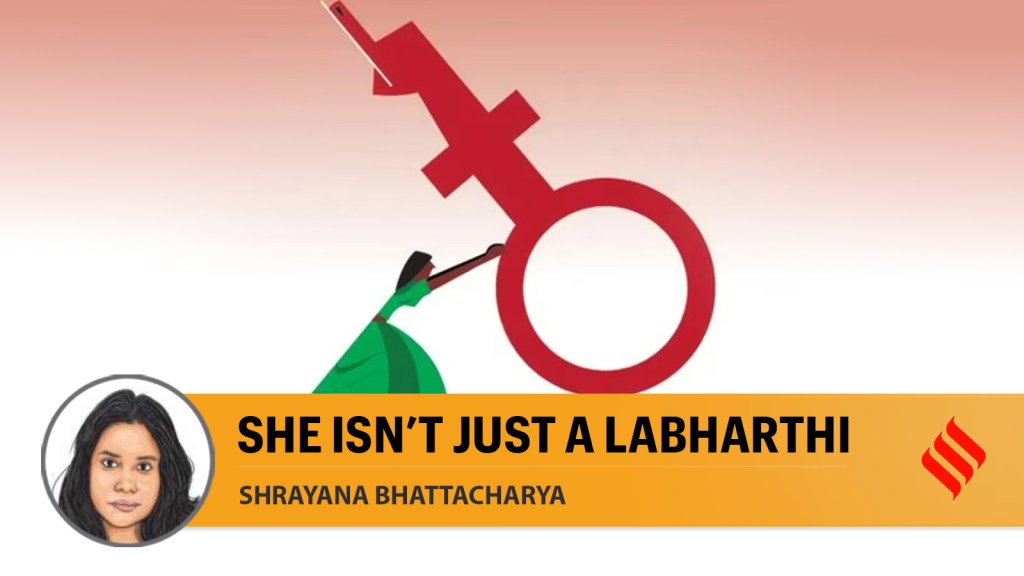
As budget season approaches, policy discussions on leveraging welfare schemes to address gender gaps will become buzzy again. In this deluge of serious data and serious debates by serious people, let’s hope the images of unserious women laughing, joking and seeking joy remain central to the objectives of public investment and our policy makers. Often, stories of women using transport subsidies to meet lovers, enjoy personal holidays or seek adventure tend to make technocrats uncomfortable. Cases of joy rides, or using cash from welfare schemes for personal purchases could be labelled by serious economists as cases of “leakage” in welfare schemes, a diversion of government funds meant to be used by the female beneficiaries purely for lofty development goals. Perhaps, it’s time policy makers abandoned making programmes for well-behaved women who always follow the rules and tradition. Badly-behaved women wink at us, and instruct us to broaden the way we think of how the public interacts with public policy in three ways.
First, our personal and romantic autonomy is often underpinned by economic autonomy. Feminist scholars and activists highlight how government cash transfers directed towards women can boost their intra-household bargaining power and enable many to walk away from unhappy or abusive marriages. My longitudinal research into the labour market choices and careers of a diverse set of Indian women for 15 years, highlighted how most framed economic independence as being a vital ingredient for emotional and sexual independence. Policies that boost women’s access to cash, livelihoods, and a just labour market can ensure that female dependence on arranged marriages and kinship ties for economic insurance and security is reduced. According to the National Family Health Survey which interviewed women between the ages 15 to 49 years, only 13 per cent own a house on their own, while 29 per cent report joint ownership. Reacting to such bleak statistics on asset ownership and well-known gender gaps in the paid labour force, government programmes across the political spectrum have pushed for women to be registered under welfare schemes as primary beneficiaries.

In a view that makes me extremely unpopular amongst propertied married people, I’ve always maintained that many Indian marriages would risk breaking down if women weren’t rendered dependent on men for safe housing and financial security. This is not a misguided endorsement of neoliberal ideas of individualism and their inherent lovelessness. Instead, public programmes that aim to foster an equal and inclusive economy can liberate families and marriages from social pressures and discriminatory traditions that guide who and how we can love. If we know we can live on our own with safety and ease, if the state and market strengthen our ability to take care of ourselves, if laws protect our rights to create our own communities of care — we can marry for love or walk away from the lack of it. This strengthening of personal choice — through redistributive policies — can only improve the health of our social bonds and connections.
Second, it is common to hear politicians and policy wonks suggest targeting women for welfare benefits as a reward for female victimhood, votes, and good behaviour. Reams of data from well-intentioned economists tell us that women spend the cash transferred to them from schemes, or their own incomes, on the “good” of the family — nutrition, savings, and other expenditures deemed worthy by society. Female representation in village governments and corporate boards is studied to provide a business case for equality of voice. But women are hardly do-gooders and saints, let alone a homogenous passive block of wifely voters being seduced by cooking gas and cash. They can run away with the transport subsidies they are given. They can run scams on schemes. Far from the boring hyper-choreographed weddings of sanskari women are the more interesting, unchoreographed weddings of uncouth women. Empowered women need not be too eager to prove their trustworthiness or value to a benevolent policy elite. Nor are they desperate to contribute to human development goals or the GDP. It is refreshing to hear a hint of deviance from women in a society where many politicians and powerful coteries see wives as welfare entitlements and sexually independent women as enemies of the state. Despite economic distress impacting men and women of our precariat equally, the sympathies of our policy discourse are reserved for the male farmer struggling to find a wife due to poor earnings over the woman farmer who wants to marry for love as she navigates a hostile economy and public space, while also providing an endless supply of invisible care labour.
Finally, effective safety nets serve women because they can make dominant masculine power structures feel very unsafe. Such phenomena need deeper study and documentation. Too often, we leave the analysis of welfare programmes to economists with instruments and imagination too limited to grasp the impact such programmes can have on the landscape of interpersonal relationships and social bonds. A few scholars have analysed the shifts in labour power and community dynamics ushered by the Mahatma Gandhi Rural Employment Guarantee Act and self-help groups. Such work needs more dedicated investment, as opposed to being a qualitative annexure or by-product of a quantitative evaluation.
Sadly, the impact of schemes on social ties remains a footnote in the standard framework of appraising programmes. People become passive beneficiaries in elite policy debates — data points for tracking votes, coverage or leakage, robbed of all dignity and agency, always the silent part of a Grand Theory that a Grand Thinker wants to opine about. I have no theories to offer but humbly argue that the credible impact of schemes ought to be measured not only by standard measures of consumption smoothing and leakages but also by how these policy instruments impact the dignity and personal autonomy of the marginalised. After all, each one of us lives for love, pleasure, and purpose; not productivity and profit. Real people and their humanity can’t go missing in our debates on welfare policy.
Bhattacharya is an economist and author. Views are personal



 Share


