There are moments in intellectual history that open up new vistas. The publication of Rahul Sagar’s brilliant The Progressive Maharaja: Sir Madhava Rao’s Hints on the Art and Science of Government is one such moment. The book gives fertile material for thinking about what an alternative state and constitutional imagination based on the princely states would have looked like. In the late 19th century, many princely states – Mysore, Travancore, Baroda — were experimenting with a form of government that would keep the sacral and symbolic power of the monarchy intact, create very limited avenues of representation, but would devolve power largely into the hands of capable administrators, who would impartially modernise the states, and its capabilities. They also had intellectual ambitions. Think of Baroda’s roles in the life of both Ambedkar and Aurobindo Ghosh, or Vivekananda’s reliance on the Maharaja of Khetri. There were, of course, other radical experiments like the constitution of Aundh, where a princely state converted itself into a Gandhian one.
But these modernising states created an extraordinary space for a forward looking pan-Indian cadre of administrator-statesmen, wary of popular government, as much as they were way of absolutist ones. Growing up in Jaipur, the joke used to be that there are two pan-Indian road initials: MG Road, after Mahatma Gandhi, and MI Road, after Sir Mirza Ismail, who had roads named after him in Jaipur, Mysore and Hyderabad. But the jewel in the crown of these administrator-statesmen was Sir Madhava Rao, the brilliant administrator at the heart of three of India’s most politically important states — Travancore, Indore and Baroda. He transformed Travancore and Baroda — fixed the revenues of these states, encouraged industry, modernised their practices, created new administrative cultures, and propelled them into an ambition about learning and culture. One of India’s more revered statesmen, he is now all but forgotten. The book’s riveting introduction is an act of retrieval.

Monarchies, in the final analysis, rest upon nothing but the virtue of their rulers. One of Madhava Rao’s tasks was to educate Sayajirao Gaekwad. For this purpose, he delivered a series of lectures, “Hints on the Art and Science of Government, a treatise in the education of the Ruler”. Like Machiavelli’s Prince, the text was not immediately published, but it had a fugitive afterlife, with references and summaries showing up here and there. But the original text had never been seen. In recent years, interest in the text was revived by Justice Rama Jois, whose post-retirement scholarship was devoted to thinking about Indic political theory. He also published Raj Dharma: With Lessons on Rajneeti. The second part of the book dealt with the teachings of Sir Madhava Rao based on a garbled text. The foreword to the book, which singled out the second part for special mention, was written by Narendra Modi.
What Modi picked out from Jois’ summary is an intriguing matter. In his foreword, he singles out the need for professionalism in the context of administration and statecraft. He praises Madhava Rao’s emphasis on teamwork and fair play, and argues that after selecting officers for capacity “the minister should treat them with confidence”. It ends with the resounding recommendation that “his (Madhava Rao’s) teachings have the potential to solve any problem faced by Governments and the Corporate World”.
In a magnificent feat of detective work, archival research, dogged perseverance, Rahul Sagar managed to find the original text of Sir Madhav Rao’s lectures. Hints on the Art and Science of Government is, now, finally in our hands. It is an astonishing window into that alternative modernity statesman like Madhav Rao were trying to induce — a non-representative, non-absolutist, impartial administration. Historians of Indian political thought and politics owe Rahul Sagar a debt too deep to be formulated.
These are lectures for the edification of a prince; they are not sustained pieces of argument. They have two objectives. On the one hand, they articulate the aims and ends of government in a way that is impressively wide ranging. The book is not a liberal tract in the modern sense of the term, where the starting point is the freedom and equality of citizens. The word liberal and its cognates, liberality, are used a lot. But that is in the 19th century sense of cultivating an elevated, open and magnanimous character. It broadly advocates a form of what might be called strong state liberality. It grants great deal of personal liberty, moderate taxes, due process and equality before law, strong rule of law, strong emphasis on public health and education, and even a taxation policy that encourages manufacturing, open to men of talent (like Madhava Rao himself), without being a meritocracy. The lectures are silent on social inequality. The second objective is the art and science of administration — the emphasis on procedure, but most importantly, the grasp of character. Like all monarchies, Madhava Rao’s, in the final analysis, is reliant on a discourse of virtue. You can instinctively see why the contemporary discourse on duty has a monarchical flavour to it. But in most of the fun parts of the book, the emphasis is on the king acquiring insight into human character, particularly those of his ministers — how to spot discontent, intrigue, faction, and how to inspire confidence in ministers.
It is intriguing that Modi’s foreword highlighted the parts on professional administration. What is striking in the book is the concern that even in this ambitious state, there is a concern for liberty. In an extensive discussion of public health, sanitation, water, air, drainage and vaccinations, it ends with this caution: “In our anxiety to promote public health, we have however to be careful not to interfere unnecessarily with the liberty of the individual — a liberty which is one of the most valuable blessings. The individual must not be forced to take a particular diet or particular medicine.”
You can also trace an alternative genealogy of secularism through the Princely States. On education, he writes: “The education given should be elemental in regard to religion, that is to say no special religious instruction should be given. The policy of the State should be to let every individual practice any religion he likes, provided he does not thereby injure others, that is to say violate the rights of others.”
This is not a text written for democracy; if anything Madhava Rao wanted to stave off representative government. But as we get nostalgic for formidable but now forgotten figures like Madhava Rao, we might be better off not just with their concern for administration, but their elevated liberality in the best sense of the term.
The writer is contributing editor at The Indian Express

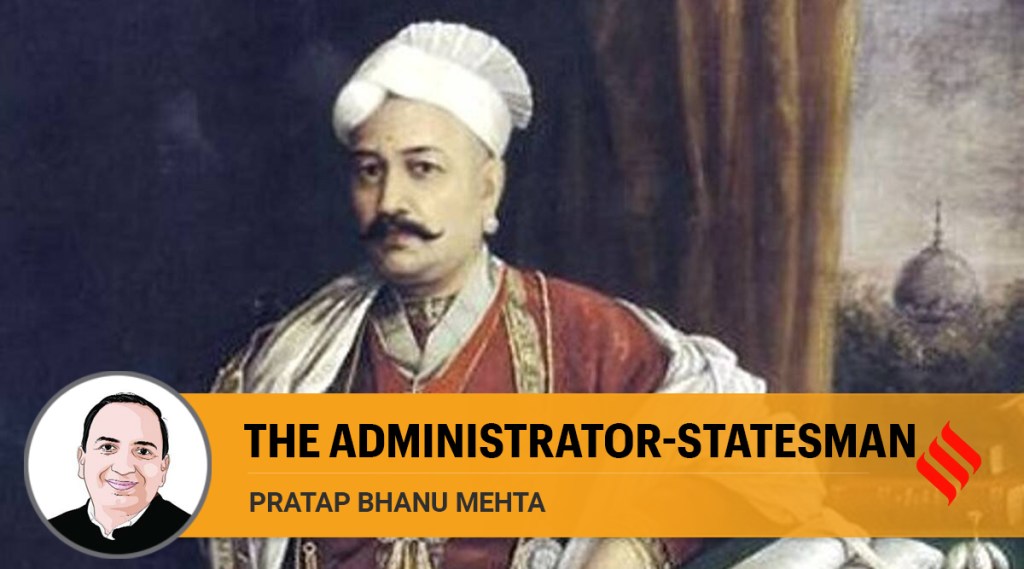 Pratap Bhanu Mehta writes: Hints on the Art and Science of Government is, now, finally in our hands. It is an astonishing window into that alternative modernity statesman like Madhav Rao were trying to induce — a non-representative, non-absolutist, impartial administration. (Wikimedia Commons)

 Share


