
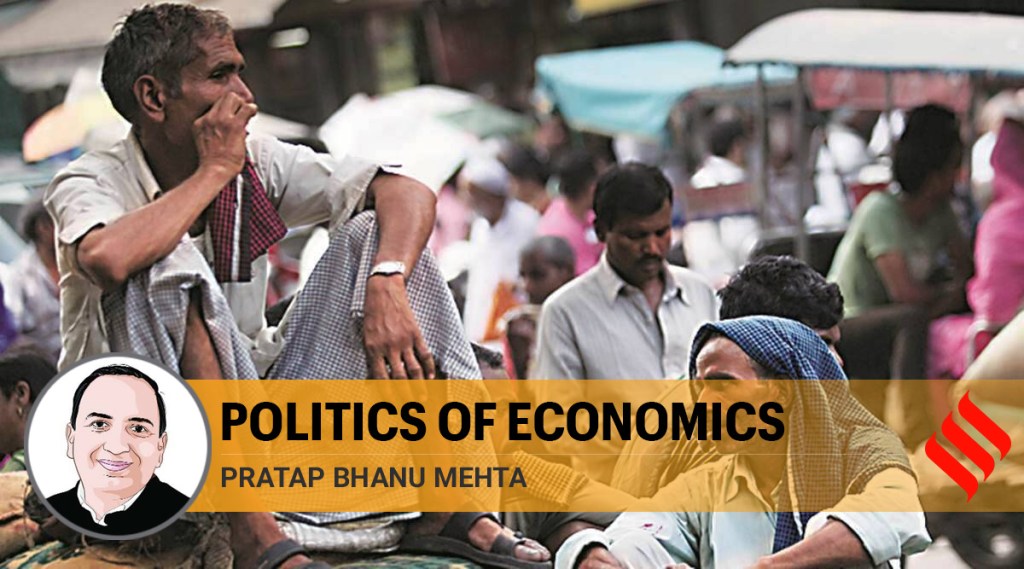
What does India’s political economy look like in the aftermath of a series of high-profile economic reforms that the Narendra Modi government has undertaken? The economic effects of these reforms will play out over the long run. This piece is not an economic assessment of these policies. It is a reflection on the political economy of the Modi model, which is now acquiring systematic contours.
First, broadly speaking, macro-economic stability matters. But, politically, the government remains convinced that inflation carries serious political risks. This is going to remain a cornerstone of macro political economy.

Second, the relative bargaining power of capital in relation to labour will continue to radically favour capital. This has been the trend for the last two decades. In emerging economies, there will be a race to the bottom as far as sensible protections for labour go. Indonesia has, like India, gutted labour protections. The previous regime of labour laws was deeply broken and it served neither the cause of capital efficiency nor labour protection. So, it is politically pointless to defend the status quo. Politically, it was easy to portray the small section of the economy that has protected labour as an aristocracy impeding the progress of other excluded labour rather than as a bulwark against capital. But the migrant labour crisis throws up another puzzle. The degree of hardship inflicted on migrant labour is still not showing up in any serious political backlash. One explanation is the politics of faith — like demonetisation, this punishment has not deeply broken faith in Modi. But there may be something deeper: That migrant labour has been always so radically disenfranchised in political terms that they have little faith that any alternative dispensation would have done better for them. So no political strike against Modi.
Third, in agriculture, the problem is similar to labour — any position that simply involves defending the status quo loses political support. Whether or not these bills will result in greater prosperity for farmers is an open question. It depends on the follow-up. The political consequences of the agriculture bills are far-reaching in a state like Punjab where MSP is very significant. But the political effects will be largely concentrated in a few states like Punjab and Haryana. In fact, for those not in agriculture, the bills strengthen the government’s reformist credentials. Ideologically, it is not easy for the Congress to mount an opposition to the bills, because their policies were headed in the same direction, even if they might have been more nuanced. Also, nothing in the bills precludes the state from continuing with MSP. So, the whole argument will turn on convincing affected farmers of the government’s intentions. The events in Punjab could yet spiral into a crisis if not handled well. But there is little evidence of a national opposition to the bills.
Fourth, state-capital relations. State and capital relations will remain very politically cosy. In significant sections of Indian capital, there is a deep commitment to the Hindutva project. The government understands that control of the information order requires control of capital; so it will superintend it. Corruption will be more structural rather than transactional. This has the advantage of being able to mobilise all the necessary funds, and yet at the same time giving the impression that transactional corruption has come down. There are three areas of discretion that will continue to be the subject of state-capital negotiations. First, there is no evidence to suggest that the channelling of credit will not, at the margins, continue to be directed to the favourite players. The Insolvency and Bankruptcy Code was a good legislation. But, as Urjit Patel argued in Overdraft, the government undermined its own legislation, largely it seems so that it could still exercise discretion. So the political economy suggests that we are not going to see major financial sector reforms soon. With Atmanirbhar Bharat, there is more scope for negotiation on tariffs in different sectors. It will be interesting to see if these negotiations are governed by an economic or a political economy logic.
Finally, this government is comfortable with greater concentration of capital. The argument that there is a need to create national champions who can leverage scale will be used to justify the dominance of the Ambanis over the Indian economy to a point that is unhealthy. But can this nexus be converted into a political narrative of corruption? This is going to be difficult. In the previous anti-corruption movement, the media was complicit in the campaign and it acquired plausibility because of existing high-profile transactional corruption. Structural corruption will be harder to convert into a political narrative.
Fifth, there is a deepening of the new welfare state. Interestingly, the Modi government’s focus here is on six of the new indicators that the Oxford Multi-Dimensional Poverty Index uses to supplement traditional indicators of health and education. Cooking fuel, water, sanitation, electricity, housing and assets. These schemes have several political advantages. These are vital initiatives. They target women, and are visible. The real question is whether outcomes are translating into results. For instance, the Ujjwala Yojana was quite successful in reaching its target of the number of new connections. But, according to government data, per capita cylinder use under the scheme in 2019 was 3.28 refills, suggesting that the gap between the number of connections and the usage you would expect based on those connections was very wide. But these are the six schemes to monitor closely. We need more objective scrutiny of these schemes of the kind MGNREGA was subject to under UPA. But a lot will depend upon whether the government narrative on these schemes can be countered with some real evidence that these schemes are not delivering. From a political point of view, the challenge will be that while some of the government’s claims may turn out to be inflated, will the shortfall be sufficient to demonstrate government failure?
Finally, there is the political economy of federalism that has come under immense strain because of GST and the government’s encroaching on the state’s rights in recent legislation. But the blunt truth is that, in the final analysis, the potency of this fault line depends on the states. If the BJP wins Bihar and Bengal, the potential of significant revolt on federalism issues will diminish.
Despite economic headwinds, it has not been easy to use the economy as a point with which to attack the Modi government. It has still positioned itself as a breaker of the status quo. The opposition will have to think more intelligently about the political economy of protest to counter the new political economy of reform.
The writer is contributing editor, The Indian Express

 Share


