
Guilty till proved innocent
Burden of proof in POCSO cases lies on the accused. The introduction of death penalty will make it difficult for the weak and poor to overturn presumption of guilt.
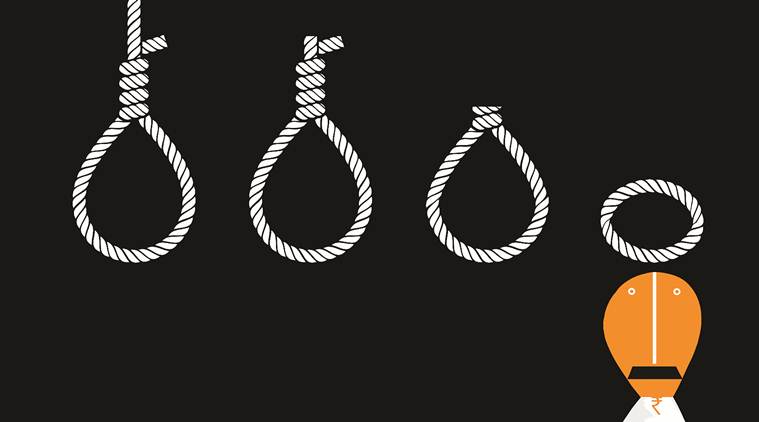 Sexual violence is a grave problem in India, and child sexual abuse has been described as an epidemic. (Illustration: CR Sasikumar)
The Union Cabinet has approved amending the Protection of Children from Sexual Offences Act, 2012 (POCSO), to introduce the death penalty as a punishment for offences of penetrative sexual assault and aggravated penetrative sexual assault (Sections 4, 5 and 6). Cases of sexual assault by police officers, members of the armed forces, public servants, gang-penetrative sexual assault, and relatives are treated as “aggravated” cases, as are cases where the survivor is less than 12 years old.
The reason given for introducing the death penalty is that it will deter child sexual abuse. The government’s press release does not cite any evidence to prove that the death penalty can achieve this goal, in the absence of better policing and shorter trials. POCSO is already a stringent act, carrying presumptions of guilt of the accused. Imposing the death penalty for offences that already carry such stringent presumptions violates the right to life guaranteed under the Constitution. Further, it is especially difficult for the poor or disadvantaged groups to overturn these presumptions. And, studies show that most death row prisoners are from poor, lower caste or religious minority communities.

Usually, in criminal cases, the burden of proof lies on the prosecution, and the guilt must be proved beyond reasonable doubt. Under POCSO, however, there is a presumption that a person who is prosecuted for an offence has actually committed the offence, unless the contrary is proved (Section 29). Instead of “innocent until proven guilty”, the court assumes that the accused is guilty once the prosecution lays the foundation of the case. The Act also presumes that the accused person had a sexual intent when touching the child (Section 30).
The 262nd Law Commission Report has recommended universal abolition of the death penalty, except in terror cases. (The report excluded terror cases not because it found any penal or national security justification for retaining the death penalty, but because there was a sharp division amongst law makers on this question.) Under Article 21 of the Constitution, a person can only be deprived of their life or liberty in accordance with the procedure established by law. This procedure must be just, fair and reasonable. Without quality legal representation, it is virtually impossible for an accused to overcome the presumption of guilt. Imposing death penalty in an offence with a presumption of guilt cannot be a just or fair procedure.
Rebutting these presumptions requires either that the accused bring witnesses and documents in their defence or conduct a stellar cross-examination. Both require high quality lawyering. In my experience defending indigent POCSO accused as a lawyer for the Delhi High Court Legal Services Committee, overcoming these statutory assumptions is difficult and expensive for the poor. For daily-wage earners, the legal process means loss of income as well. If the accused is in jail, their family will have to collect evidence and find witnesses. And neighbours or employers may not readily give evidence for migrant workers.
A 2016 report by the Death Penalty Project, National Law University, Delhi found that death row prisoners are overwhelmingly poor, lower caste, or religious minorities. Seventy six per cent of death row inmates were poor. The report found that 17.4 per cent of death row convicts were aged 18-21 years at the time of the incident, 18.5 per cent of this group had never attended school and 59.2 per cent had not completed their secondary education. Researchers identified “economic vulnerability” based upon occupation (including manual casual labourers, marginal and small cultivators, low paying public and salaried employment, small own account enterprises, students, unemployed, religious occupations, salaried public and private employment) and landholding (medium and large cultivators). Based on this criterion, 74.1 per cent of death row prisoners were found to be economically vulnerable.
Economic vulnerability impacted the experience of the prisoner during the investigation and trial. About half of the sample of 383 prisoners spoke about lack of access to lawyers. Of these, 97 per cent (185 prisoners) did not have access to a lawyer during interrogation. Eighty per cent of those who did not have access to a lawyer were economically vulnerable. One hundred and fifty five persons spoke of their experience of custodial violence, and 128 of being tortured in police custody.
Seventy six per cent of death row prisoners were from backward classes and religious minorities. Although the report noted that its “purpose was not to suggest any causal connection or direct discrimination”, it suggested that the “disparate impact of the death penalty on marginalised and vulnerable groups must find a prominent place in the conversation on the death penalty”. At the national level, 24.5 per cent of those on death row were from Scheduled Castes and Scheduled Tribes with Maharashtra, Karnataka, Madhya Pradesh, Bihar, Jharkhand and Delhi being above the national average. The report also found that as cases travelled up the court hierarchy, the proportion of general category prisoners fell, and the proportion of Scheduled Caste and Scheduled Tribe prisoners increased.
Introducing the death penalty in POCSO is likely to send more poor, lower caste and religious minority accused to death row. Sexual violence is a grave problem in India, and child sexual abuse has been described as an epidemic. Introducing the death penalty may grab headlines, but it is not the solution.
 Share


