5 min readAug 25, 2021 07:40 AM IST
First published on: Aug 24, 2021 at 03:27 AM IST
The recent Monsoon Session of Parliament is proof that the speed of passing laws trumps their rigorous scrutiny in our legislative process. These pages have been replete with statistics about the two Houses passing laws in the din in a matter of minutes. Our national legislature has similarly enacted laws even during previous administrations. The repetition of such legislative functioning is appalling, especially as both government and Parliament continue making the same mistake. In our parliamentary system, a majority of laws originate from the government. Each ministry decides the path its legislative proposals will take from ideation to enactment. For example, last year, the Shipping Ministry requested public feedback on the two bills — Marine Aids and Inland Vessels— it piloted during this session. This mechanism enables the strengthening of the legal proposal through stakeholder inputs before being brought to Parliament. However, ministries expedite their bills by not putting them through a similar pre-legislative scrutiny process.
Another way for the government to fast track legislation is through the ordinance route. The Constitution empowers the government to make a law when Parliament is not in session, and the situation requires immediate action. Over the years, successive governments have exploited the spirit of this constitutional provision. Governments have promulgated an ordinance a few days before a parliamentary session, cut a session short to issue one, and pushed a law that is not urgent through the ordinance route. But the executive sometimes fails to follow through on the legislative urgency. For example, last October, it issued an ordinance to set up a commission for air quality management of the national capital region. But during this year’s Budget Session, it missed the deadline for getting parliamentary approval for the commission. The government had to re-promulgate the ordinance after the Budget Session. Parliament then passed the bill to replace the ordinance in the din during this monsoon session.

Bringing in law through the ordinance route also bypasses parliamentary scrutiny. Logic would suggest that the legislature rigorously examine a hurriedly-enacted law to ensure its intended purpose is not compromised. But parliamentary committees rarely scrutinise bills to replace ordinances because this may take time and defeat the issuing of the ordinance. But this does not always result in the desired outcomes. Over a year ago, the government promulgated the three farm ordinances. There was pandemonium in Rajya Sabha over the demand to get them examined by a parliamentary committee. Since then, disruption in Parliament on the farm laws continues, and the statutes have been kept in abeyance by the Supreme Court. Over the last few years, bills like GST, Consumer Protection, Insolvency and Bankruptcy, Labour Codes, Surrogacy, and DNA Technology have benefited from parliamentary committees’ scrutiny. Their closed-door technical deliberations, inputs from ministry officials, subject-matter experts, and ordinary citizens have strengthened government bills.
Unnecessary urgency in getting laws passed by Parliament does not result in their immediate implementation. For the law to work on the ground, the government is supposed to frame rules. Last year the Cabinet Secretary twice requested the personal intervention of secretaries heading the Union ministries to frame regulations for bringing into force the laws made by Parliament. He wrote, “delays in notifying subordinate rules/regulations adversely affect the timely implementation of Acts and defeat the purpose for which they were legislated.” Before the Monsoon Session, he wrote a follow-up letter on similar lines to his colleagues.
Our country needs a robust lawmaking process, one that does not bend to executive urgency or succumb to political expediency. The government must ensure that it identifies the gaps in our legal system proactively. All its bills should go through pre-legislative scrutiny before being brought to Parliament. The legislature, on its part, should conduct in-depth scrutiny of government bills. A simple debate on the floor of Parliament should not be enough for the legislative institution to stamp its approval. Mandatory scrutiny of bills by parliamentary committees should become the rule and not the exception. Hurriedly-made and inadequately-scrutinised laws hardly ever achieve their desired outcomes. Our statute books are full of examples of laws that have either failed or had unintended consequences. Enacting statutes without proper scrutiny also wastes the legislature’s time when the government approaches Parliament to amend such laws. But the unmeasurable cost of a poorly-made law is in the loss of opportunity to an entire nation that has to comply with it.
This column first appeared in the print edition on August 24, 2021 under the title ‘More scrutiny, less speed’. The writer is head of outreach, PRS Legislative Research

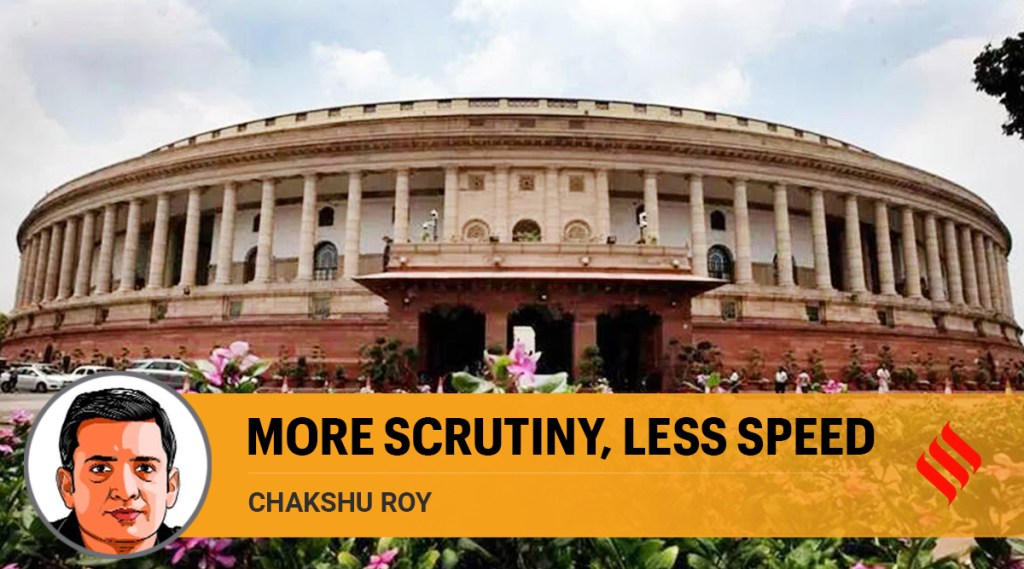 The Constitution empowers the government to make a law when Parliament is not in session, and the situation requires immediate action.



 Share


