On April 22, when Pakistan-linked terrorists attacked tourists in Pahalgam, it was a strike on our national conscience. Their brutality shocked the country. Earlier, they had targeted military posts — these were also acts of terror — but this time, they attacked innocent civilians. Everyone, irrespective of party, stood by the government. A strong response was needed. Indian forces carried out precision strikes on terror bases in Pakistan, followed by strikes on airbases in response to Pakistani escalation. Subsequently, we accepted Pakistan’s ceasefire proposal. But we can hardly believe its assurances.
Past instances show that Pakistan has never kept its promises. The wide gap between what it says during diplomatic meetings and its actions reveals its unpredictability. On May 23, 2019, after the results of the Indian general elections, Imran Khan, then Pakistan’s Prime Minister, tweeted, “I congratulate Prime Minister Modi on the electoral victory of the BJP and allies. Look forward to working with him for peace, progress and prosperity in South Asia.” However, such commitments didn’t find any resonance on the ground. In 2022, after Khan’s removal following a no-confidence motion, Shehbaz Sharif became the PM. In its electoral manifesto, Sharif’s party reportedly promised “peace” with India and other countries. In February this year, months before the heinous attack in Pahalgam, Sharif even expressed his intention to resolve the tension between the two South Asian neighbours, along the lines of the 1999 Lahore Declaration. But talk of peace and terrorism cannot happen together.

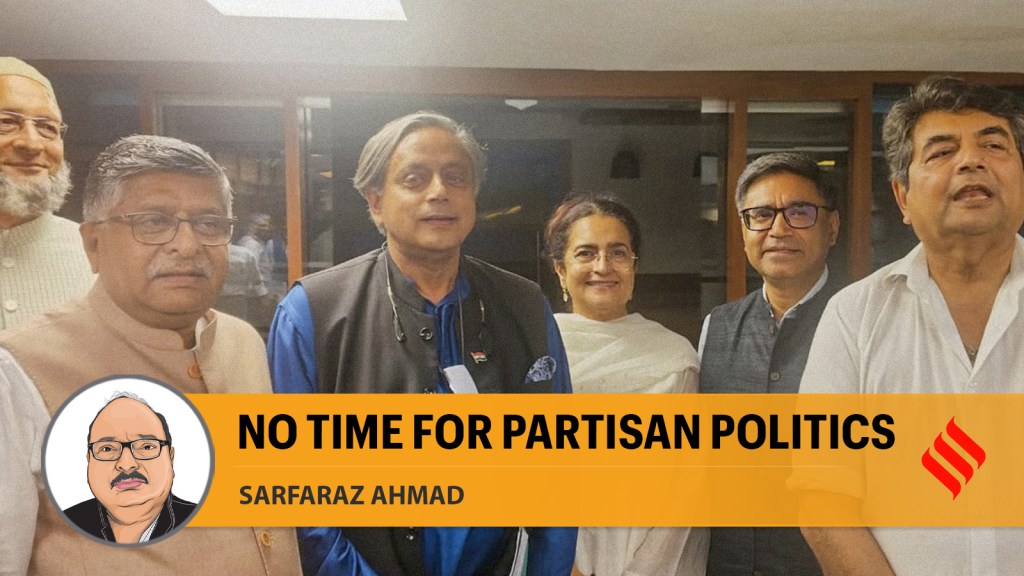
This is why we must address the global community and expose Pakistan’s hypocrisy. After Pahalgam, we had two all-party meetings where we stood together with the government for the larger national interest. In the same spirit, the government plans to send multiparty delegations to a number of countries, barring China and Turkey, which seemed to have supported Pakistan during the escalation. The government’s gesture to the opposition parties is a welcome move. Still, there are many issues to resolve, and discussion is the only way forward.
Leader of the Opposition and senior Congress leader Rahul Gandhi has raised some crucial questions regarding the modus operandi of the operation and the losses suffered by India. The government must clear these doubts before the delegation leaves to convey India’s message to the world.
The formation of the delegations and the selection of representatives have also resulted in some controversies. Though I was directly asked by Union Minister Kiren Rijiju to join the delegation, and I got back to him after getting approval from my party’s top leadership, the case of Congress is perhaps different. The party may have some internal issues over Shashi Tharoor’s selection as a member of the delegation. But there are other Congress leaders who are part of it — one recommended by the party. The Trinamool Congress also initially expressed concerns and withdrew Yusuf Pathan’s name. However, it was soon resolved as the government agreed to nominate Abhishek Banerjee instead. We are a democracy because we have differences and we know how to talk them out.
Whatever the controversies may be, this is the time for us to present a united front to the world to counter the malicious campaign run by Pakistan. National interest trumps partisan politics. We must not forget that justice has not yet been fully served to the families of the Pahalgam victims. They need the assurance that there will be no Pahalgam, Uri, Pathankot, or Amarnath in the future. Our delegation is a step in that direction.
The writer is a Rajya Sabha member and a senior leader of the Jharkhand Mukti Morcha. He is part of the government delegation to the US



 Share


