
Opinion There can be no equivalence between India and Pakistan on terror
Against this backdrop one must understand the importance of political leaders from across party lines speaking in one voice and attempting to correct perceptions in major world capitals
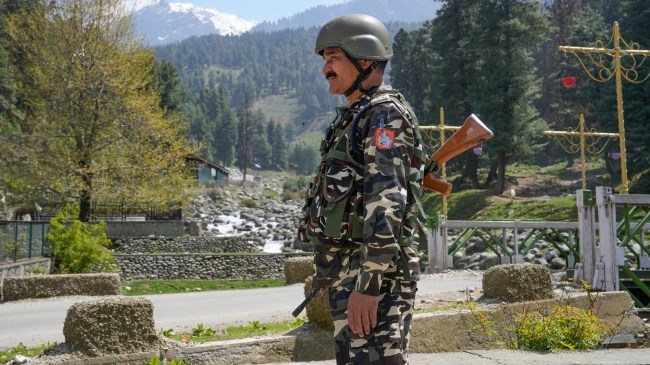 Many consider both India and Pakistan to have legitimate complaints against each other, viewing both as being at fault, in one way or another.(PTI Photo)



A Brahmos missile — several were fired during Operation Sindoor in response to the gruesome terror attack in Pahalgam — typically costs around Rs 35 crore. For approximately less than half that cost, seven all-party delegations have made as much of an impact. Just like the BrahMos, they were precisely on target. Galvanising global political and social opinion in India’s favour at such a time cannot be left to career diplomats alone. The decision to send these delegations is itself a historic step by the government, with the political class across the spectrum rising to the occasion.
This step was needed as foreign governments and media, especially from the West, have not grasped the gravity of the challenge of cross-border terrorism faced by India for the last several decades. The West, generally speaking, also has the habit of looking at Pakistan as just another Islamic state, ignoring the history of its origin, its partition in 1971 and its habit of promoting terrorism while playing the victim card. Many consider both India and Pakistan to have legitimate complaints against each other, viewing both as being at fault, in one way or another.

While the challenge of tackling misperceptions about India — especially our neighbourhood policy — is daunting, the least we must do is persuade foreign leaders and opinion makers to drop their habit of bracketing India and Pakistan together. It is against this backdrop that one must understand the importance of political leaders from across party lines speaking in one voice and attempting to correct perceptions in major world capitals.
Global opinion makers habitually make at least four mistakes: Looking at Pakistan as being forced to secede from India; thinking that India instigated the conflict between West and East Pakistan; equating Islamic nationalism with India’s cultural nationalism, and finally disregarding the centrality of the army’s role in Pakistan’s governance.
Why does the global media continue to be shy in calling a spade a spade? Why are terrorists in Jammu and Kashmir referred to as militants? Let’s examine the seriousness of these mistakes, as India has been paying a huge price for the ignorance — manufactured ignorance, in some instances — of the global community.
First thing first: The global community needs to be told that the creation of Pakistan out of undivided India is not comparable with the case of East Timor or Kosovo. Those who left for Pakistan during Partition were neither persecuted nor did they face any injustice. However, the deep-seated guilt complex of Indian leaders of the time manifested through the policy of Muslim appeasement for several decades post-Partition and lent credence to Pakistan’s attempts to present itself as an underdog. This went unchallenged primarily because we failed to make the right noises, backed by data, in opinion-making circles, thereby failing to show how Pakistan shelters and patronises terrorists to ensure its own survival.
The second grave mistake of the global community lies in equating the separation of East Pakistan with Pakistan-sponsored secessionism in Jammu and Kashmir. Unlike the government of Pakistan back then, governments in India — regardless of which party is in power — worked to transform J&K into a developed state. They’ve done this by providing huge welfare support to the people of this border area. It would not be wrong to suggest that the continuation of Article 370 was used by the global community as evidence of India’s wrongdoing, that it undermined its claim over this Union Territory. It is high time we make it clear to the global media, academia and intelligentsia that the case of J&K is not comparable to that of Bangladesh and that the JKLF is not the Mukti Bahini.
The BJP has made it clear that not just cultural nationalism, but even the idea of a Hindu rashtra, has nothing to do with a theocratic state. Ekam sat, vipra bahudha vadanti is the foundational value of our cultural nationalism, reflected not just in the BJP’s worldview but in its governance. Indian culture is all about abhorrence of any monopolistic approach in spiritual matters. Sadly, thanks to many in our own intelligentsia, there are attempts to build a false narrative that eventually allows Pakistan to take shelter under a manufactured whataboutery.
Right from the time of its founding, Pakistan has presented itself as a victim. Indian governments of the time, on the other hand, failed to present Pakistan as an aggressor state. Post-Independence, our leadership always shied away from bringing Pakistan’s expansionism to the notice of the global community with adequate force.
The writer is a national executive committee member of the BJP

 Share
Share


