
NJAC was the people’s will
The most important structure of the Constitution is parliamentary democracy and Parliament represents the will of the sovereign.
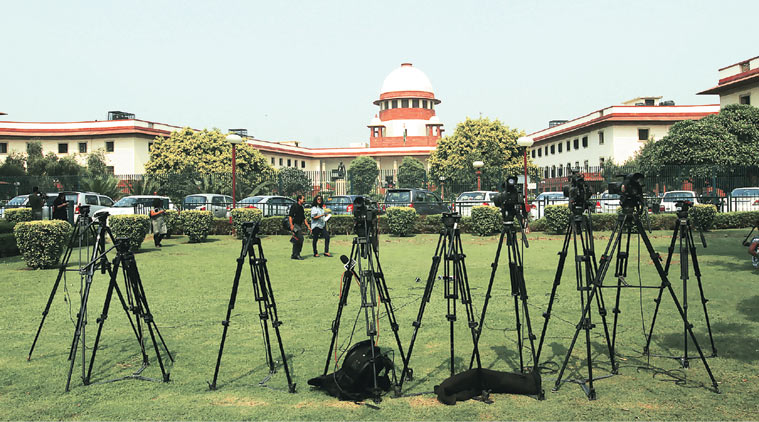 Supreme Court of India
On October 15, a constitutional bench comprising five judges declared the National Judicial Appointments Commission (NJAC) act unconstitutional on the plea that it would affect the independence of the judiciary. The bench also struck down the 99th Constitution Amendment Act, which was passed unanimously by both Houses of Parliament. In fact, the judgment has tried to compromise with the basic structure of the Constitution of India. The Constituent Assembly, in the Preamble to the Constitution, made it clear that the people of India will be the sovereign of the Indian Republic. The most important structure of the Constitution is parliamentary democracy and Parliament represents the will of the sovereign.
India’s 125 crore sovereign rule the country through their elected representatives, parliamentarians, councils of ministers and the different organs of the executive, legislature and judiciary, which work under Montesquieu’s theory of the separation of powers. One organ should not interfere with the powers of another. But one thing that cannot be compromised is the sovereignty of the nation, which lies with the people of India and is exercised by the people through Parliament.

In its order, the apex court has not only declared the NJAC act unconstitutional but also allowed the collegium system — which was introduced in 1993 by former Chief Justice of India P.N. Bhagwati although there is no constitutional provision for it — to function. Many learned jurists have criticised the functioning of the collegium system. K.P.S. Gill, former DGP, said that India is the only country where judges select themselves, determine their own transfers and discipline themselves. He recommended the setting up of a judicial commission that would not only be responsible for the appointment and transfer of judges but also for seeing to it that judges perform their duties without any favour (in Judging the Judges, Gyan).
In a discussion in the Rajya Sabha on the Liberhan Commission report, former law minister and then leader of the Opposition, Arun Jaitley, expressed his view that there are two types of judges — “one who knows law and second who knows the law minister”. This opinion strengthens the allegation that the influence of the executive in the appointment of judges cannot be ruled out unless a judicial commission is formed. On the same occasion, Jaitley also said the clamour for post-retirement jobs is also adversely affecting the impartiality of judges of the higher judiciary.
In September 2012, the CJI wrote to the law ministry that in case of a complaint against a judge of a high court or the Supreme Court (SC), it is important for the judiciary to conduct its own probe before the matter is handed over to any agency. With this letter, the CJI put a question mark on the integrity and independence of our investigating agencies.
On the issue of judicial accountability, Shanti Bhushan, in an article published in September 2009, remarked that the problem of judicial accountability has been compounded by the SC’s judgment in the Veeraswami case, in which the apex court held that no judge of the SC or a high court can be subjected to even an investigation
for any offence of corruption, unless one obtains prior written permission from the CJI.
This has resulted in a situation where no sitting judge has been subjected to investigation in the last two decades, despite public knowledge and complaints of widespread corruption in the judiciary. The police do not dare approach the CJI for permission to investigate the charges labelled against a judge unless they already have clinching evidence, which they cannot get unless they investigate.
There were many criticisms about the collegium system as it failed in its aims and objectives of maintaining transparency in the appointment of judges and dealing with corruption charges against them. It also resulted in inordinate delay in the disposal of cases and pendency of a large number of cases in the higher judiciary. Further, the complexities of the collegium system resulted in a large number of vacancies for high court and SC judges.
The NJAC act was passed unanimously on the demand of noted jurists and learned personalities in order to make the process of judicial appointment transparent and for dealing with corruption in an effective way. Surprisingly, the five-judge bench not only struck down the act but also brought back the collegium system that has so many discrepancies. It is necessary to make a brief list of different enactments for the appointment of judges.
In August 1861, the Indian High Courts Act was passed and it prescribed professional qualifications for judges. The judges were appointed by the British monarch and held office at her majesty’s pleasure. The
enactment of the Government of India Act, 1935, gave a new dimension to the country’s judicial system. It guaranteed security of tenure to judges who could hold office until they attained the age of 65. They could be removed by her majesty only on grounds of proven misbehaviour or infirmity of mind. After Independence, Article 124 to 147 dealt with the establishment and constitution of the SC, the appointment of judges and related matters.
In all these enactments, the sovereign of the nation was empowered to make appointments to our judiciary. If the learned judges found any element of unconstitutionality in the NJAC, they could suggest the removal of such elements because the act was passed unanimously and expressed the will of 125 crore people. Striking
down the act is an effort to weaken Parliament’s sovereignty. Striking down the 99th amendment and re-legislating the provisions of Article 124 and 217 are also a violation of the principle of separation of powers. The independence of the judiciary is an important objective of the Constitution, but the basic structure of the Constitution cannot be compromised as has been done in the present case.
The writer is Union minister for micro, small and medium enterprises
 Share


