6 min readNew DelhiAug 10, 2022 09:08 PM IST
First published on: Aug 9, 2022 at 07:49 PM IST
“Jo party ya parivar nahi balki apne dum par zameen se uththa hai, vo satta-bahattar saal par jakar pradhan mantri banne ka mazboot davedaar ban payega” (the one who rises from the grass roots, not through a family or party, but on his own steam, will, in his seventies, become a strong candidate for prime minister). Nearly 10 years later, I remember these prophetic words by Nitish Kumar, from a dinner event in honour of Nobel laureate Joseph Stiglitz who was visiting Bihar.
In 2010, Bihar was going in for an election that would set a new template for its politics. Nitish Kumar, then widely credited for building a new grammar of developmental politics, was up for re-election. Chandrababu Naidu’s unexpected defeat a few months earlier in Andhra Pradesh was reinforcing the impression that development doesn’t win votes. Nitish was set to belie that story. The visible transformation of law and order alongside the beautiful sight in village after village of girls riding cycles to school and the relentless building of roads laid the foundation for the Nitish-led Bihar model. He led the Centre-state public finance dialogue for Bihar with support from his deputy, the BJP’s Sushil Modi. To his credit, the then Prime Minister, Manmohan Singh, understood the needs of Bihar and respected the mission of Nitish Kumar, even if he was with the NDA. This was a gentleman-statesman era of Indian politics, now fast disappearing.

Nitish Kumar won the 2010 assembly election with a thumping majority. At that time, as a student at Harvard University, I led the Bihar Leadership Project which focused on data analytics, developmental messaging, and systematic monitoring of the campaign. The chief minister invited me to return to Bihar after graduating from Harvard to work with him and I readily accepted. Over the next five years, I was assigned key roles in several ambitious missions such as the Harit Bihar Abhiyan and the Special Category Status for Bihar Campaign. Starting 2012, the race for prime ministership in 2014 became an open contest. Nitish vs Modi and Bihar Model vs Gujarat Model became the most engaging conversation in many parts of the country. In reality, Nitish never cast himself in the race. It was his many successes in governance that put the spotlight on him. He shocked the country by breaking the alliance with the BJP in 2013. Powered by unmatched campaign machinery, the BJP and Narendra Modi bulldozed the Nitish model in 2014 with a thumping victory in Bihar. Taking moral responsibility, Nitish resigned as chief minister and announced Jitan Ram Manjhi as his successor. Seeing an opportunity to vanquish Nitish, the BJP played every trick in the book. Manjhi was the first Eknath Shinde but he would not be the last. By all accounts, RCP Singh has turned out to be the latest missionary for the BJP.
In 2014, when Nitish Kumar resigned as the CM, I was working as Country Economist for the London School of Economics. I resigned to serve as chief of staff for the ex-CM. In this role, I came face to face with the person behind the image. For example, Nitish moved into a new house that was barely functional — all it had was a telephone. I ordered the modem and a laptop based on the allowance he would get as part of his salary. The e-commerce delivery person was amused to learn that the ex-CM was ordering such products online. I was able to bring Nitish up-to-speed with platforms such as Twitter, Facebook, Linkedin and digital news. In no time, he was able to see the way the BJP had used social media to replace his narrative of development with false propaganda. He decided to set the record straight by conducting a “Sankalp Yatra” across Bihar, where he would play during his speeches the now popular set of audio bytes of false promises made by Narendra Modi that I had collated for him.
It is a magnificent achievement that Nitish defeated the BJP not only to reclaim the chief ministership from Manjhi but also build an alliance with Lalu Prasad. Together, they routed the BJP in the 2015 elections. An unrelenting BJP struck back to force Nitish to break the alliance in less than a year, much to the disappointment of all who saw him as a self-made leader who could be prime minister. Notwithstanding this, the BJP’s anger against Nitish did not subside. Chirag Paswan became its instrument to deceptively counter Nitish in the 2020 Bihar elections. Once again, the BJP failed to vanquish Nitish Kumar. As the RCP Singh story unfolds, it is clear that the BJP has not given up.
What makes Modi and the BJP nervous about Nitish Kumar? Whether he was an ally or enemy, they made countless deceptive attempts to “finish” Nitish (in the words of a Union minister). Nitish comes from a family of freedom fighters. Unlike Modi, he is neither a multiplier nor a divider of public narratives. His moves are incremental but concrete. Unlike BJP leaders, Nitish is not a religious person. He is a man of wisdom and spirituality. Nitish’s most used line is “jo kahte hain, kar ke dikhaate hain (we do what we say)”. He has a socialist lineage and is unaligned to and unhyped by corporate lobbies, not powered by media and social media propaganda, and uncompromising on communal harmony, political decency and the constitutional framework of the country.
At a time when the common man is slipping into poverty, caught in daily debates of communal hatred and anger, and cynical about bullet trains, Nitish Kumar promises a cycle ride of progress with harmony and social justice.
(The writer, with the JD(U) from 2010 to 2015, is national spokesperson, Samajwadi Party)

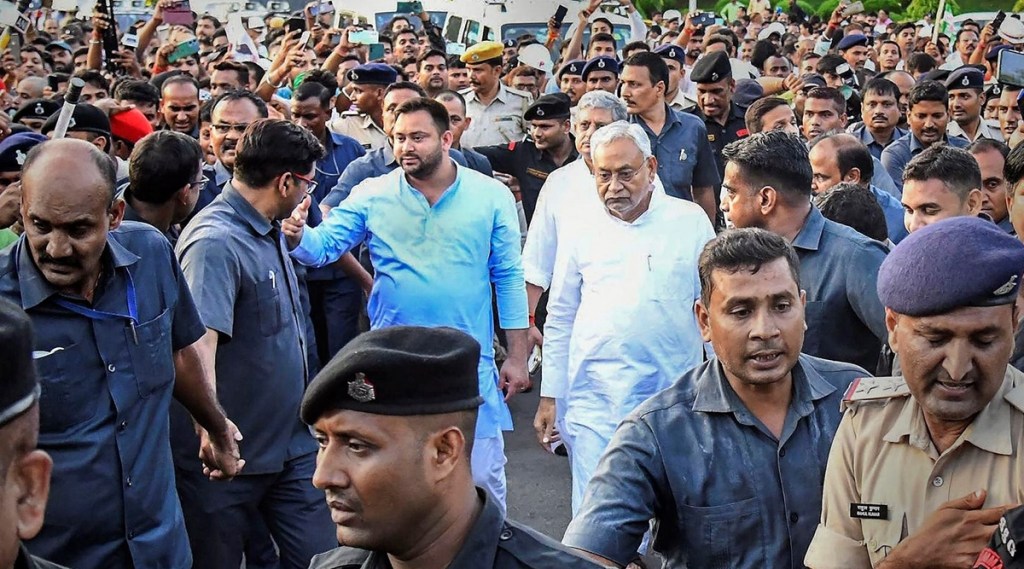 JD(U) leader Nitish Kumar and RJD leader Tejashwi Yadav leave after meeting Bihar Governor Phagu Chauhan, in Patna, Aug. 9, 2022. (PTI)

 Share


