4 min readSep 6, 2020 09:50 AM IST
First published on: Sep 6, 2020 at 03:30 AM IST
Written by Gaurav J Pathania
The new National Education Policy (NEP) replaces a 34-year-old policy. In the past three decades, India’s socio-economic landscape and educational field have seen drastic privatisation. There are about 50,000 institutes of higher learning in India, 70% of which are private, catering to more than 35 million students. In the past 20 years, access, equity, and quality have become buzzwords. Yet, in the past three years, of the 2,400 students that dropped out of IITs, nearly half were Scheduled Caste and Scheduled Tribes. According to MoS Hansraj Gangaram Ahir, between 2014-16, 26,500 students committed suicide. Thirteen years ago, the Thorat Committee Report pointed to caste discrimination and growing suicides among Dalits and Adivasis in elite institutions, but the Congress government ignored it. Even after Rohith Vemula’s suicide, no policy is in place to deal with these trends. And unfortunately, on these issues, the NEP is completely silent.

Our education system has been producing self-centered youth with a parochial commitment to their caste but not to the society at large. Every year, about 600 manual scavengers die cleaning our sewers. Yet our policymakers, educationists and engineers from elite IITs have failed to think critically to end such an inhuman practice.
The divisiveness of caste is stamped into our system. Just think of the caste names of colleges and hostels: Vaishya College, Jat School, Gaur Brahmin College, Rajput hostel, Reddy School etc. If a child grows up hearing these names, is it a wonder that (s)he will be an active agent of the reproduction of castes? The goal of education is to inculcate a humanistic approach to understand the pain of fellow Indians. And critical thinking is about recognising social privileges and denouncing them to maintain equity in society. The NEP emphasises “ethical, moral principles and values”, but does not address these infrastructural issues.
An Oxfam report revealed that 75% of the 6 million children currently out of school belong to socially marginalised communities (32.4% Dalits, 25.7% Muslims and 16.4% Tribals). Except for Kerala, Punjab, and Sikkim, the quality of infrastructure in the country is inferior in rural areas.
The government’s mid-day meal scheme reaches about 12 crore students. During my fieldwork in Uttar Pradesh, I observed this scheme up close at the only school in a village. Sitting on the ground, students waited for food with steel plates in hand that they brought from home. When it was served, the portions were so small that the students begged for more. When that didn’t come, they licked their plates. Later, I discovered rampant institutional corruption in mid-day meal schemes. Often, dominant caste students refused to eat meals prepared by a lower caste cook.
The NEP states, “Institutions and faculty will have the autonomy to innovate on matters of curriculum and pedagogy” (12.3, p.60). In reality, the intellectuals’ autonomy is at stake. The words “academic freedom” are absent from the policy. Since 2016, more than 30 academic events have been cancelled or disrupted that featured eminent public intellectuals such as Vivek Kumar, Ghanshyam Shah, Romila Thapar, M N Panini, Nivedita Menon and Satish Desh-pande, all promoters of anti-caste thinking.
Through the NEP, the government promises to bring innovation, diversity, inclusion and a multi-disciplinary approach to inculcate “critical thinking”. In reality, the government has completely omitted chapters on social movements, federalism, citizenship, nationalism and secularism from the Class 11 political science syllabus. Instead of paying homage to icons from socially marginalised backgrounds, the government has removed many social reformers from textbooks.
The NEP’s recommendation for primary education to be conducted in the mother tongue is ambitious, but it will add to the existing rural/small town-urban divide, which is Hindi-Hinglish-English, that has caused great damage to the socially marginalised. Like previous policies, the NEP’s vision looks promising but will not bring about the structural changes needed for a more inclusive education system. It requires a perspective from below to bridge the institutional and epistemic divide and to balance the humanitarian and utilitarian goals of education. By only looking to the moon, we fail to see the manholes in the ground.
Gaurav J Pathania teaches sociology at Georgetown University in Washington DC
Suraj Yengde, author of Caste Matters, curates the fortnightly ‘Dalitality’ column

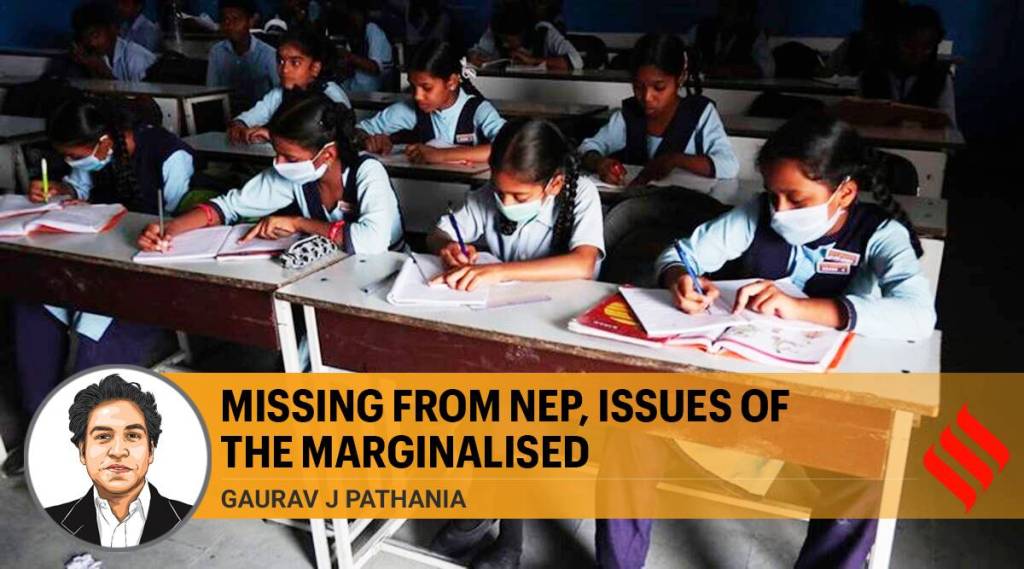 Our education system has been producing self-centered youth with a parochial commitment to their caste but not to the society at large.


 Share


