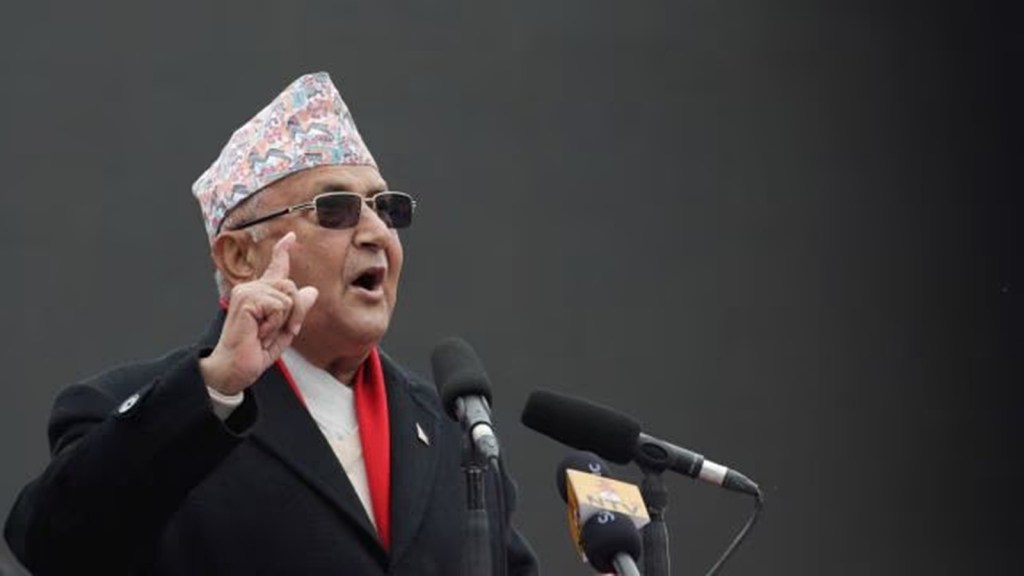
Nepal Prime Minister K P Oli’s China visit from December 2 to 5 had triggered a loud response even before it began. The Chinese media, including Global Times, called it “tradition breaking” while some in Indian media called it a surrender to the north. Nepal’s political spectrum, including the two major constituents in the ruling coalition – Oli-led Communist Party of Nepal (Unified Marxist-Leninist) and the Nepali Congress – were divided on whether Nepal should sign the Belt and Road Initiative framework that may involve having to take loans from China as it goes into implementation phase.
Before he flew back home, Oli said on social media platform X, “Today, we signed the Framework for Belt & Roads Cooperation. As my official visit to China concludes, I am honoured to reflect on the bilateral talks with Premier Li Qiang, discussions with NPC Chairman Zhang Leji, and the highly fruitful meeting with President Xi Jinping.”

Seemingly, Oli defied NC’s strict condition that cooperation from China under the BRI should only be grant based. The BRI framework agreement has not offered any special concessions for Nepal. Oli may face the wrath of the Nepali Congress, and even face a crisis of survival, but he found the risk worth it. As with his previous two visits as PM, he has been able to create an impression this time too that Nepal can trust China more and enhance strategic cooperation. In 2016, close on the heels of an economic blockade by India, Oli had signed the treaty of Trade and Transit with China, securing alternative access to the sea.
Oli did not wait indefinitely for an invitation from Delhi this time, generally the first port of call for a Nepali PM, giving a message that Beijing is no less important. In fact, it is more welcoming.
On November 25, the Nepali Congress and its leader Arzu Rana Deuba had rushed to Chengdu and told her counterpart Wang Yi that her government and party would only welcome grants, not loans in any form under the BRI. Yi, understandably, gave her the cold shoulder, and responded by asking her to convey it to Beijing.
That was not without reason. Deuba had played an active role successfully lobbying for parliamentary endorsement of the Millennium Challenge Corporation’s (MCC) Nepal compact worth $500 million grant in 2022, five years after the two sides had signed an understanding. That delay was largely because of fear and division within the communist parties that the MCC was part of an Indo-Pacific strategy with security components. But a hawkish warning by the US that Nepal’s failure to ratify by the February deadline will lead to a review of the entire gamut of US cooperation had its desired impact.
Second, the Nepali Congress and the Bharatiya Janata Party have now become “’fraternal parties”. Foreign Minister Deuba may not have gone down well with China, but Oli’s 20 minutes one-on-one meeting with President Xi on Tuesday seems to have done the magic. President Xi may not have given a deadline on the BRI Framework like the Americans did on the MCC ratification, but China’s interest next door being undermined vis-a-vis the US was not acceptable to it. For Oli, overruling Xi ‘s concern was far more difficult, if not impossible.
Xi, who had visited Nepal in October 2019, reiterated his preparedness to do anything to safeguard Nepal’s independence and its right to choose its developmental path. Enhancing strategic cooperation, transforming the once India-locked Nepal into a prosperous country by linking the two sides by rivers and mountains, developing Himalayan railway and road connectivity, investing in energy, trade and investment and hospitality, promoting Chinese tourism in Nepal, especially next year when the two countries will be celebrating their 70th anniversary of diplomatic ties, and dispatching volunteers to teach Mandarin across Nepal were the other agendas the two sides agreed upon.
For Oli, consolidating the proximity with China seems crucial with all the risks it may contain. Not trusting the assurances coming from Xi was difficult, if not impossible. In his speech at Peking University on Tuesday, Oli spoke at length about Nepal’s domestic politics, the history of movements for democracy in the country, hailing the current alliance between UML and NC, and denouncing both the monarchy and the Maoists. In a way, he was making a case that China has a trustworthy ally only in UML. He gave no credit to any one in the past for developing ties with China, but praised himself for his sacrifice and suffering in Nepal for the struggle for democracy.
He praised BRI as a visionary initiative of President Xi in the spirit of shared prosperity and win-win cooperation, hoping “together, Nepal and China can envision a future of shared prosperity and enduring friendship, inspired by mutual respect and the pursuit of a better world for all.”
Despite Oli’s totalitarian character, political actors other than the Nepali Congress may not be unhappy over what he achieved on the Beijing trip. But how the two sides would move to execute the BRI projects in near future is something that would require time to assess. What fate awaits Oli politically would largely be decided by the NC response at home over it being overruled in China. But Oli, even if he loses his chair, will try to emerge as a “martyr” for the nation’s cause.
The writer is the Kathmandu-based contributing editor of The Indian Express.



 Share


