The Ministry of External Affairs has underlined the government’s changing position on the Myanmar crisis, moving to a more pro-active stand as concerns grow worldwide about growing internal strife and instability there. On social media and in briefings, Ambassador TS Tirumurti, India’s Permanent Representative to the United Nations General Assembly in New York, who also represents India as a non-permanent member at the high table of the Security Council, and Arindam Bagchi, the government spokesman in New Delhi, signaled that change.
After a closed-door UNSC meeting on Myanmar, Tirumurti’s tweets condemned the violence, condoled the loss of lives, called for the release of detained leaders and urged maximum restraint. The social messages, significantly, said that the situation must “meet the hopes and aspirations of the people” and underlined India’s commitment to a democratic transition. There was a line about supporting peace efforts by the Association of South East Asian Nations (ASEAN, of which Myanmar is a member). However, ASEAN has been tentative, even timid, in the face of China’s support to the junta. Bagchi was more unequivocal: “Let me be very clear … We believe that the rule of law should prevail. We stand for the restoration of democracy in Myanmar.”

The language is the bluntest so far by India on Myanmar and a response to criticism of its earlier stand within and outside the country. This marks a welcome departure from the tightrope walking by befriending the military (which has not always been friendly to India’s interests) and engaging with the civilian government, which held office only for five years. It is not just the horror of troops firing into crowds of peaceful demonstrators but also at mourners in a funeral and the growing number of civilian casualties — more than 500 in the past weeks. Despite its strong-arm tactics, however, the military is still not in control.
Our concern should be two-fold: One, the people of Myanmar, who, having tasted freedom of expression, assembly and association for the first time in decades under Suu Kyi, are determined to hold on to it. In their tens of thousands, they are rallying on city streets and village squares, refusing to turn up for work, leading processions and protests, and have not been cowed by bullets, beatings, brutality and detentions. The second is the future stability and security of the North-east as well as the policies that have been emphatically espoused at the highest levels of government — the Act East and Neighbourhood First policies are anchored in the eight states of the North-east. We also cannot forget that various insurgent groups from the North-east have a history of relations with ethnic armed groups in Myanmar, where they have taken shelter and established bases and where some still live.
A few factors probably account for the steady change in South Block’s approach. The first is the growing accounts of disorder in Myanmar which appears to be escalating as the civil disobedience movement (CDM) flares in this extremely complex nation. The CDM has been innovative, energetic and driven by young people in the majority Burman and Buddhist-dominated heartland. Disobedience could lead to extensive civil disorder and worse. Already, telecommunications are cut, curfews are in place but daily shows of defiance occur, the banks are not functional, markets are shut, the only courts which appear to be open are those used to present detainees and those charged with violations of regime controls while the cases against Suu Kyi and her colleagues pile up. The battle-scarred armies of the ethnic groups, which fought the Myanmar army to a standstill over nearly 70 years but which signed a ceasefire with Suu Kyi, are girding for war again and are allying with each other. A provisional government of leaders who escaped detention has been announced.
Another would be the impact on India’s border states of the North-east. Not less than four states — Arunachal Pradesh, Nagaland, Manipur and Mizoram — have long borders with Myanmar and the last two states have taken some 1,500 persons, including a number of junior police officials, fleeing from the crackdown in the bordering Chin State. This has raised issues of Centre-state relations, with New Delhi advising the states on the border not to allow Myanmar nationals fleeing the crackdown to enter Indian territory.
Mizoram Chief Minister Zoramthanga has rejected this approach, saying that his government will accept people fleeing, on humanitarian grounds. He wrote to the prime minister saying that as the world’s largest democracy India could not stand aside: “Mizoram cannot just remain indifferent to their sufferings. India cannot turn a blind eye to this humanitarian crisis unfolding right in front of us in our own backyard.”
The Manipur government, too, has withdrawn its circular which had asked district officials along the border to “politely” turn back refugees. What many in the country need to understand is that the Chins in Myanmar and the Mizos and Kukis (and sub-groups) in Mizoram and Manipur are kin; a historical affinity connects them by ethnicity, religion, language. In the aftermath of the 1988 army crackdown on the pro-democracy movement, which killed thousands, many Chins and other refugees fled to Manipur and Mizoram. Local leaders and non-government groups, with the tacit support of central and state agencies, allowed them to live, work and even settle. They were seen as the eyes of India to look through the window on the border into Myanmar and help develop a nuanced field assessment of conditions there. This approach needs to continue.
The present situation provides an opportunity for India to develop a long-term approach to the issue of refugees fleeing political persecution in their homelands. India does not have a National Refugee Law nor is it a signatory to the UN Convention governing refugees.
India has allowed Tibetans, Tamil refugees from Sri Lanka, Chakmas of Bangladesh, the Lothsampas of Nepali origin from Bhutan, Afghans, Somalis and many others into this land. But these remain ad hoc approaches. This has been sought to be addressed for six “minority” communities of Pakistan, Bangladesh and Afghanistan in a long-term manner by the controversial Citizenship Amendment Act. However, the CAA does not cover many of the cases listed above. A national mechanism needs to be developed which goes beyond short-term measures and takes into account a needs-based assessment of how best to handle rapid outflows of persecuted persons.
This column first appeared in the print edition on April 7, 2021 under the title ‘Relooking at Myanmar’. Hazarika is a writer and commentator on issues of NE India and its neighbourhood. He is currently director of the Commonwealth Human Rights Initiative

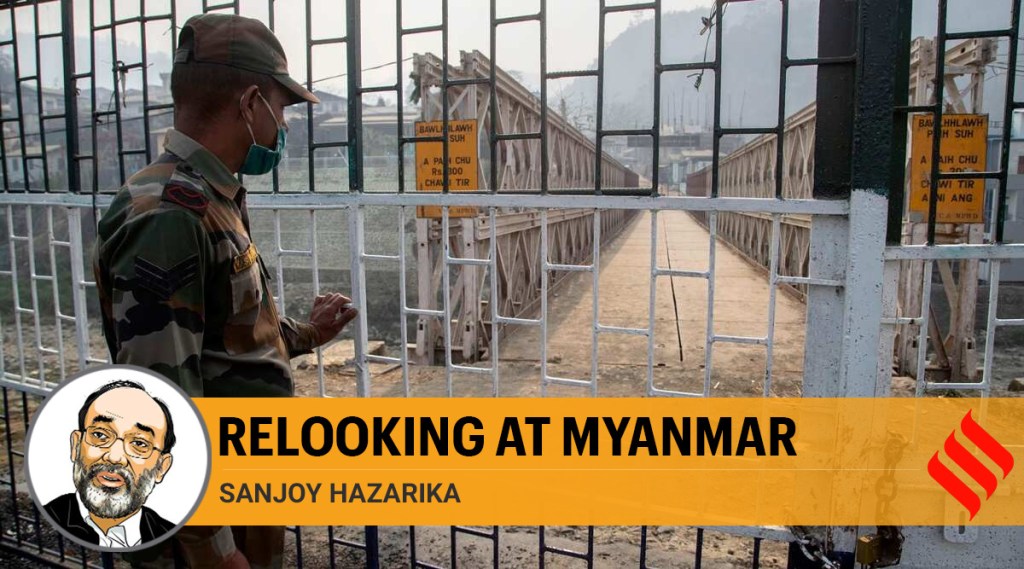 An Indian paramilitary soldier stands guard near the bridge on Tiau river along the India-Myanmar border in Mizoram (AP Photo/Anupam Nath)


 Share


