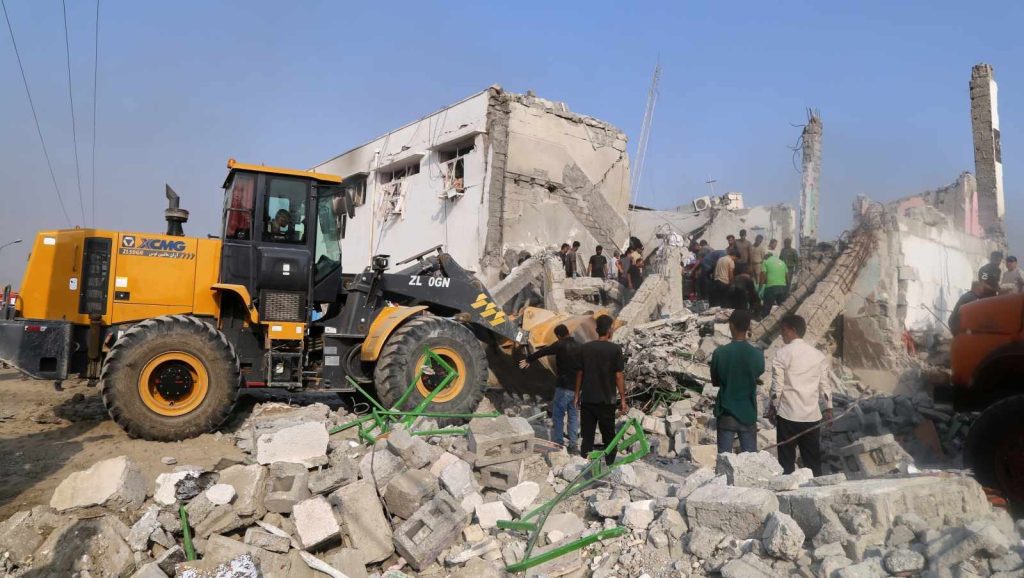
They must have had nicknames and favourite foods. They must have hummed songs without knowing the words. They were put to bed with made-up stories and lullabies. Now their small bodies lie in rows in the earth, and the world scrolls past. The images of scores of children killed in a targeted bombing of an Iranian school by Israel and the US show that it was decided in a cold calculation that children were acceptable losses. Our grief at witnessing this violence, if it is real, must become something harder than tears.
Each time children are killed in an armed conflict, whether in Iran, Gaza, or any other troubled geography, the immediate response is grief. Then there is outrage, followed by more enduring philosophical questions: What does it mean for a world that claims to be governed by law? Let us recall that modern international law is not silent on the protection of children, and it is in fact unusually emphatic. The Geneva Conventions and their Additional Protocols articulate the principles of distinction and proportionality. These clearly state that civilians cannot be targeted. Excessive harm relative to anticipated military advantage is prohibited, and all feasible precautions need to be taken to minimise civilian casualties.

Children fall squarely within the category of protected civilians. The Convention on the Rights of the Child reinforces this protection by recognising children as rights-bearing individuals. Even during armed conflict, states are obligated to respect international humanitarian law applicable to children and to ensure their care and safety. The Rome Statute, which established the International Criminal Court, defines the intentional targeting of civilians and attacks against buildings dedicated to education as war crimes. It moves beyond abstract state responsibility, and there are provisions requiring that individuals be held criminally liable for these crimes.
On paper at least, the legal framework is robust. The standards and norms are set, but acceptance by the parties involved and the political will to execute these norms are challenging tasks. International humanitarian law rests upon a moral assumption that even in war, there are limits. They are the embodiment of a civilisational understanding that violence cannot be unbounded. The protection of children is central to this understanding. Children symbolise continuity, possibility, and the shared future of humanity. To harm them is to erode the ethical foundations upon which those rules were constructed.
Yet we are confronted with a recurring pattern wherein schools, hospitals, and families are being attacked without moral compunction or legal consequence. Governments across the world choose their words as if they are choosing what not to say. They speak of concerns. They call for restraint on all sides. They shake the hand of those who order the killing, then have the shamelessness to face their own people, to lecture them about values, duties and rule-based order. This is a particular cowardice that wears the garb of diplomacy.
Meanwhile, the graves are still being dug.
From a realist perspective in international relations, law is secondary to power. States act primarily to secure survival and advance national interests. Under these hardened, amoral security doctrines, civilian casualties, including those of children, have come to be accepted as tragic yet predictable outcomes.
Critics assert that it is naive to expect that law alone can restrain major powers, but liberal institutionalism offers a more optimistic reading, which argues that norms matter, even when violated, even repeatedly violated. We should expect that the existence of conventions, courts, and monitoring mechanisms shapes state behaviour.
Civil society organisations and advocates who document, name and shame, and work towards the possibility of prosecution, however remote, do so with a conviction that they are contributing to a gradual internalisation of standards. Even powerful states must publicly justify their actions in the language of law, which itself indicates the normative force of legal principles.
There might be truth in this because we can see that modern warfare is accompanied by public explanations that must stem from legal advice. Violations are contested based not just on a judgment of whether an act was permissible or not; advocates also bring legally sophisticated assessments of whether something was proportionate, as well as disputed interpretations of legal standards.
While it is true that all this has often not amounted to adequate redress, it did mean that humanitarian law retained moral authority. But in the last few years, Western powers have lost moral authority because they insisted on openly practising hypocrisy and asking for selective enforcement. If certain regions are subjected to intense scrutiny while others are shielded by alliances, the universalism of humanitarian law is compromised. A selective law is nothing but an unjust political instrument. No wonder that we feel that we inhabit an increasingly lawless world.
Ultimately, the protection of children in armed conflict serves as a litmus test for the international order. Law alone cannot transform geopolitics, but it provides a moral vocabulary against which actions are judged, and limits that must be heeded for the law to mean anything. The death of children in the manner that took place in the Iranian school shows that those limits exist only in letter.
The international system need not become utopian to be ethical. It requires only consistency and an acknowledgement that the protection of children is not a negotiable value. The question, then, is not whether the law has failed us but whether the international community possesses the will to apply it evenly.
We know that history will not be kind to this moment. It will note who had the faculties to comprehend what is unjust and immoral, yet they chose to stay quiet because bilateral relationships and trade figures weighed more heavily in their calculus against the small, fragile bodies. The children cannot wait for history’s verdict.
The situation calls for world leaders to give up diplomatic ambiguity and engage in plain speaking. They have to recognise that the people of the world refuse these cold calculations entirely. We demand that international humanitarian law mean what it says. We wrote it for moments like this. For all its failures, it is still the only language we have built together.
The writer is Member of Parliament (Rajya Sabha), Rashtriya Janata Dal

 Ultimately, the protection of children in armed conflict serves as a litmus test for the international order.


 Share


